In The best offense is no offense, I wrote:
...I’d be curious to watch a frisbee game and track how many turnovers happen “because of the system”, and how many happen because of individual skill deficits—whether inaccurate throws, bad decision-making, or simply not having the field sense and throws required to get oneself out of a tight situation. I don’t have that data for you today, but I personally would wager that imperfect skills cause turnovers more often than imperfect systems.
I didn't really have any plans to collect that data myself...until I was re-inspired when YouTube recommended Thinking Football's recent video Why Do Interceptions Happen?
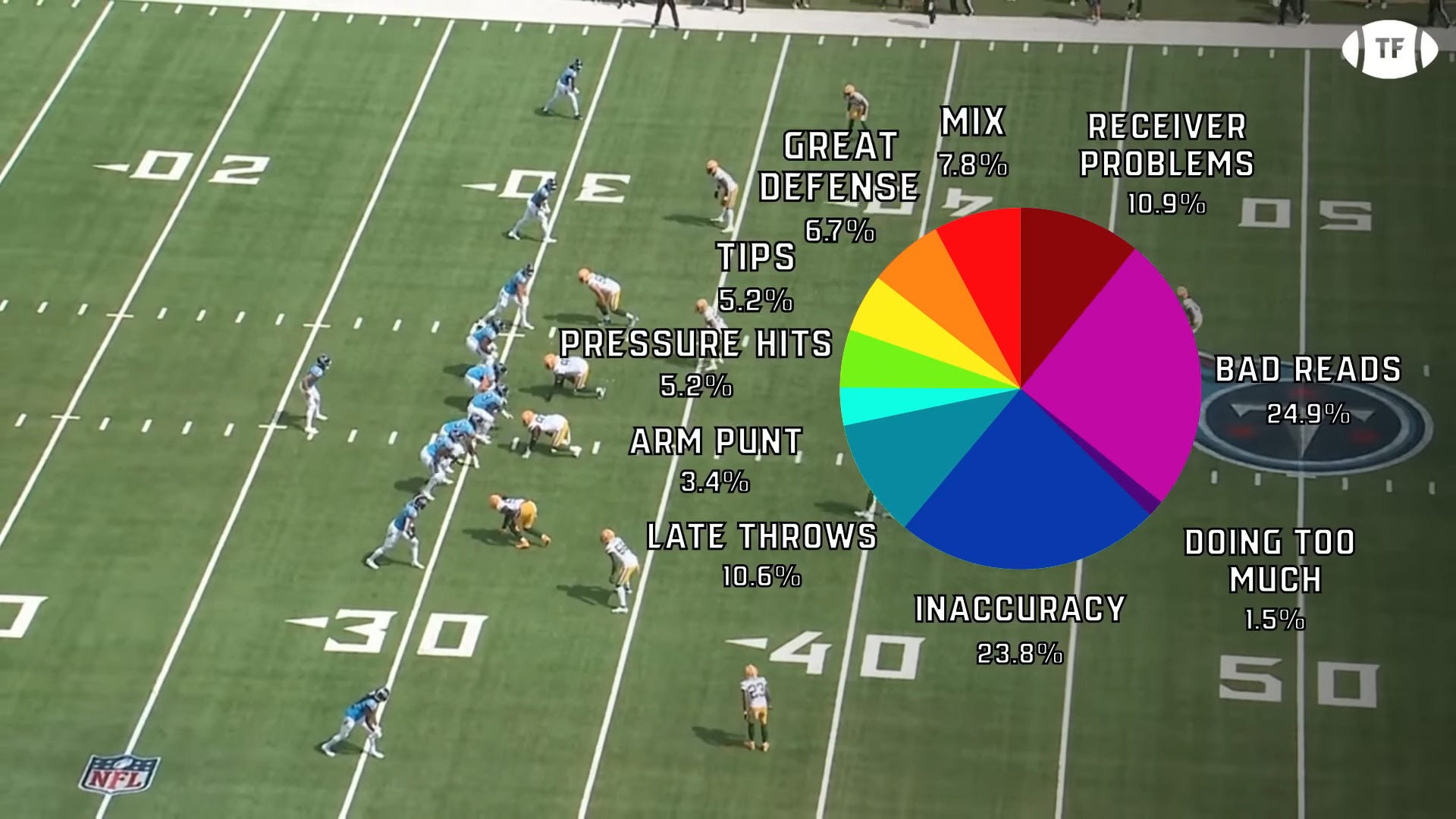
And in thinking about turnovers, I realized I already have some data on this question from previous posts. For example, in Fury's fast breaks I tracked whether San Francisco Fury started their offense quickly after the turnovers they earned in their 2024 nationals semifinal and finals games. So, I went back to that data and this time I wrote down why each of those turnovers happened.
Based on my own judgement (see notes and caveats below), I assigned primary/secondary/tertiary causes for each turnover, along with various other notes about each turnover. Here's a summary of the results:
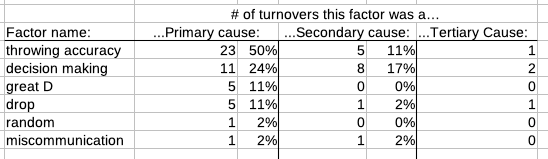
Also of note: out of the 46 turnovers, 18 were D'ed, 26 were not D'ed, and 2 were too close to call so I could only say "maybe". According to Fury's fast breaks, 11 of those 18 Ds were caught.
Let's look in greater depth at these categories:
Recognizing deep help
I noted “Decision making” as a primary factor in 24% of turnovers, and factor of some importance on 46% of all turnovers. One of the biggest decision making issues was throwing hucks into help defense.
In his video on deep throws for Hive Ultimate, Harper Garvey says that:
Really, against good defense, most of that [decision-making on deep throws] calculation is in evaluating the help defense. It's rare that you will have a one-on-one in the deep space.
This was a challenge that Fury's opponents clearly struggled with at 2024 nationals.
I count 13 turnovers generated by Fury on their opponents' huck attempts.
6 of them hit the ground, D'ed by nobody.
5 of them were D'ed by help defense (almost always Shayla Harris or Dena Elimelech—see Fury's defense will ignore your weakest link.)
Two were D'ed by the player guarding the deep cutter.
Heck, this one even ends up looking like it was thrown into a triple team (with, of course, two of the three being Shayla and Dena):
This might even undersell Fury's help defense, as help defense was ready and waiting even on some of the hucks that went un-D'ed.
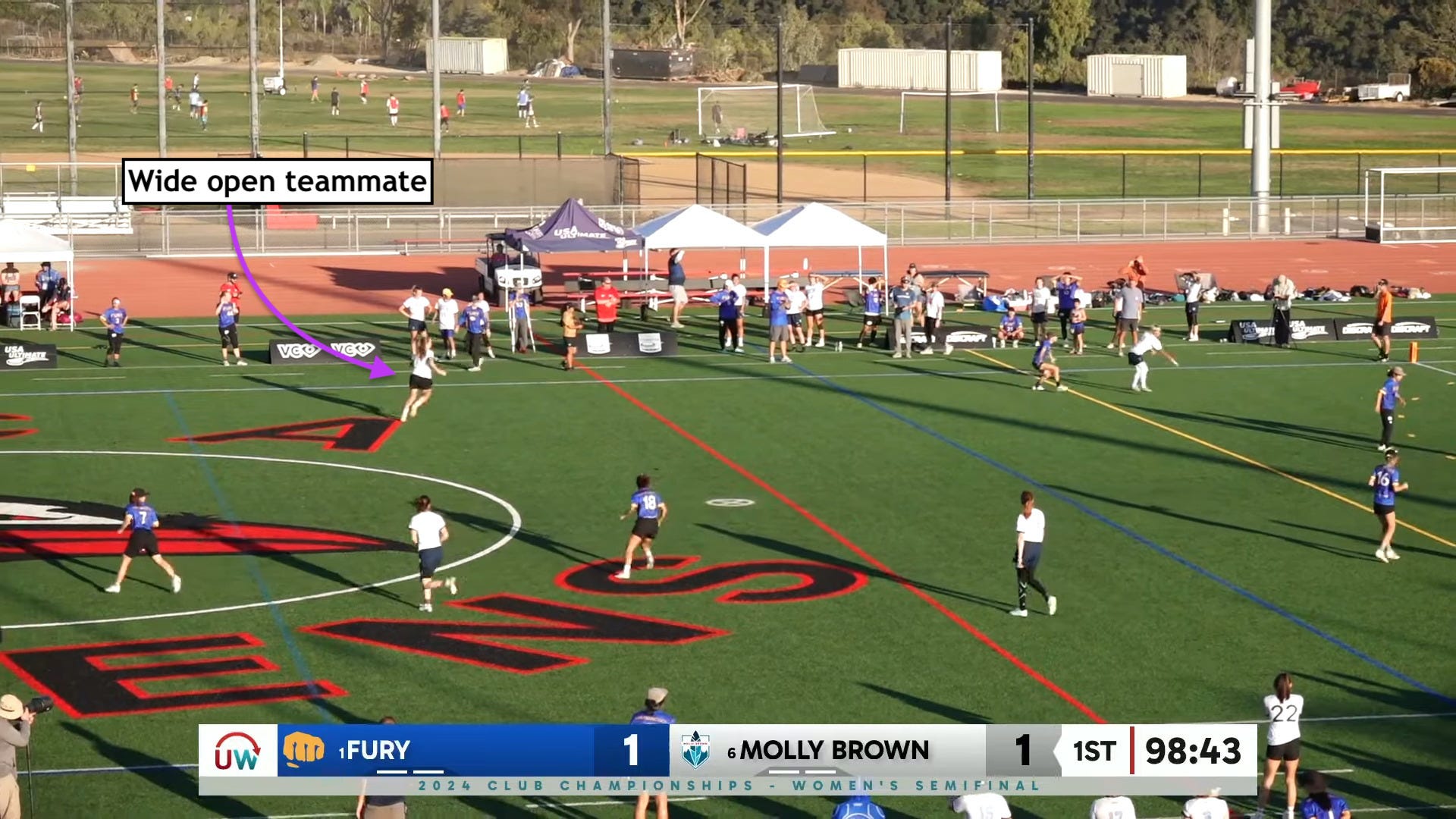
The good news for Fury's opponents: help defense is also an opportunity for the offense—if they can read and react to it in time. Check out how open the cutter is underneath on this Manu Cardenas huck early in the Fury vs. Molly Brown semifinal:
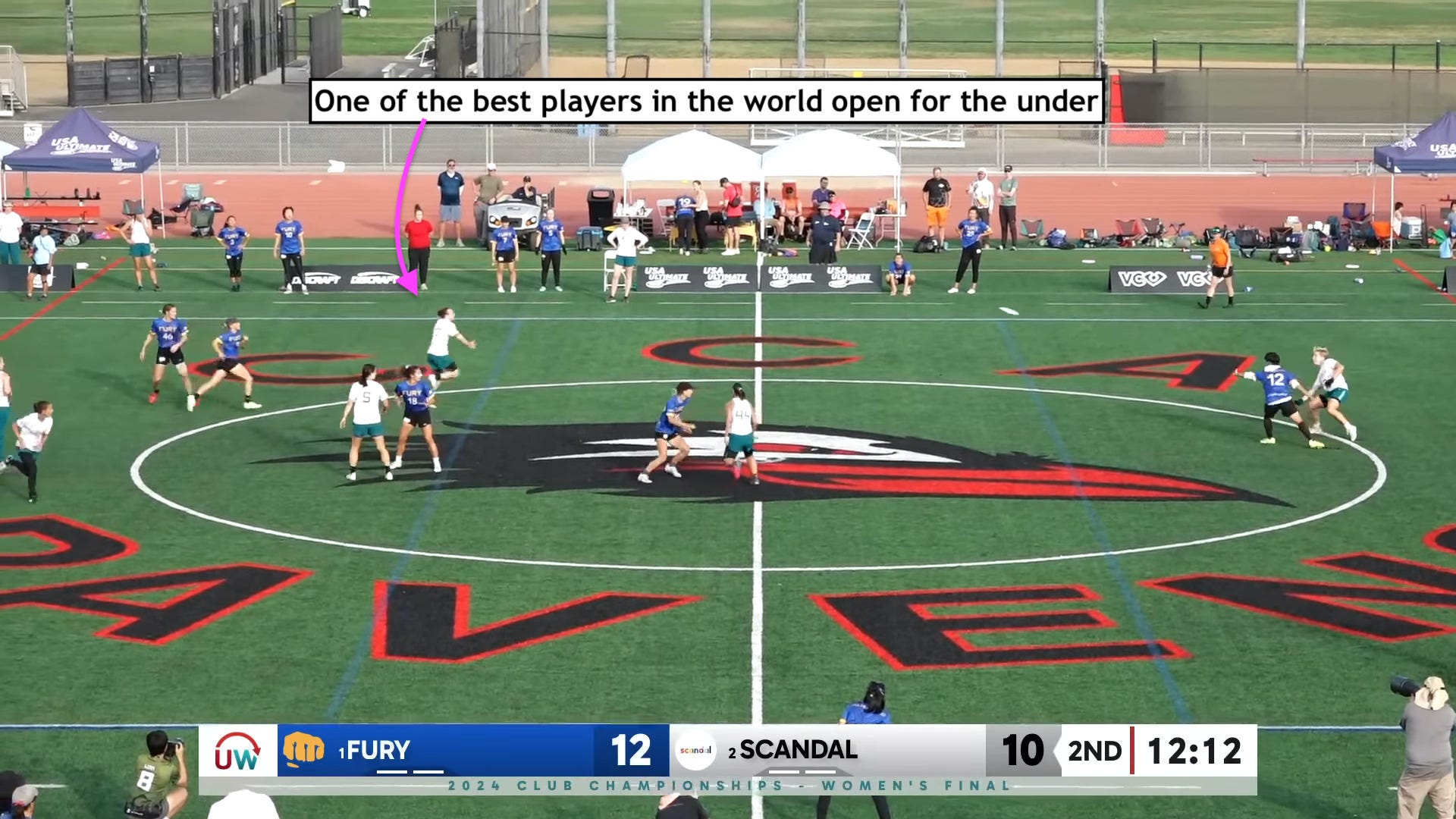
One of the clips above similarly involved DC star Claire Trop getting very open for a 15-yard under pass as a huck was being thrown into help defense:
Fury’s ability to generate 1-on-1 huck opportunities (through fast breaks and through hucking early), and denying those same opportunities to their opponents is one of their greatest structural advantages.
Attacking the sideline
More and more, frisbee teams are beginning to understand that having the disc on the sideline is a dangerous way to play offense. Passes to the sideline run the risk of the receiver running out of space, and after a catch, a player with the disc on the sideline only has 'half' a field to throw to.
When the Shown Space guys were on Pod Practice recently, they shared that their model predicts a team has a roughly 10% lower chance of scoring with the disc on the sideline, compared to having the disc the same distance from the goal but near the middle of the field:
A number of the turns Fury generated happened near the sideline, especially on plays that combined a higher degree of difficulty with a pass thrown towards the sideline. For example:
I don't think it's feasible for a team to completely remove high-degree-of-difficulty throws from their game plan—good defenses will force you to do hard things. But I do think players can develop better intuitions around how the sideline increases the inherent degree of difficulty of every throw. These aren’t impossible throws by any means, but it’s easy to run out of room when you try to squeeze the disc right onto the sideline.
Fury, unsurprisingly, has an offense that optimizes their ability to attack the middle of the field. Commentator Keith Raynor made this point a couple times during Fury's game against Boston Brute Squad at the 2025 US Open:
Drops
As I've written before: Catching well is always important. Boring but true. And as both fatigue and pressure increase towards the end of a tournament, skill and focus decrease and drops may become more common.
With the caveat that there were a couple plays where it's hard to say whether a disc was purely dropped or deflected slightly by the defense first, I counted what I'll call 5.5 drops between the two games. That's about 12% of all turnovers.
There's not really much else to say here. Less drops mean less turnovers and I'd say these teams haven't maxed out their catching skills, especially in high-fatigue, high-stakes environments.
Throwing accuracy
Another boring-but-true source of turnovers—and a source of lots of turnovers—is throwing accuracy.
In my data, 18 of 46 turnovers (39%) were purely issues of throwing accuracy, with no secondary reason noted.
Another 11 turnovers involved throwing accuracy combined with other factors, meaning throwing accuracy was a contributing factor in 29 of 46 turnovers (63%).
This was true on hucks:
But was also true on many shorter throws:
On the subject of hucks: I think it makes a lot of sense to throw floaty hucks, and these clips exemplify why. Obviously no one can just choose to throw perfect hucks—there will always be some variance. So let's say you can either choose to err on the side of being to floaty, or err on the side of throwing too hard and far. If you outthrow your receiver, they have a 0% chance of catching the disc—they literally can't reach it even when running at max speed.
But, if you throw a floaty disc, the defense has time to attempt a D, but the offense still has at least some chance of catching it. And some chance is better than the 0% chance you have if you outthrow your receiver. Hence I've tried to shift my "spectrum" of huck outcomes slightly towards the floaty side.
It was surprising to me just how many turnovers were throwing accuracy issues. It tells me that there's still lots of benefits to be gained by simply developing players who are really freaking good at throwing discs. This is a topic I've discussed before in articles like Throw a whole lot and How accurately can you possibly throw a frisbee?. (I also recently read this quote from disc golf world champion Ohn Scoggins: “I play two rounds a day [...and] I putt hundreds of putts a day. I work so, so hard.”)
And for those who haven't been reading this site long enough to know my feelings on this topic, let me be clear: when I say teams can benefit by improving their throwing accuracy, that doesn't mean spending hours on simple partner throwing. Skills are best learned in context (i.e.—play a lot of frisbee) and when forced to go out of context, practice should be as challenging and realistic as possible (see How to practice throwing, An introduction to the science of learning, for frisbee throwers, and Book review: How We Learn to Move). But intelligent, deliberate practice isn't worth much if you're not also willing to put in a boatload of hours.
Athleticism
I didn't use this as a category in tagging the data, but there were a few discs that were marked 'throwing accuracy' but could've been caught if the receiver had been able to jump just a tad bit higher for them. I think it's within the realm of possibility for many players in the women's division to add another inch or two to their vertical, so I'll mention it as a possible source of reduced turnovers:
Obviously being faster/quicker would also help players run to discs that were just out of their reach, though I didn't note down any specific turnovers where that was the case the way it was for discs that went overhead in the clips above.
Some caveats
An analysis like this can only tell us so much. In fact, I've written an entire post about why we should be careful about over-analyzing turnovers: Turnover analysis has its limits. I'll briefly recap a few of the points I made there and some new points that are specific to this article:
Some turnovers aren't necessarily bad. The obvious example being that "punting" a 60 yard huck to nobody may be the highest expected value play for the offense in some situations. I decided not to use Thinking Football's "arm punt" category in my analysis, but some of the huck turnovers were probably reasonable decisions by the offense, in expected value terms. (But, of course, there's still benefit to making these "punts" as catchable as possible.)
Reducing turnovers doesn't guarantee scores. Just because a team doesn't turn the disc over on "pass A" doesn't mean they're guaranteed to score—they may fix one problem just to have a turnover anyway on "pass D" later in the hypothetical possession. This analysis should give us some intuition for what bottlenecks team face right now, but they may just face new bottlenecks once they get past the current ones.
That being said, I think we should expect that removing some turnovers from an offense will, on average, make it at least slightly better. Maintaining possession gives you at least some chance of scoring on subsequent passes compared to turning the disc over.Conclusions are specific to the context of this data. Previous projects from others (see here or here for example) have generally found there's more turnovers in the women's division than in the open division. Even within the women's division, both of the games I'm analyzing here are against Fury, who is not necessarily playing defense the same way other women's teams play.
And to the extent this data is used to decide what to work on in practice to reduce turnovers, the context is also relative to the experience these players have. Maybe these players would benefit from leveling up their throwing accuracy, but that doesn't prove other players wouldn't benefit more from learning their team's system.
Sometimes the turnover isn't the turnover. I could point out that a turnover happened because a 10-yard forehand was thrown over the head of the target receiver, but that doesn't necessarily mean the best way to avoid that turnover is to improve the thrower's accuracy. Perhaps the team's offense would be more effective if the thrower had thrown a stall zero dishy pass to a teammate attacking forwards instead of ever even considering the 10-yard forehand. An analysis like this can't really tell us that.
Other subtle skills. I've long held the opinion that one thing great receivers are really good at is noticing right away when a throw is off target, and having the presence of mind to start adjusting to the actual throw immediately. Mediocre cutters maintain their original path for longer and only attempt to adjust as the disc gets closer, at which point it's too late. It's hard to see on camera when this would or wouldn't have been possible, so I haven't recorded it (or any other similarly subtle tactics) as a "source" of turnovers, but it could be one path to reduced turnovers.
Final thoughts — systems
As I noted above, I don't think this data really proves either way whether these teams are using the right offensive systems. A good system should make decision-making as easy as possible, and give throwers options for high percentage throws.
I *do* think most teams have suboptimal systems. Aside from what we already discussed above about keeping the disc off the sideline, I'd like to see teams doing more:
Fast breaking (Why I like fast breaks)
Playing fast with a "point five" mentality (Point five frisbee)
Intelligently embracing jukes instead of always cut-and-clear-ing (Slowing at the saddle point)
Learning to box defenders out of throwing lanes (The box-out dump cut)
If nothing else, at least copy what Fury is doing! ("Endzone!" doesn't need to mean "vert stack")
All that is to say: I would love to be able to point to a bunch of turnovers in these games and say see, no one got open due to their system. But as much as I'd like to see Scandal (for example) play a more revolutionary offense, I also can't deny that a lot of their turnovers come from issues that are more “skill” than "system": inaccurate throws, drops, and failure to notice potential help defenders.
So: I like innovative systems, but I also like player development. I hope coaches/players who aren't interested in changing their team's systems at least take away this message: the path to less turnovers isn't just making your vertical stack even stack-ier by practicing your team's cutting patterns/systems until the sun goes down. It's mainly improving your catch rate, improving your throwing accuracy, and improving your ability/intuition for choosing the highest percentage throws.
Fury has a lot of mystique, but looking at the way teams turn the disc over against them, they don't look unbeatable.
Notes
A few more random comments on how I recorded the data:
"Decision making" vs "throwing accuracy": Pretty much *any* inaccurate throw is also a decision making issue if you consider that the thrower could've waited for an easier throw. I don't know which players 'have' or 'don't have' which throws. So I've marked a throw "throwing accuracy" if the receiver was clearly open but the throw didn't get there, even if it was a more difficult throw than was completely necessary. I've tagged a throw "decision making" if it was questionable whether the receiver was even open.
"Great D": Again, any turnover categorized "great D" could probably also go under "decision making"—why throw to someone with a defender close enough to make a great play? It’s always a bit arbitrary. I didn't use the "great D" tag much, but also don't take that as me suggesting Fury wasn't playing great D. They play incredibly smart defense, especially with their dedication to playing help defense on deep shots. But for throws where I thought a great thrower should recognize the potential for help defense, I marked it "decision making".
"Hucks" were determined purely by whether it felt like a huck to me, I didn't use a set yardage value like the UFA does.
As noted in Fury's fast breaks, I'm missing one turnover compared to the data on the USAU tournament page. I think it's my error, not theirs, I'm just too lazy to go back and find the missing turnover. 1 turnover out of 46 won’t change any conclusions much.
You work hard on these columns. Thanks for all the effort you put into the analysis
I like how your thoughts and writing are coalescing around some central ideas and principles.