All Person (AP) defense is a defensive strategy that’s the brainchild of Tim Kefalas (“TK”) and most famously used by Denver Johnny Bravo from 2021 to present. It uses dynamic marks and switchy/poachy handler defense to gunk up the offense and force them into precarious positions. At a (very) high level, the goal of All Person defense is to generate turnovers at a higher rate than other defenses1.
All Person arose from an attempt to do a few things differently from how your standard force forehand/force backhand defense works. The main impetuses behind AP are:
How can we design a defense the gets the most out of players who might not have super elite athletic abilities? (TK interview, 16:15)
How can we design a defense that makes hucking harder? A traditional force forehand leaves open an open side throwing lane that’s:
straight down the field—so the disc gets vertically down the field quickly
unobstructed by downfield defenders2—so there’s no need to put extra height/angle on your throws to get them over downfield defenders.
As a result, open side hucks (it was theorized) are completed at a high rate (Shayla Harris interview, 1:06:00).
Recent content, like this Hive Ultimate video by Noah and this Ultiworld video by Joe Marmerstein, have given us some evidence that this theory is actually true, and same third, down-the-sideline hucks are completed at a higher rate than other hucks, with Joe, for example, finding that sideline same-third hucks were completed at a 64% rate vs. 55% for non-same-third hucks3.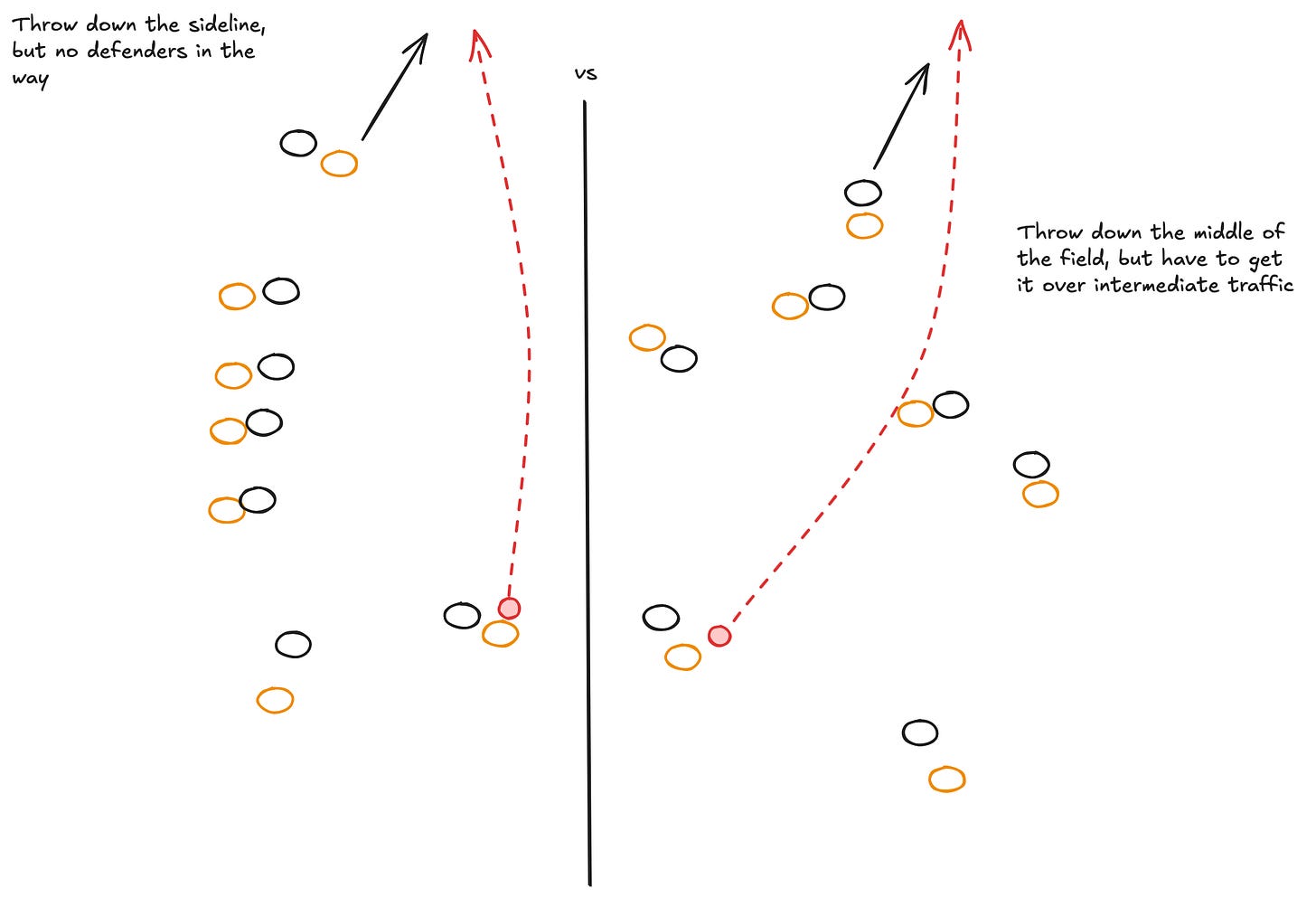
Aside from the presence of traffic, there’s the simple geometrical fact that a throw straight down the field can gain (vertical) yardage more quickly: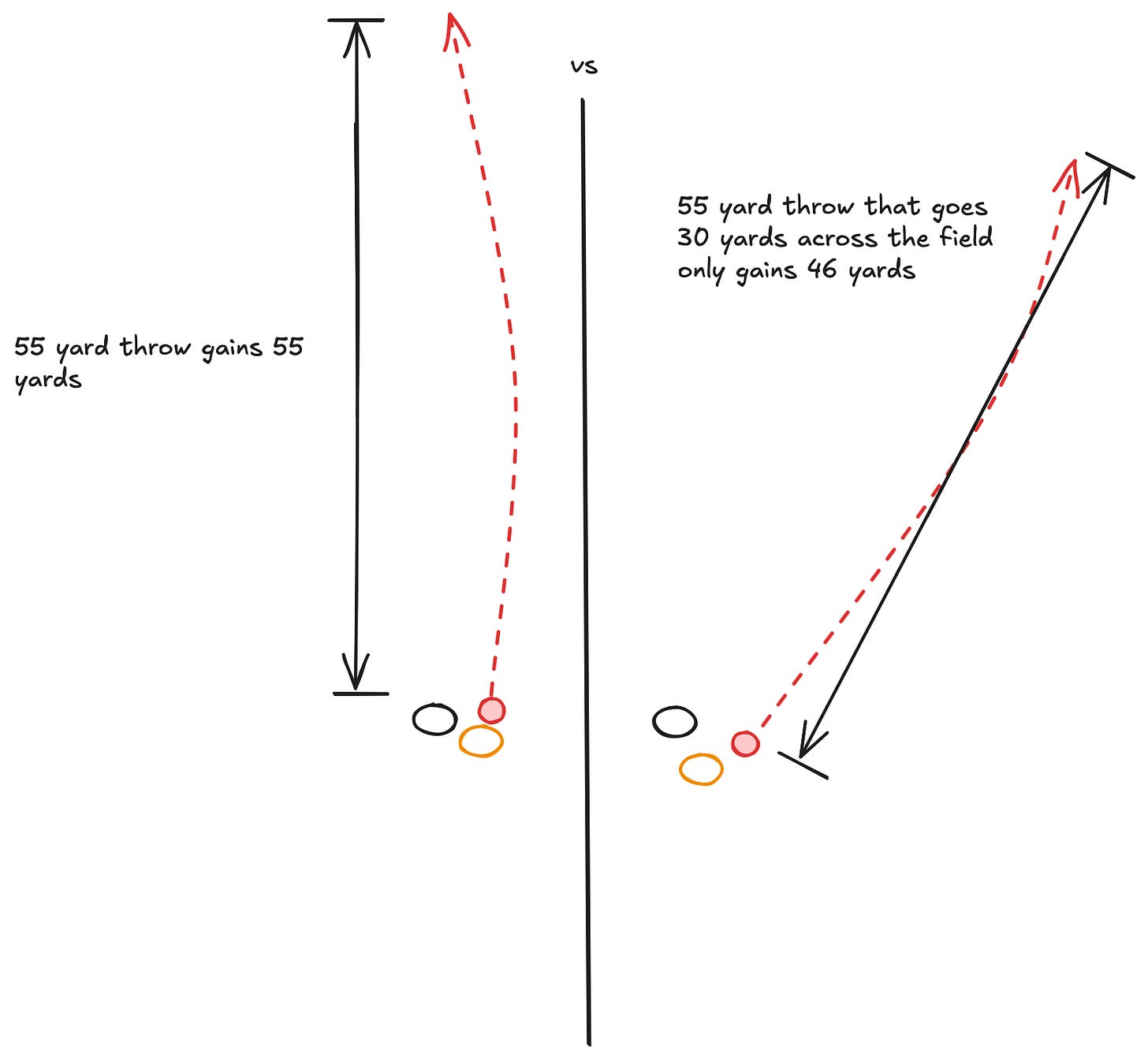
How can we design a defense that gets more out of mark defenders in general? If a thrower facing a Traditional Force Forehand defense wants to throw a pass down the open side, the mark is just...not really doing anything. Is that really the best we can do? Can we find a way for the mark to “be in the way” more often without also giving up lots of throws to the breakside?
Bravo coach Mikey Lun has described AP defense as having three principles4:
Make things choppy—disrupt the natural flow of the offense (with the positioning of the mark defender being a main way this is achieved)
Disconnect the downfield from the backfield — partly done by the active mark/“force to help” (see below), partly done by downfield defenders denying the under throws
Increase transit time — the longer the disc is in the air, the more things can go wrong (more time for D to catch up to floating throws, more time to reposition). This applies to hucks, but based on their explanation it also applies to forcing the offense to throw more passes swinging horizontally across the field in general
How it works
Marking Principles
A lot of the uniqueness of AP defense comes from the way the marks position themselves, and from the handler defense in general. Mikey Lun described their marking principles as follows:
Force it back — force the disc back in the direction it came from
Force to help — Force towards a help defender in the lane (this basically always means towards the other handler defender who’s sagging off the reset handler). This is where part of AP’s ability to “disconnect” comes from: if you’re always forcing to the side where the other handler is, on average there’s going to be more traffic in the way of downfield throws to cutters.
Force it wide — aka “force middle”. Force towards the wide side of the field.
The tricky thing here5 is that, even though there are three items on that list, there are really only like 2 or 2.5 independent principles here in practice (sometimes just one):
If the offense just threw a reset swing pass off the sideline, then “force it back” and “force to help” are both the same direction, so you might see the mark start out forcing sideline for a few beats and then switch to forcing middle, especially once the thrower of the reset swings off the sideline.
But if the thrower of the reset never leaves the sideline, the mark might just continue to force sideline, as help and back both continue pointing in that direction.
If the offense just threw a swing pass the brings the disc closer to the sideline, then “force it back” “force to help” and “force middle” are basically all pointing the marker towards forcing middle.
Here’s a clip that showcases how those examples work in practice (source):
First we saw a pass that took the disc closer to the sideline, and the mark is a mostly consistent force middle:
On the next touch, the marker starts forcing sideline—“back”+“help”. But then as the “help” moves across the field to the wide side, the marker makes a well-timed switch to force “help+wide”. It doesn’t really work out this time6 because Doublewide is looking for handler play anyway, but the timing is impressive:
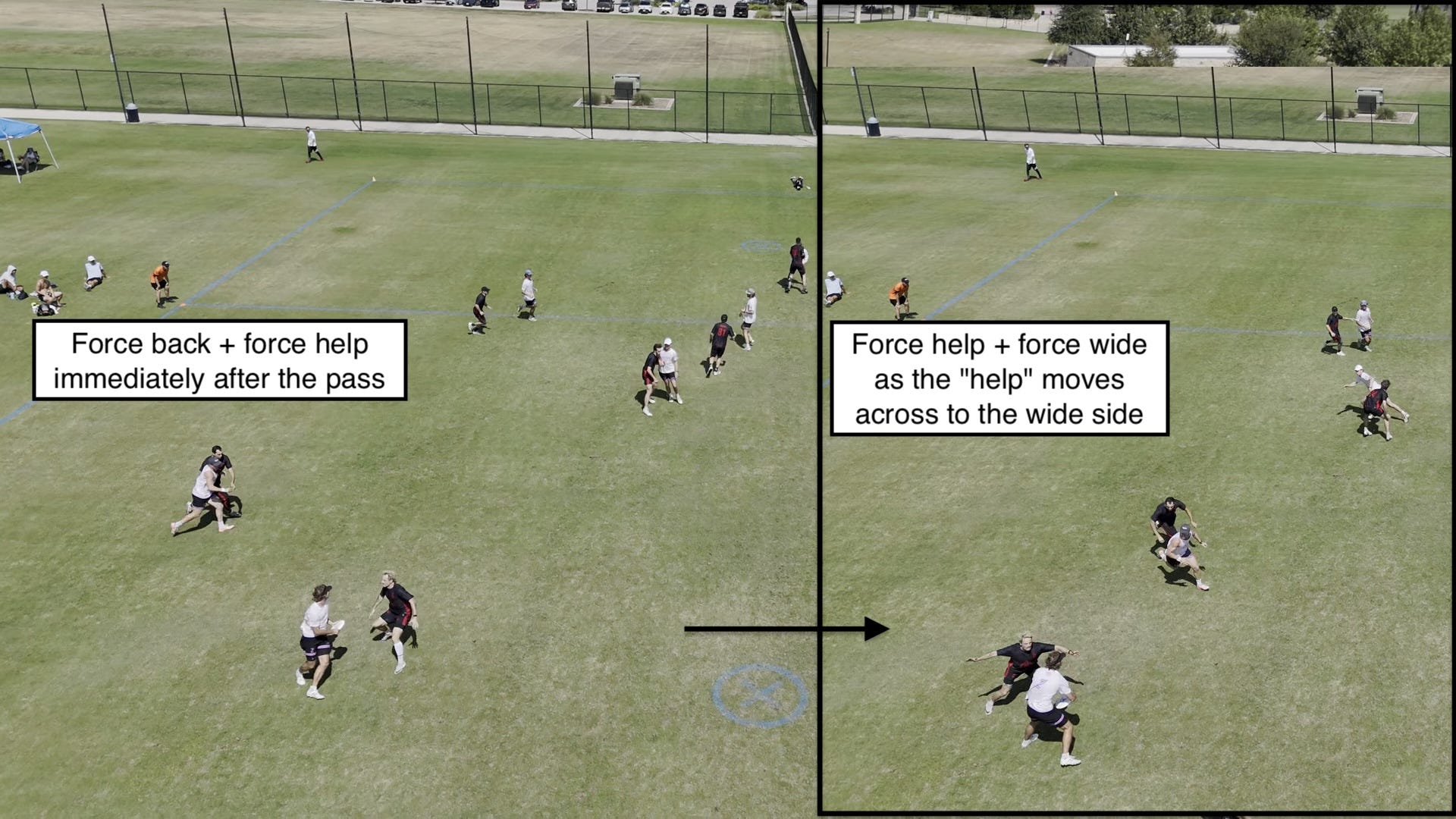
To me this is a good example of how to use dynamic marking to gunk things up for the offense. Done right, it starts to feel like there is no “open” side - there’s just the breakside on one side, and the side with traffic on the other.
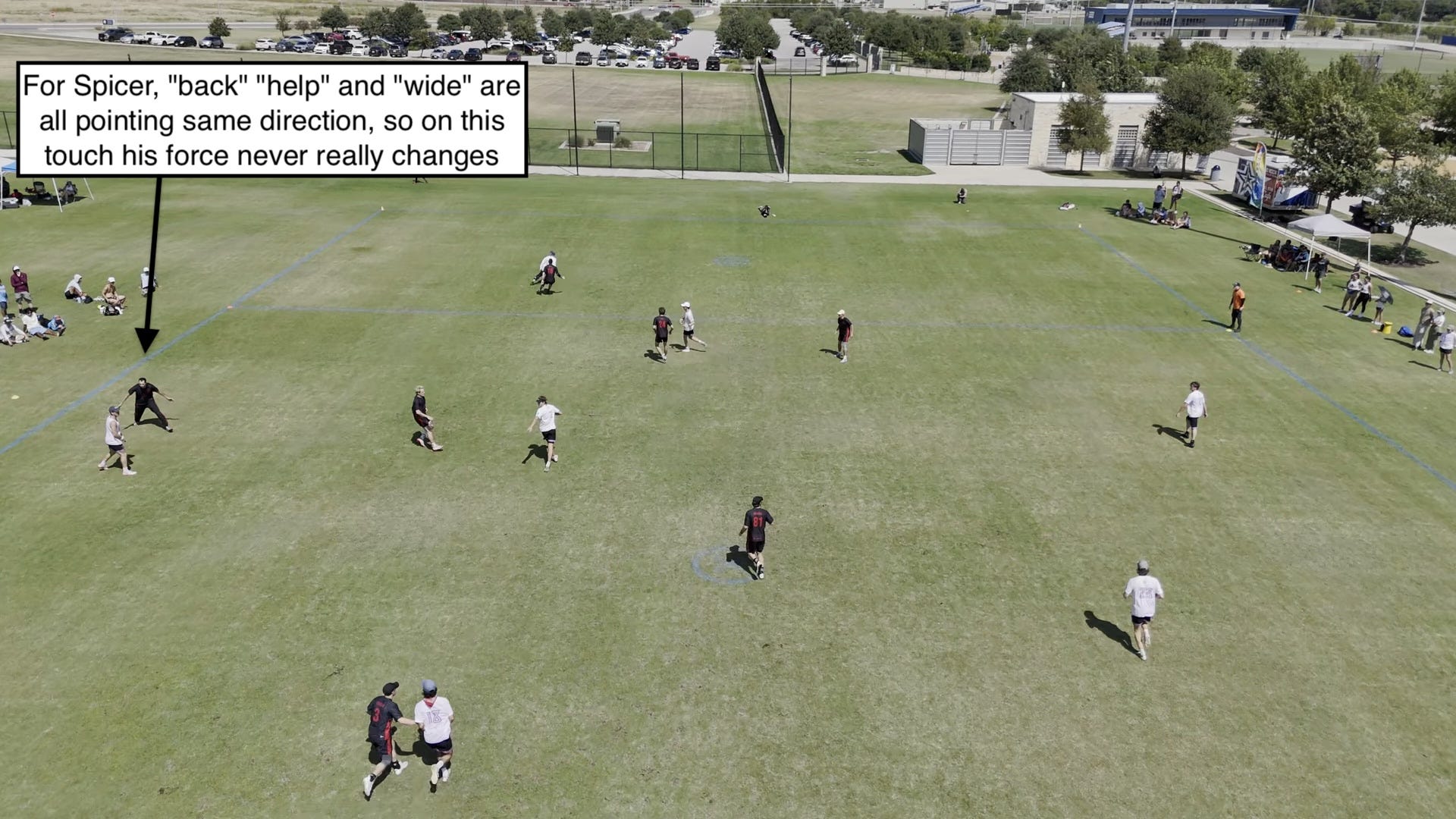
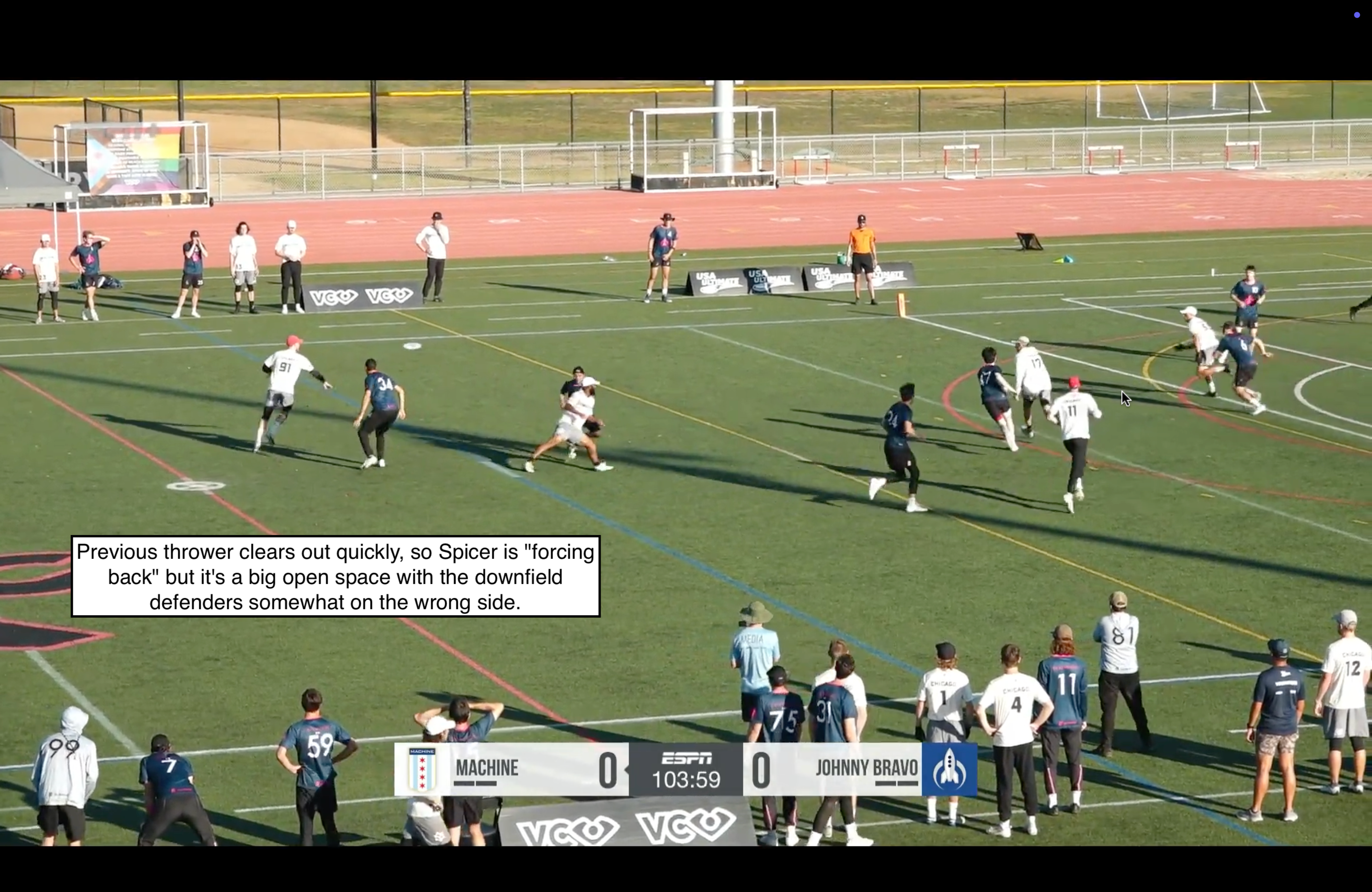
Here’s another example where Cody Spicer forces towards the sideline (“back + help”) when the help/traffic is there, then switches his force to “help + wide” once the other handler clears out of the sideline lane:
Off-ball handler defense principles
The other big part of AP is what the handler defenders are doing when they’re not marking. Here, a few main principles show up on film:
If the disc is near the middle of the field, look to poach into the downfield throwing lane and encourage a swing pass towards the sideline.
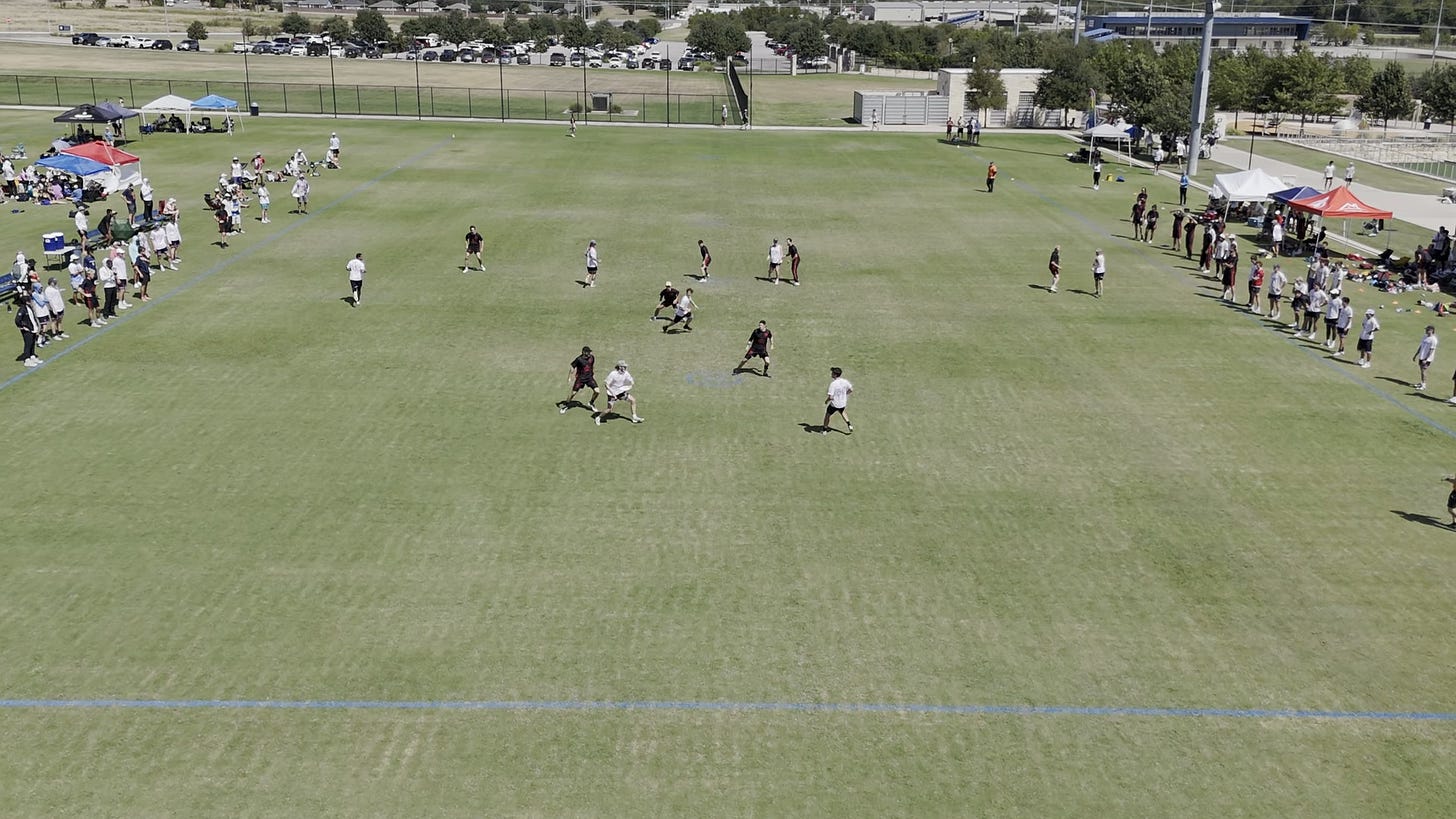
White has the disc at the bottom of the play, going upwards 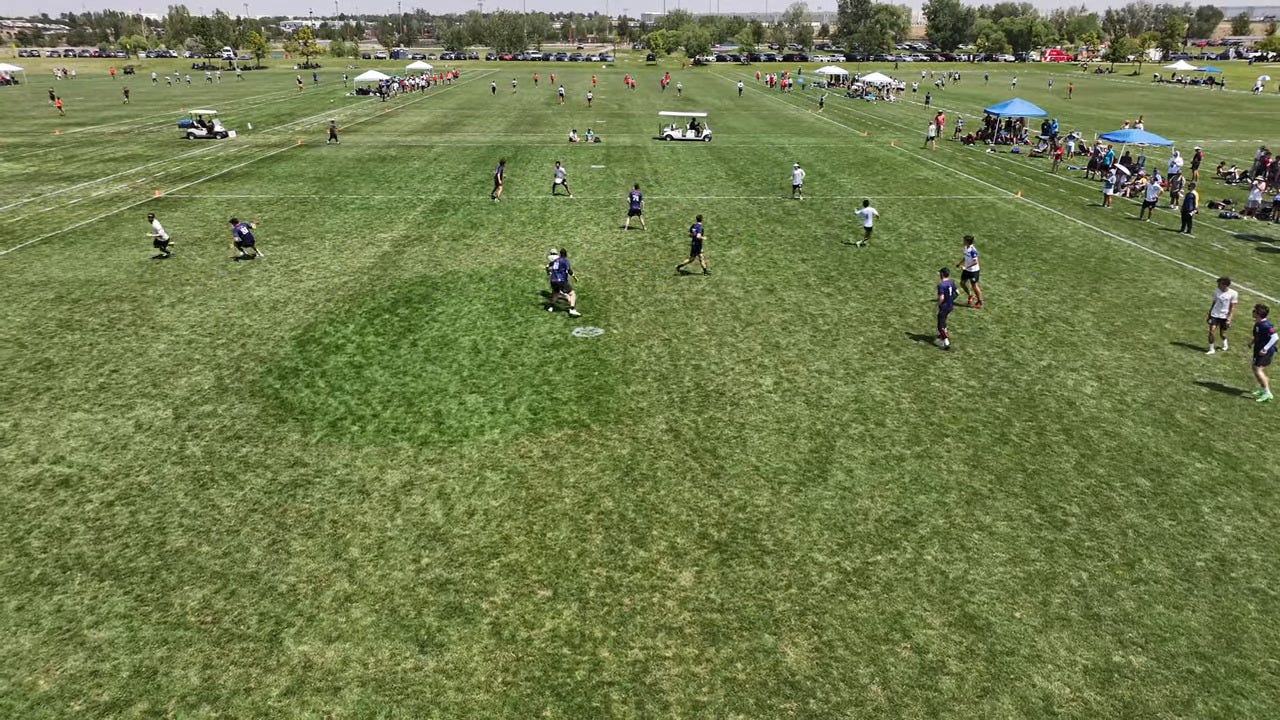
(source) Here white has the disc at the top of the image, attacking downwards Once the disc is near the sideline, reset defenders play tight to try to shut down all of the offense’s options.
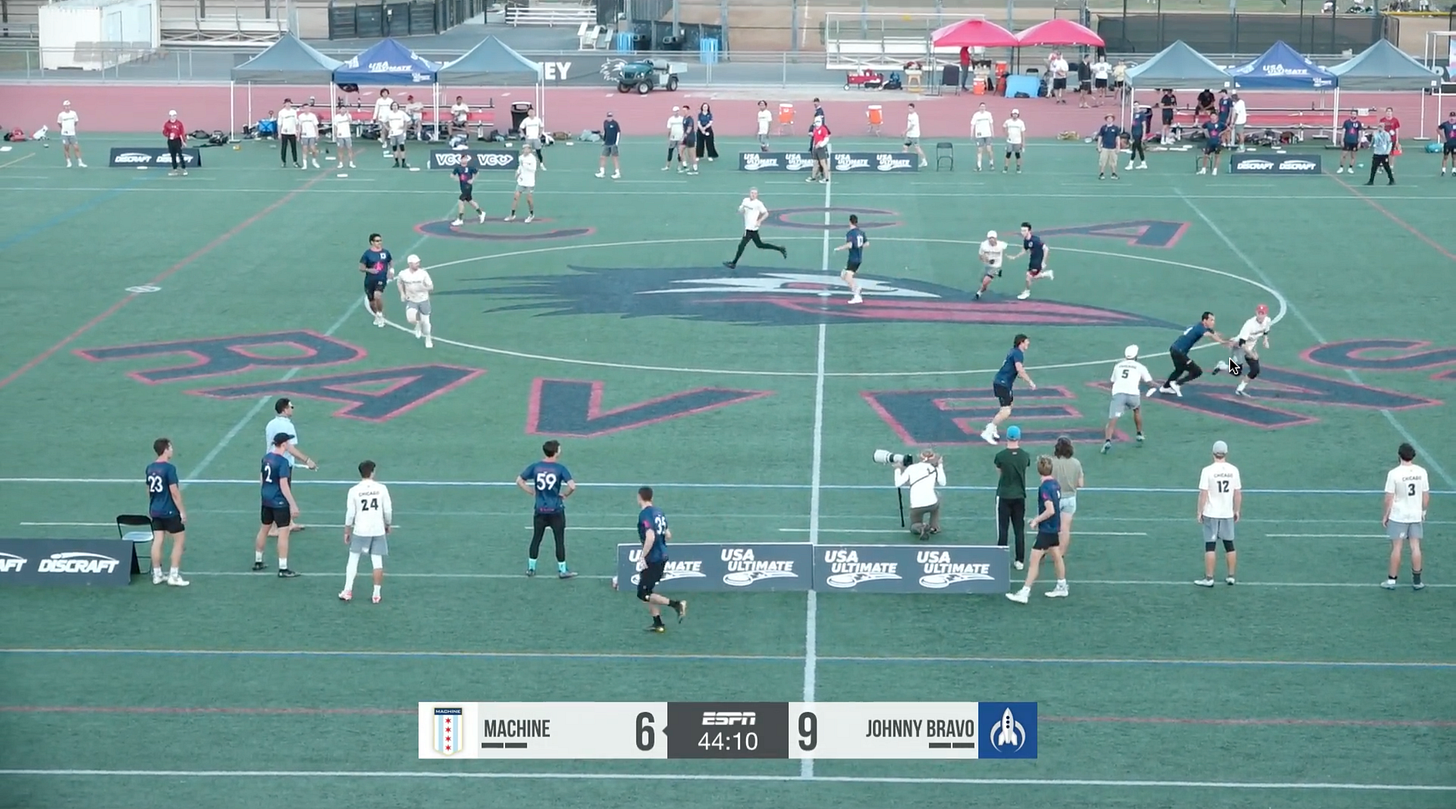
White with the disc at the bottom sideline, working from right to left This sequence against Revolver in 2024 shows the handlers starting poachy with the disc in the center then looking to play lockdown, nearly faceguarding defense when the disc nears the sideline:
In general, look for opportunities to switch on backfield defense to shut down handler-to-handler play. Mainly that’ll be on “upline”-type cuts and on cuts behind the disc towards the breakside7.
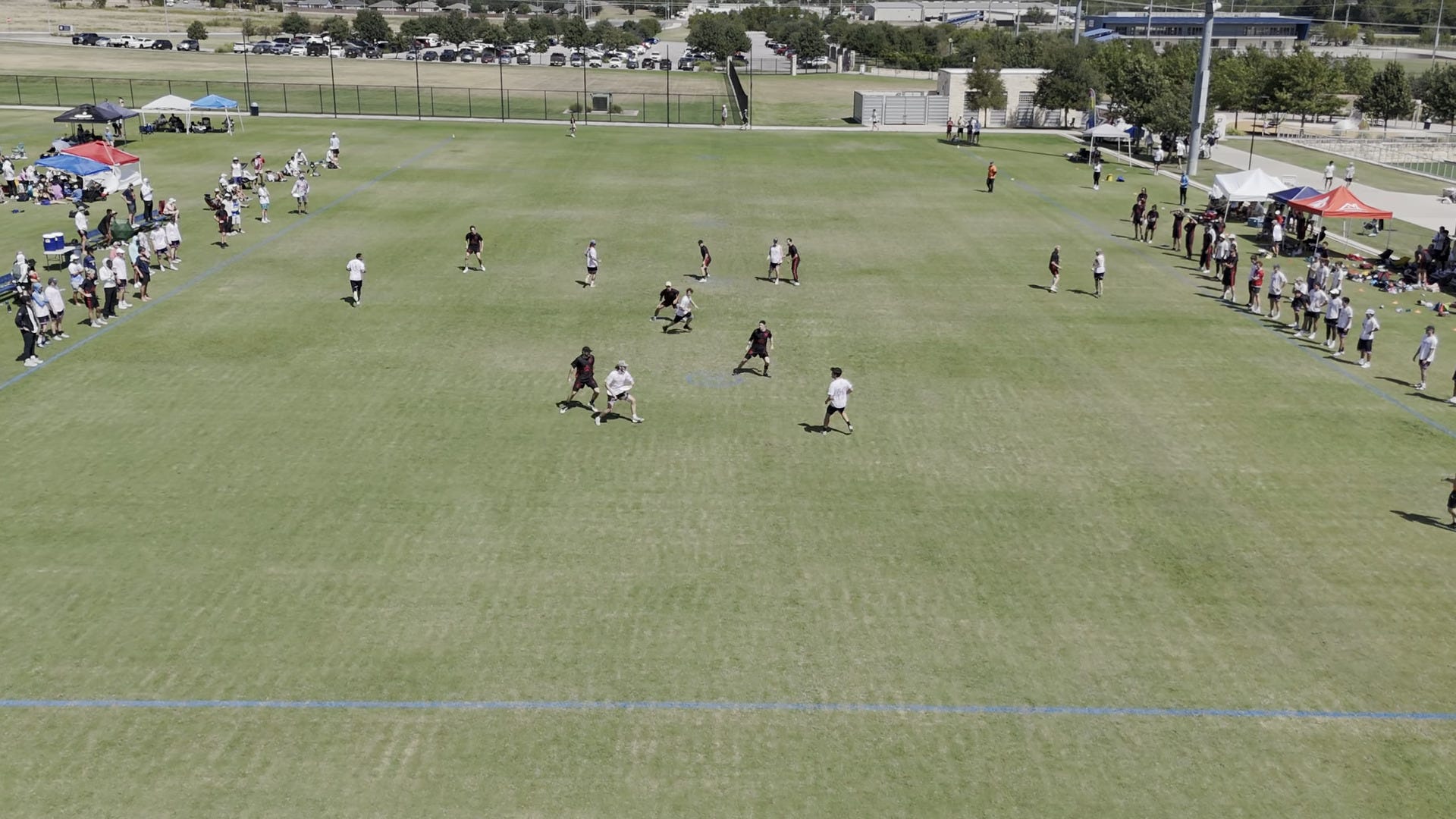
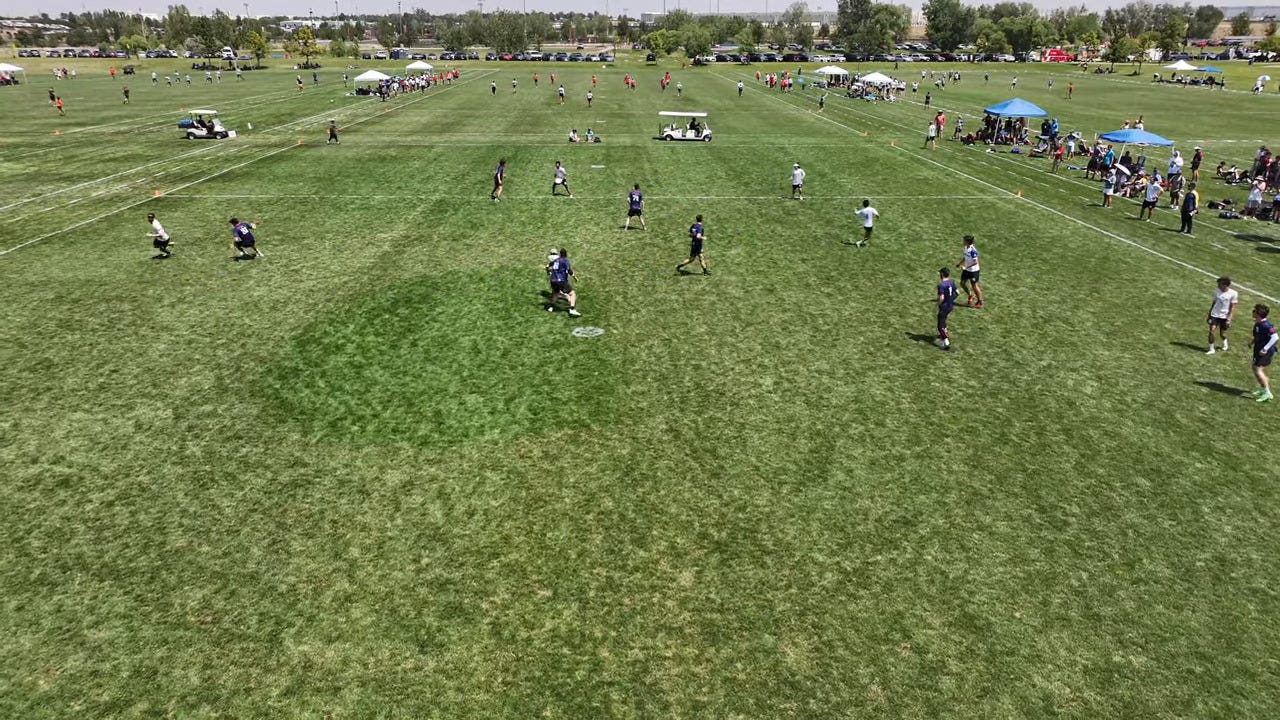
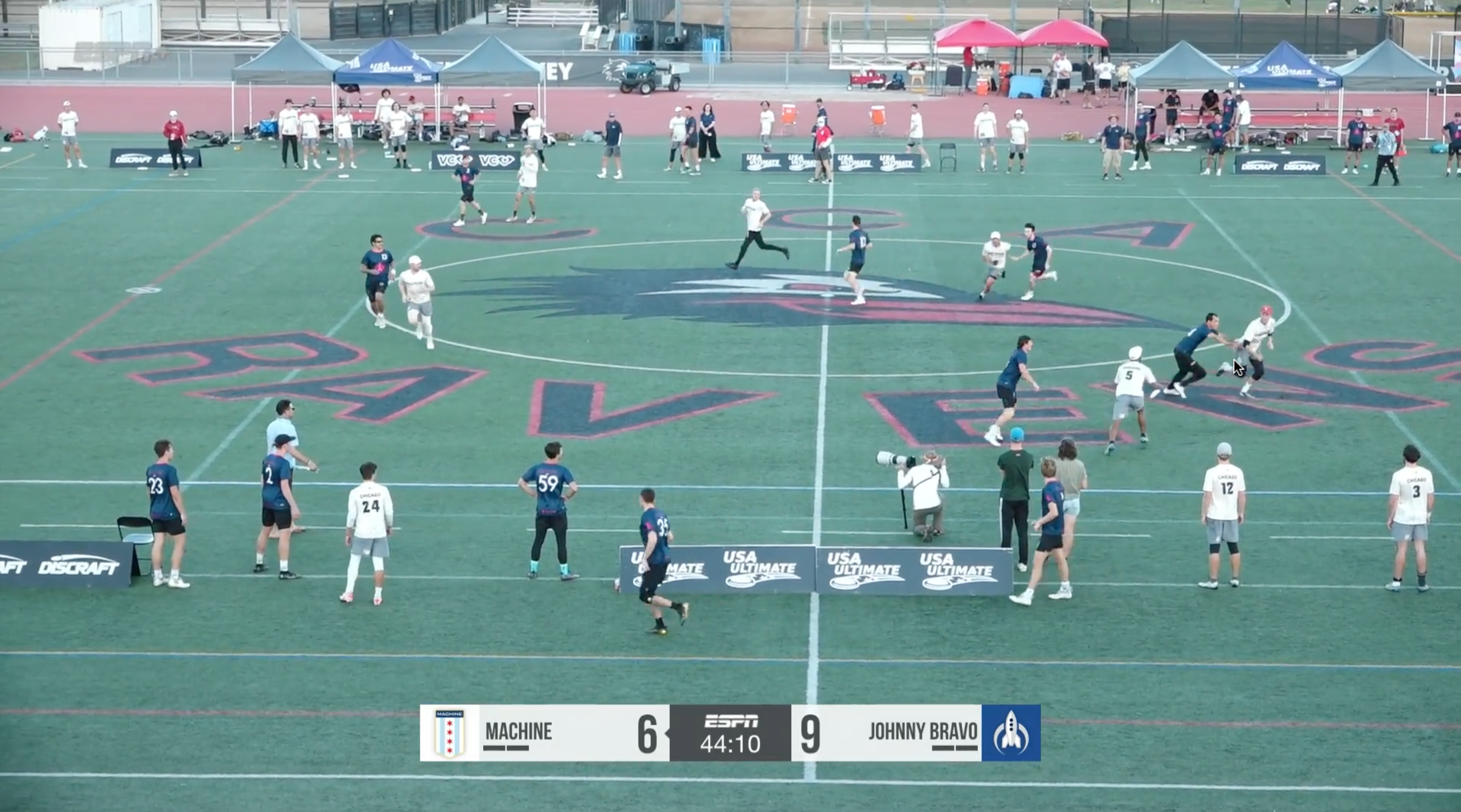
Here’s an example against Doublewide where the switching and middle-of-field poaching leads to Doublewide passing it back and forth between handlers ineffectively:
Here’s a switch on a “pepe” cut to the breakside behind the thrower (source):
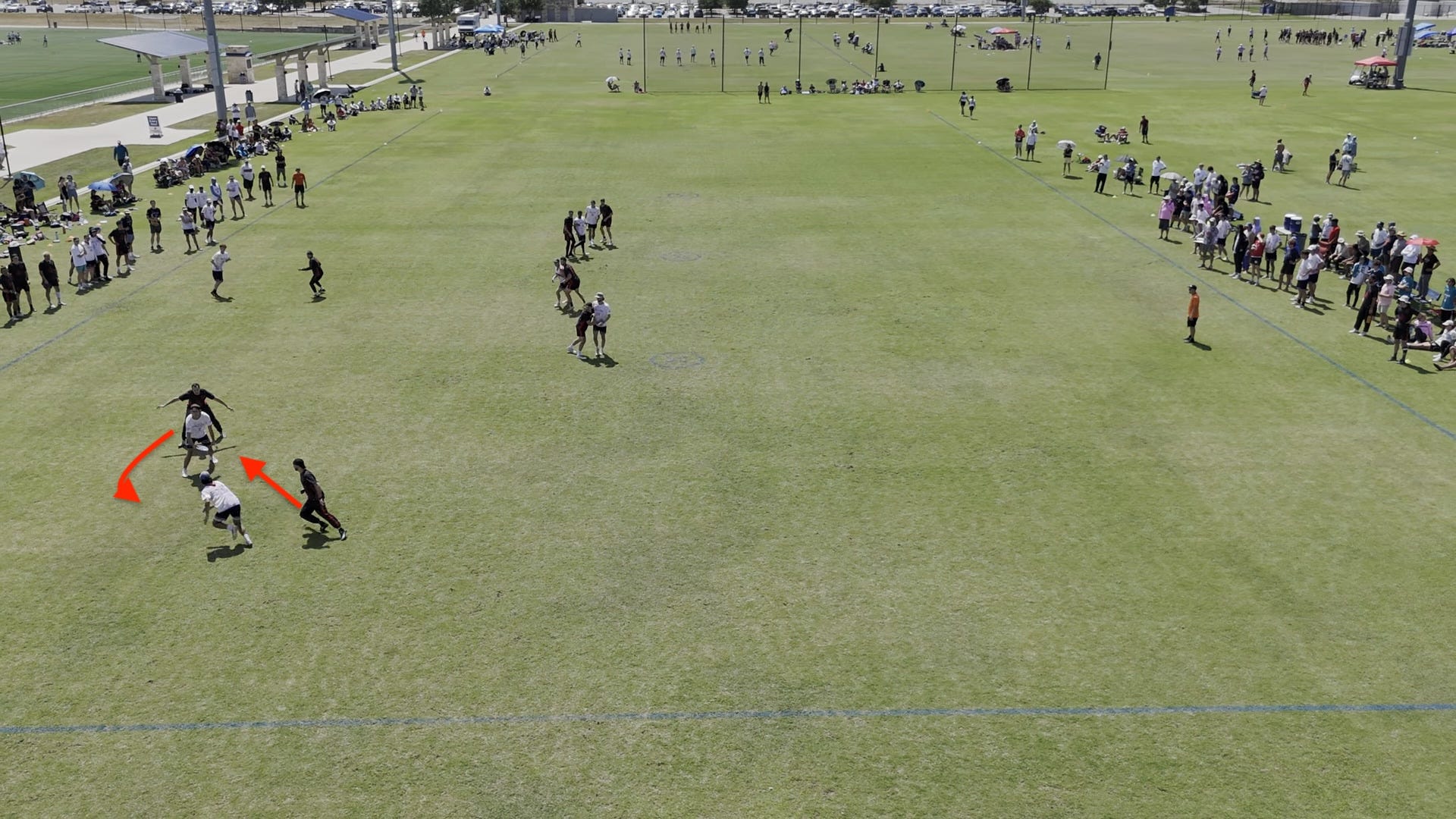
The tendency to both (a) play tight handler defense near the sideline and (b) switch on pepe cuts8 can lead to some awkward situations where a defender starts by playing incredibly tight defense, but then tries to drop off that same person once they catch the short sideline reset:
Defenders will often look to shut down the next pass before they fully commit to marking, whether that’s switching on handler movement or running way downfield to stop a continuation:
I think this is generally a strength of AP, as I’ve written before that “I’m not sure frisbee theory has completely figured out all the ways to take advantage of the thrower’s inability to move”. The marker looking to mark last, only after making sure they’ve helped shut down easy continuations, definitely feels like an intelligent principle.
Downfield
In the downfield space, defenders are mainly playing straight person-to-person defense, perhaps working harder to shut down unders than they are to shut down deep cuts.
While an earlier Reddit thread mentions orbiting as an important mechanic, it doesn’t stand out that much on film. I think there’s two reasons for this:
Forcing middle(ish) means that the downfield defenders have less orbiting to do, as they can always stay on the “middle side” of their assignment if their assignment is, say, running from one sideline to another
Because they’re generally playing tight defense, orbiting at most ends up meaning moving a couple feet from an offensive player’s one shoulder to their other shoulder:
Maybe this just feels less important to me than it really is, because it feels like such natural instinct to do it anyway. But in general, yes, the downfield defense will need to adjust slightly as the disc swings.
The sideline conundrum
There’s one big thing about Force Middle defense that never really made sense to me. In basically every other sport, it’s well-known defensive strategy that you want to force the offense towards the sideline. The sideline acts as a “second defender”, cutting off options from the offense.
Frisbee is the same—the models built by Shown Space based off of UFA data show that frisbee teams are also more likely to score when they’ve got the disc in the middle of the field, compared to having the disc the same distance from the endzone but nearer to the sideline. So (I’ve always thought9), why would it make sense to play Force Middle defense, when you’re just endlessly giving the offense the larger half of the field to work with?
Mikey Lun makes some comments in the Shayla Harris episode that are critical to understanding AP defense, when he says:
even though it looks like we’re playing [Force Middle], we really like the disc to be on the sideline.
To me, this is a key to understanding AP defense. It’s perhaps best viewed through the lens of a “trigger-based” defense, as seen through the lens of Ian French’s article: Pressing, Traps and Triggers.
When the disc is in the middle of the field against an AP defense, the handler defense is poachy, encouraging swinging the disc towards the sideline for minimal gain.
But when the disc is near the sideline, Bravo typically switches to tight handler defense10. So, they’re forcing middle when the disc is on the sideline, but they’re defending especially hard in those moments to give you no one to throw to. (And of course, when the disc is near the sideline, a “force middle” becomes more like a “force flat”, since you don’t need to shade to the side as much to prevent downfield break throws, as the sideline is doing that for you already).
When it’s done right, it can look like the offense both struggling to make forward progress and struggling to just get the disc off the sideline.
Portland Rhino Slam player and longtime frisbee analyst Joe Marmerstein makes a similar observation in an old Reddit thread11:
First of all, the idea that FM wants the disc in the middle of the field is just wrong. In my opinion the basic strength of FM is in pushing the disc to the sidelines, and then having the “flat side” scenario where you have a flat mark making upfield throws difficult and can play very aggressive on the reset.
Thanks also to Joe for suggesting this clip of Rhino struggling in a similar way to the Machine clip immediately above:
I do think it’s interesting how Kins mentions that when the disc is on the sideline, the critical area for the downfield defense is kinda the same regardless of whether the mark is forcing sideline or wide side—10 yards downfield of the disc and a bit off the sideline. But if that’s the case, I’m almost back to thinking they should just force sideline on both sides of the field since then at least the marker is taking away as much of the field as possible.
Dissolving the upline space
[Added 2026-07-25]
A couple commenters below mentioned that they liked how AP defense denied the offense traditional upline cuts. This wasn’t included in the article originally; I suppose it didn’t stand out to me at first because it’s harder to notice the *lack* of something on film.
AP trades the upline cuts for the straight-up-the-field, “inside backhand” lead pass:
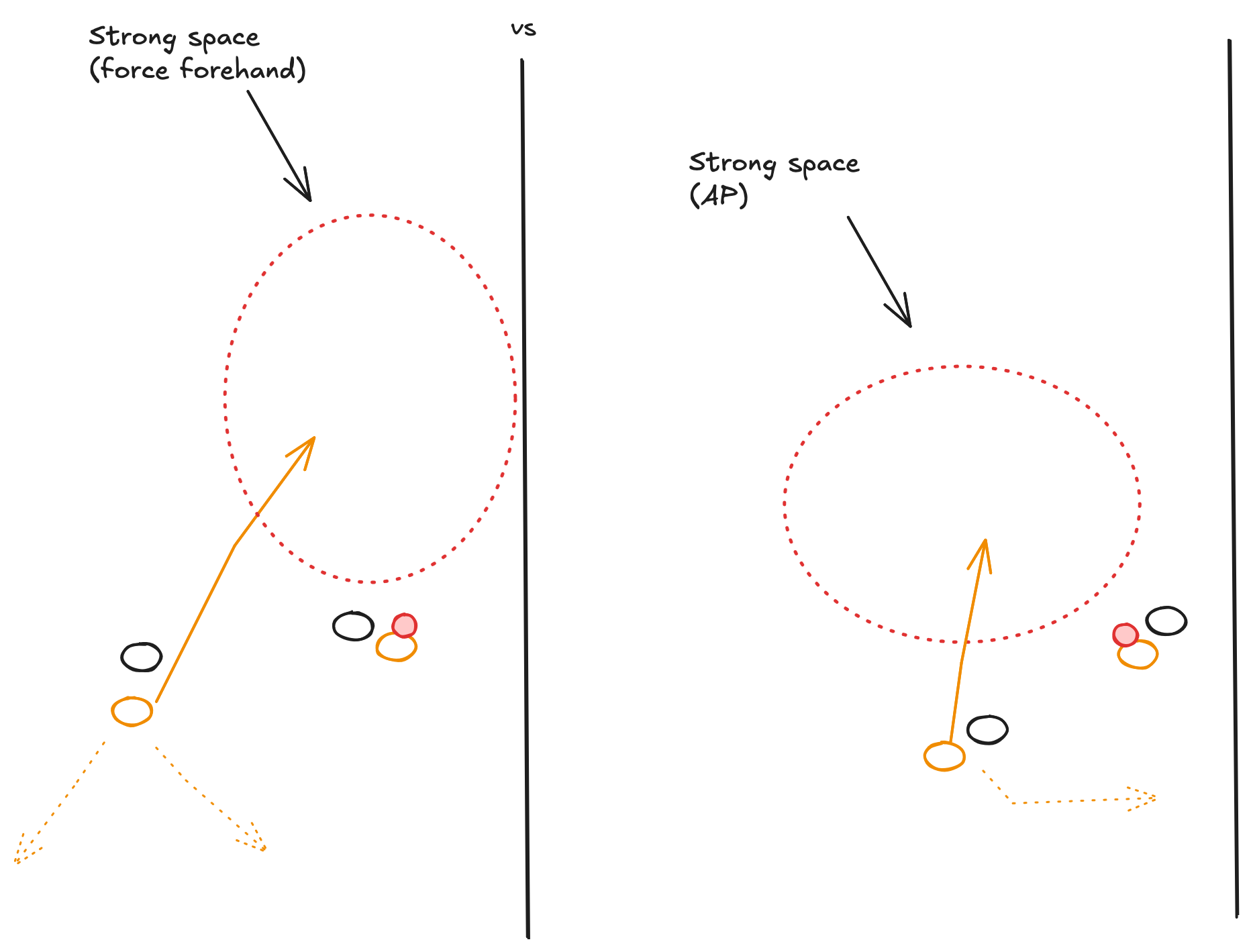
Re-watching Brown vs. Colorado in 2024 college semis, there are surely a few points where a player’s instinctive upline cut came to nothing:
But in return Brown often got offense out of the inside upfield look:
This is not an all-or-nothing situation—there are times when Brown completed a traditional strike cut even with the mark trying to take it away, and there are times when Brown turned the disc over attempting the inside upfield throw.
It’s hard to say whether this is an enduring advantage of AP defense, or if it’s just a function of many players not being fully accustomed to attacking the spaces AP makes available.
In favor of “it’s objectively a harder throw/easier to play defense” I’d probably say:
This inside backhand look usually requires curving the disc between two receivers; while the traditional upline has both defenders on the same trailing side when it’s open.
Arguably the total space in which the handler defender needs to stay connected to their person is smaller—the upline strike cut space in a Force Forehand can extend far from the reset space, while in AP defense, the upfield handler cut in an AP defense is still on the “same” side of the mark
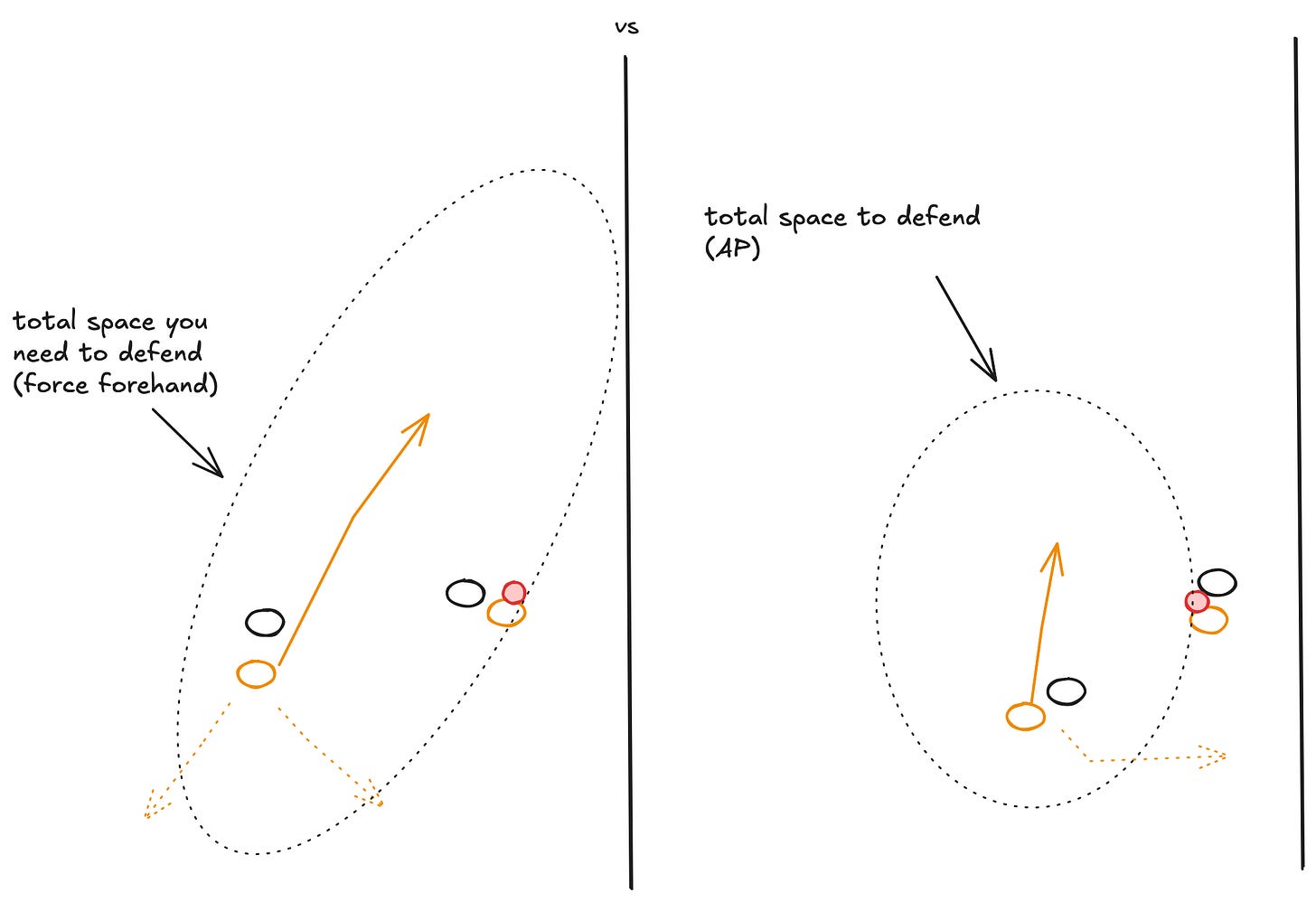
:
As a result, it’s a bit easier in AP to play hard, tight handler defense without getting beat for huge upfield gains.
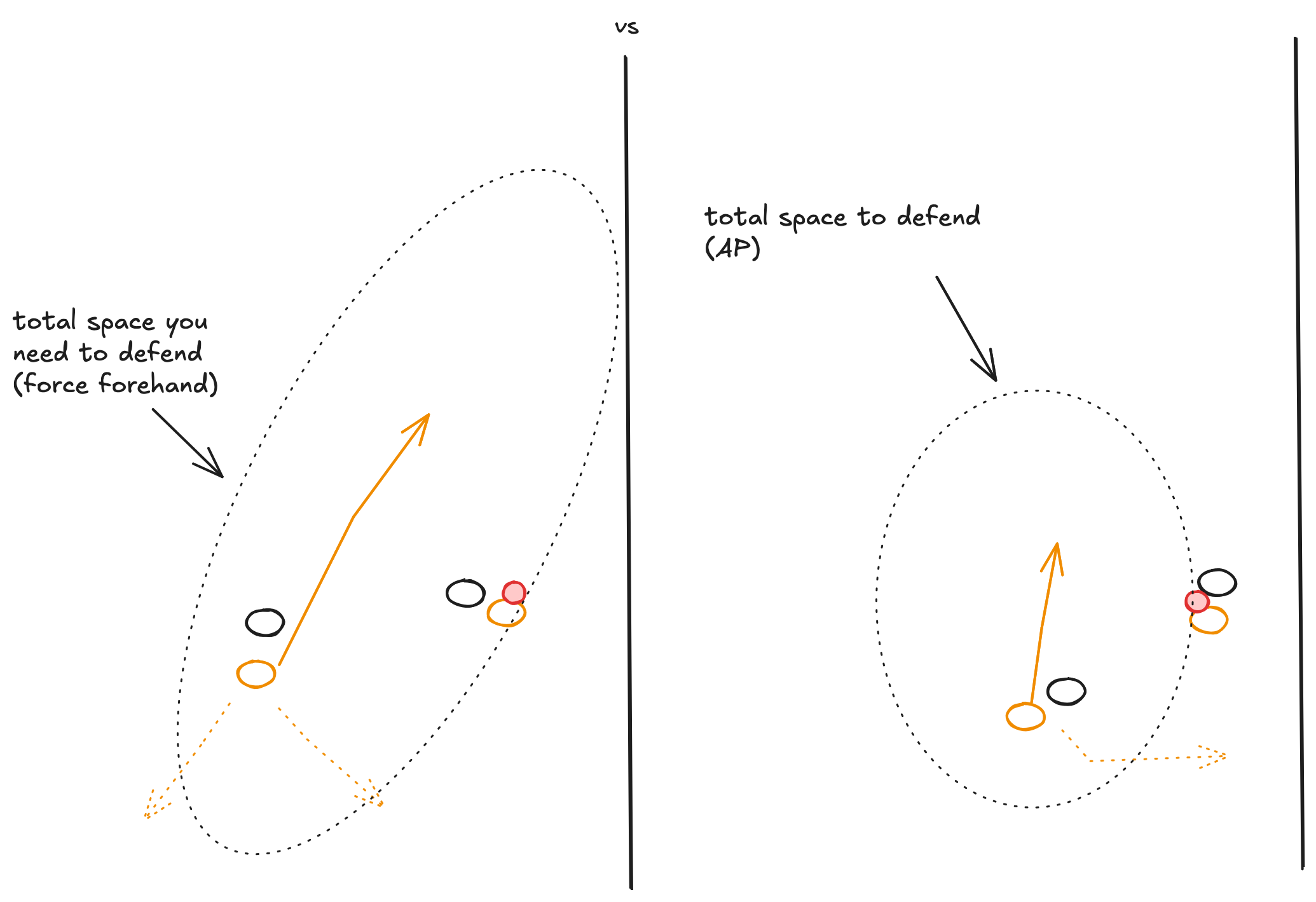
I’m personally agnostic as to whether it’s easier to defend this situation in AP. I think teams could get some of the same “keep the disc on the sideline” effect out of a Force Forehand defense if they taught their players to position better & sag a little more to deny uplines. And if more teams were playing AP, more players would get better at making (and throwing for) these cuts (more on this “off-meta advantage” below).
But without a doubt, at many levels of our current frisbee culture, having this ability to easily deny upline cuts is a useful tool.
Analysis
Now that’s we’ve looked at how AP works, here are some varied big-picture thoughts on how AP stacks up to other defenses:
The off-meta advantage
In the Shayla Harris episode, they talk about how teams want to use continuation passes—catch the pass and keep it flowing in the same direction, riding the wave of momentum.
I think this is partly human instinct—think about the field full of five-year-old soccer players where every single one of them is following the ball wherever it goes. But it’s also partly just the dominant strategy in frisbee culture—e.g., everyone learns to look for the continuation pass to the breakside before the mark seals the space.
AP defense does better than most at shutting those looks down. It’s hard for offenses to take advantage of the spaces that are left open, because it goes against the instincts they’ve developed in years of playing frisbee.
When the TK Pod Practice episode was posted to Reddit a while back, I made a comment to this effect:

Watch this sequence from the 2025 regional final:
The disc swings in the backfield from left to right, and the “ping pong” back towards the left is open immediately, but the immediate throw is looked off and the disc stops for a few seconds. The disc ends up going there anyway, but it happens ~5 seconds later and the offense has no flow.
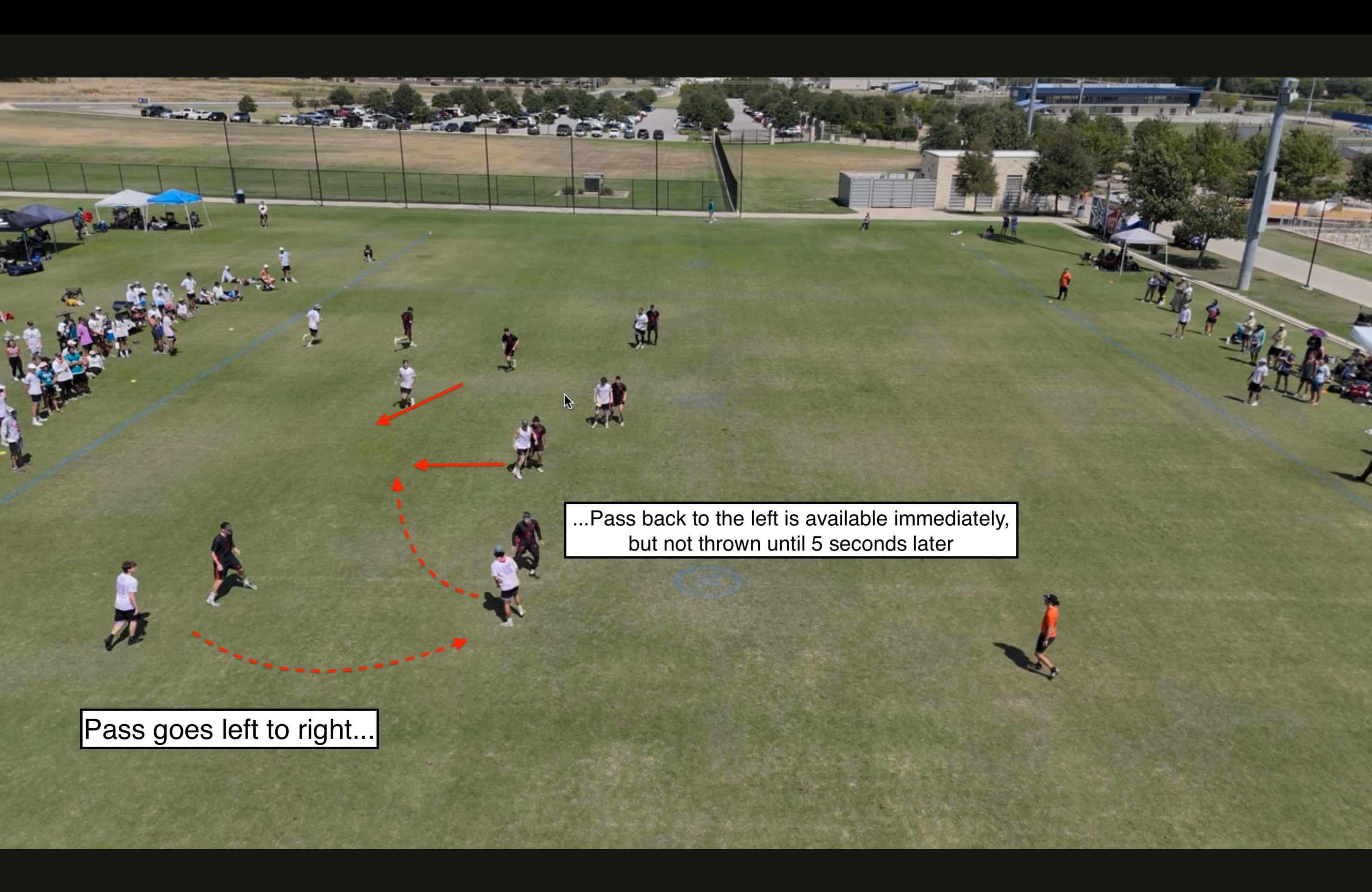
You’d think a team in Bravo’s region would be ready for AP defense and thus ready to look for that ping-pong flow, but we don’t see that consistently. As a result, it’s a bit hard to separate “AP defense is good, period” from “AP defense is good b/c teams haven’t optimized around beating it”.
The downside of huck turnovers
In his appearance on Pod Practice, TK and the guys discuss giving up deep shots. Because the downfield defenders focus on stopping under throws, this is an area where, if anything, the defense is encouraging the offense to throw the deep shots, and expecting the defense will be able to influence enough of them to come out ahead in the end.
But aside from the problem of what happens when the offense completes those deep shots, I see another potential issue: turnovers on hucks are less valuable (for the defense earning them) than turnovers closer to the endzone that the defense will be scoring in.
In other words, there’s a reason the phrase “huck & play D” exists. Using data from Shown Space, we might say roughly that a turnover on your own endline (i.e. 70 yards from scoring) is worth about 0.2 points less than a turnover near midfield:
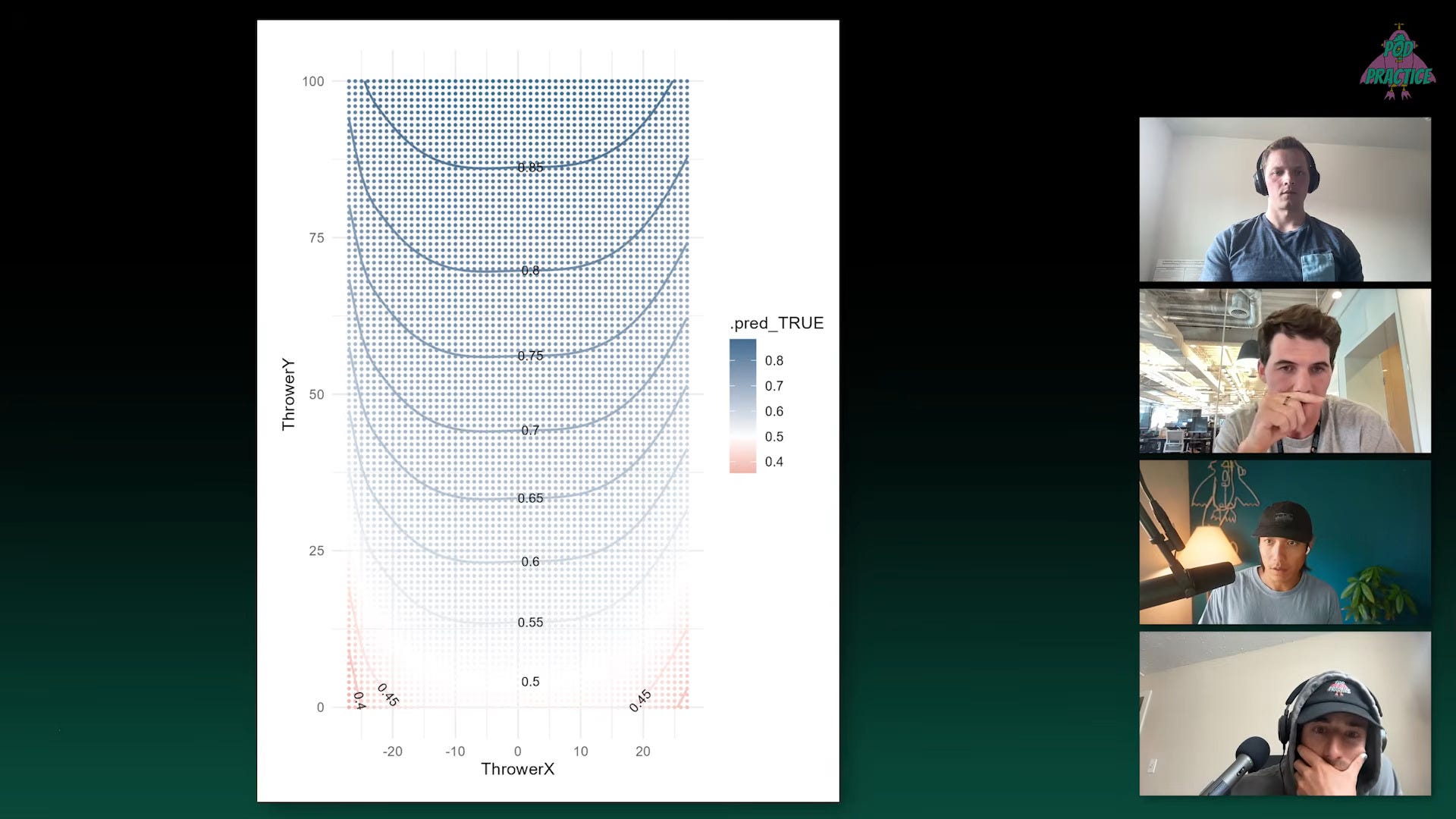
Using the image above as a guide, we can roughly say that 4 turnovers near midfield are worth 4*0.7 = 2.8 points for the defense, while it takes ~5.5 goalline turnovers (a 37% increase!) before you’ve won the same 2.8 points of value.
Obviously there are lots of huck turnovers against non-AP defenses, and lots of turnovers near the “line of scrimmage” for AP defenses, so the discrepancy will never be that obvious. But the general point remains: if your defense preferences huck turnovers, it’ll need to be more efficient than defenses that encourage turnovers near the line of scrimmage to make up for the lower Expected Value of having the disc that far from your goal.
Watch, for example the first point of this 2021 Bravo game against Machine, filmed by Flatball Club. Machine hucks it on their first pass, it’s a turnover, but then (after a long discussion) Bravo likewise turns the disc over, without making much progress, and Machine scores in a couple throws12:
Likewise in this sequence from a 2024 game against Revolver, Bravo forces an early huck turnover, is forced to call a timeout when their options on offense after the turn aren’t looking good…and then end up turning this disc over anyway, leading to a quick Revolver score.
Weaknesses of AP
Here are what I see as some potential weaknesses of AP defense:
Good hucks — AP defense is, if anything, baiting hucks. Sometimes the other team will complete enough of them that they’re playing good offense. Without having data on this it’s hard to know for sure whether AP is winning this battle or not.
Relatedly, the marginally lower value of huck turnovers — discussed above.
Confusion on which way to force — you’ll sometimes see an AP defense give up easy yards that other defenses might not because mark and downfield defender aren’t on the same page about which way to force. I think this not a pure downside, but just a “chaos giveth and chaos taketh away” situation—having a more dynamic mark has upsides but it also has downsides. Here’s one example against Machine in 2023:
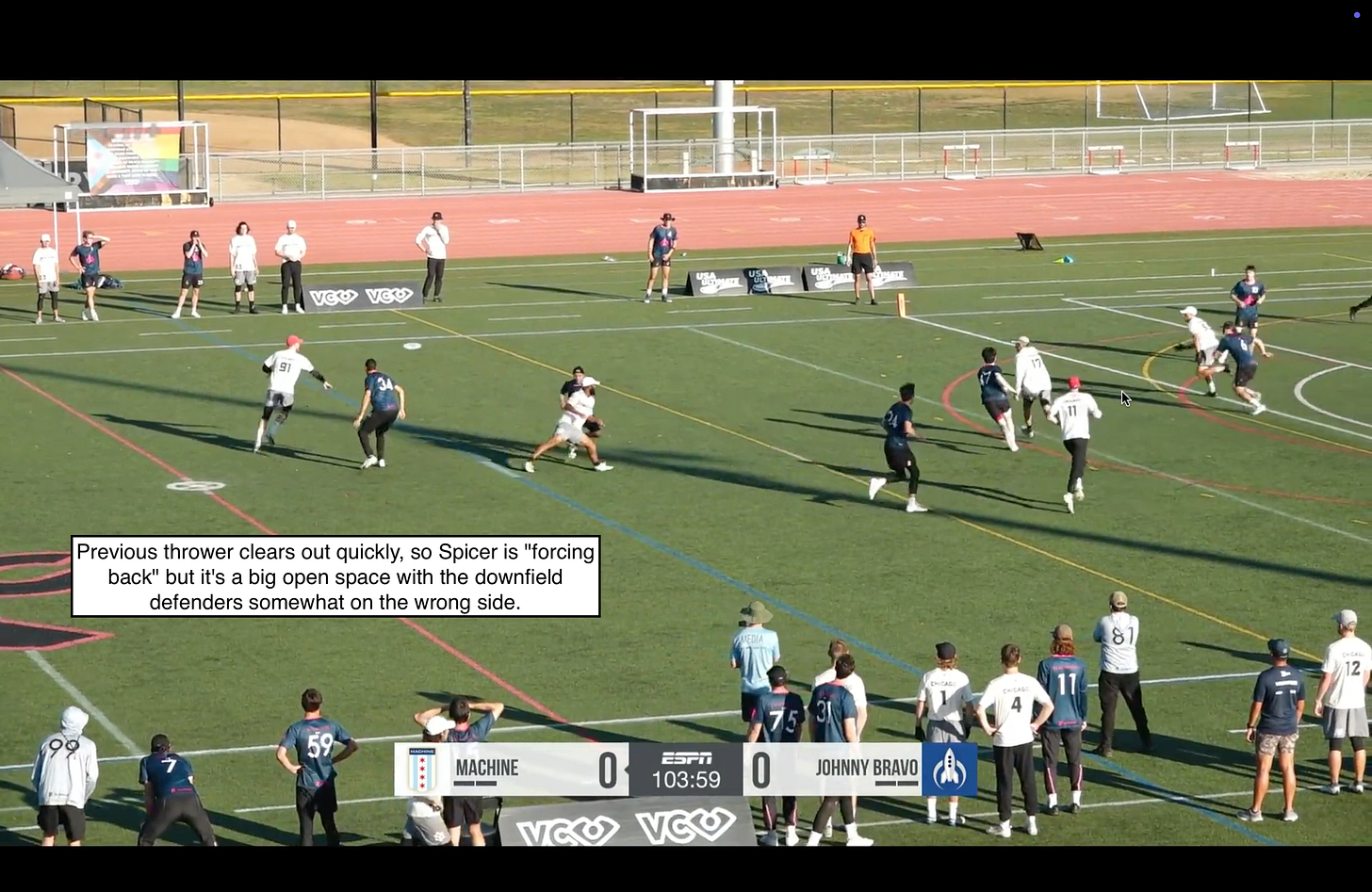
If 2024 University of Colorado counts as AP defense, here’s another example where the marker switches their force direction just in time for Leo Gordon to throw an easy score to what used to be the break side a moment before.
Point Five Frisbee — (Not that any other defense is better against fast disc movement.) Continuations are available if the offense can get them off before the mark gets into place. keeping the tempo up can lead to positioning issues and confusion for the defense and opportunities for the offense.
Here Machine uses a combination of tempo13, give and go, and ping-pong thinking (receiver catches sliding towards the bottom of the screen, then pops up looking immediately to the top of screen):Or here, Doublewide gets a few continuations in a row by being ready to throw immediately:
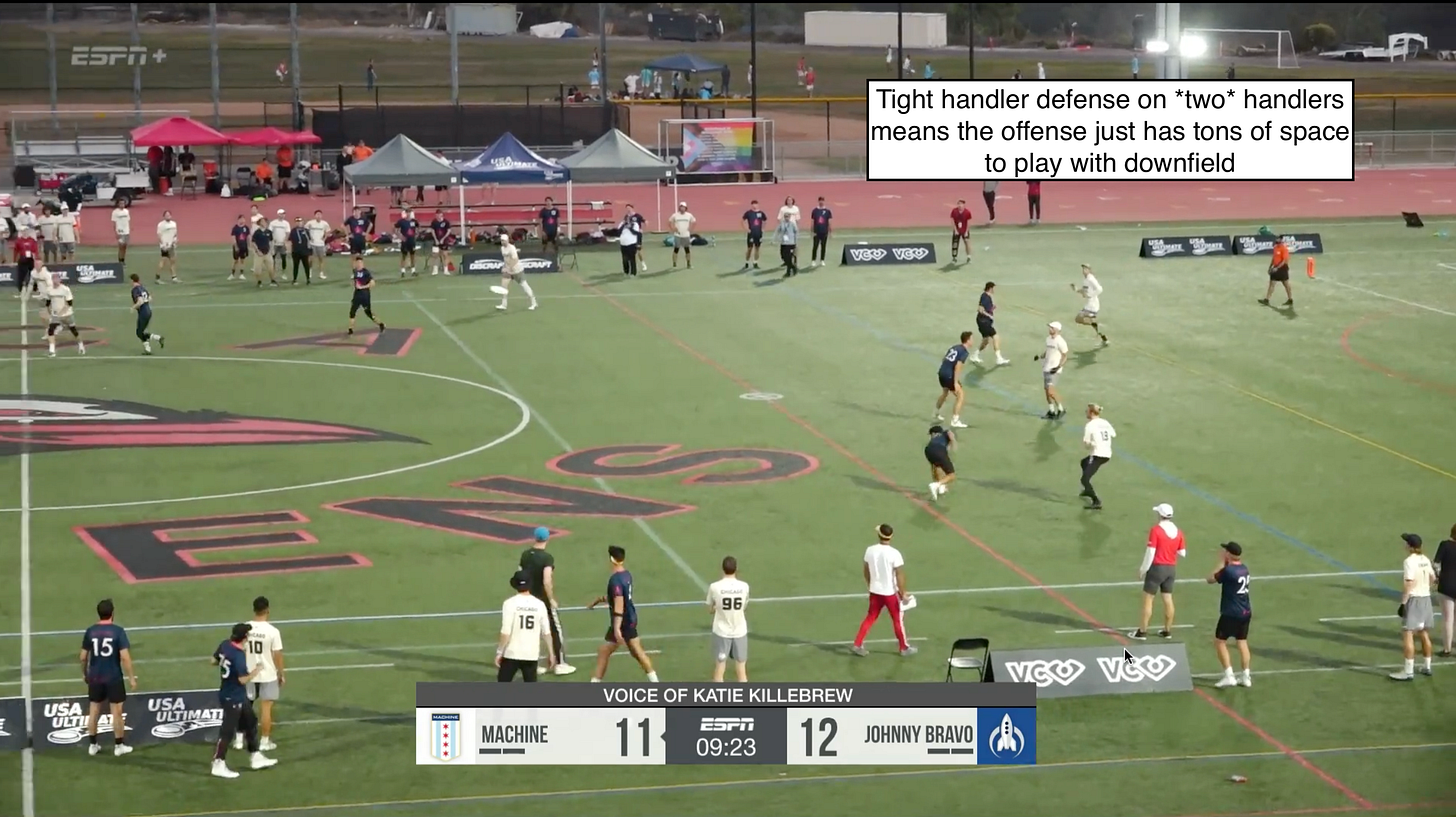
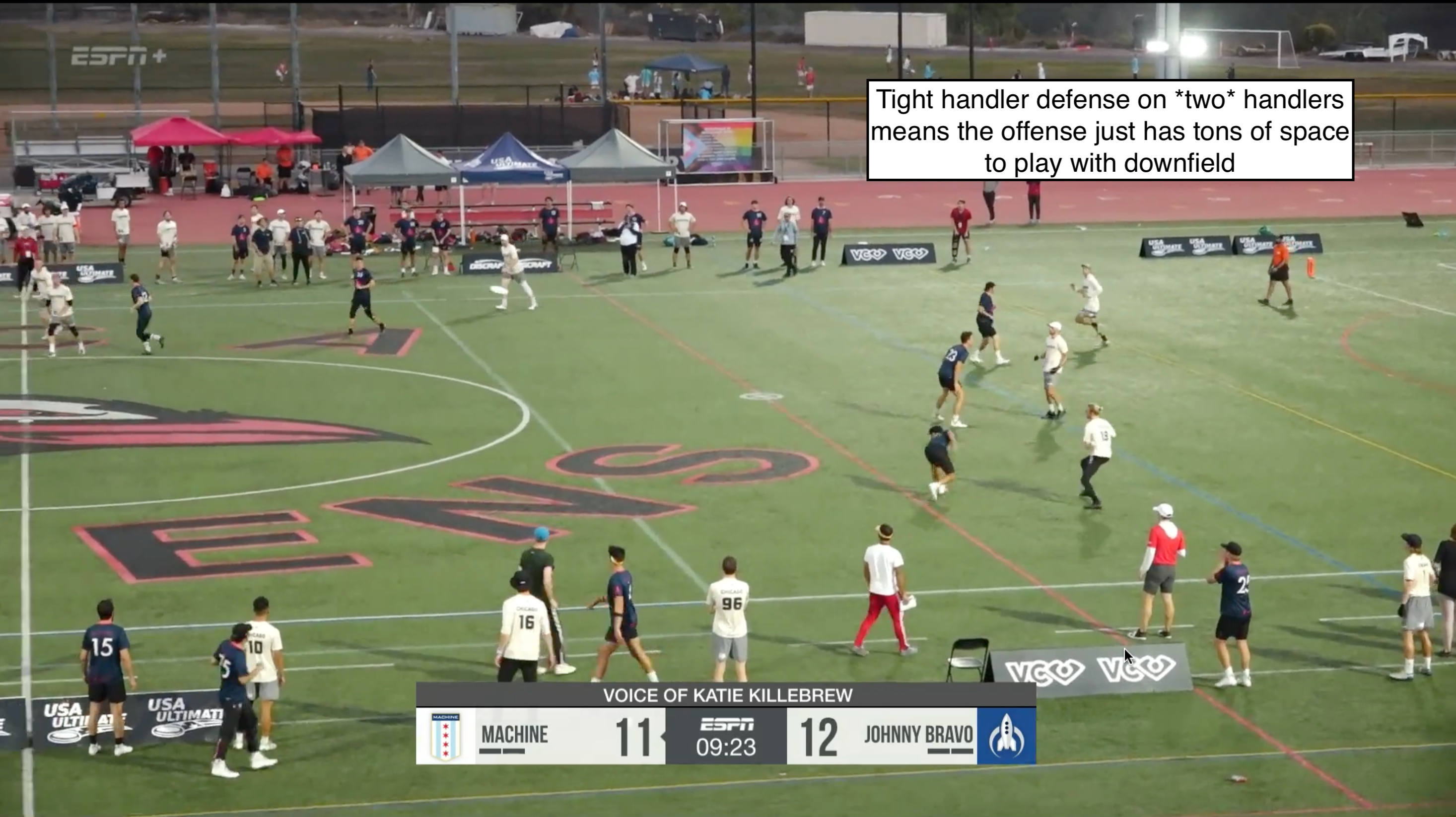
Too many defenders behind the disc. Teaching tight handler defense near the sideline works if the downfield defenders are also locking their assignments down, but it can lead to situations where the defense lets the offense have an easy “small numbers in big space” advantage if the downfield offense can get open. This especially happens in situations where two offensive players end up behind the disc, leaving a 4-on-4 downfield of the disc. Whether intentionally or not, Machine took advantage of this a couple times in their 2023 semifinal:
Emptying the backfield — Whether by plan or not, Doublewide (2025) often ended up with no one in the backfield against Bravo’s AP defense (here’s one example). It’s risky, but without anyone near the reset space to get in the way, the “force middle” strategy ends up feeling like you’re just giving the offense the wide open side of the field. Reset cuts can come off the “front of the stack”, when needed. It wasn’t a consistent enough pattern to get more than this one bullet point, but it did catch my eye a bit.
Good small ball — if a team doesn’t mind the small ball, and can hit the lanes, especially on upfield handler cuts, then forcing middle starts to feel like you’re just giving the offense extra room to work with. If it counts as AP defense, Colorado’s 2024 semifinal loss to Brown University is one big showcase in this downside. (See also: Slowing at the saddle point)
Is AP actually good?
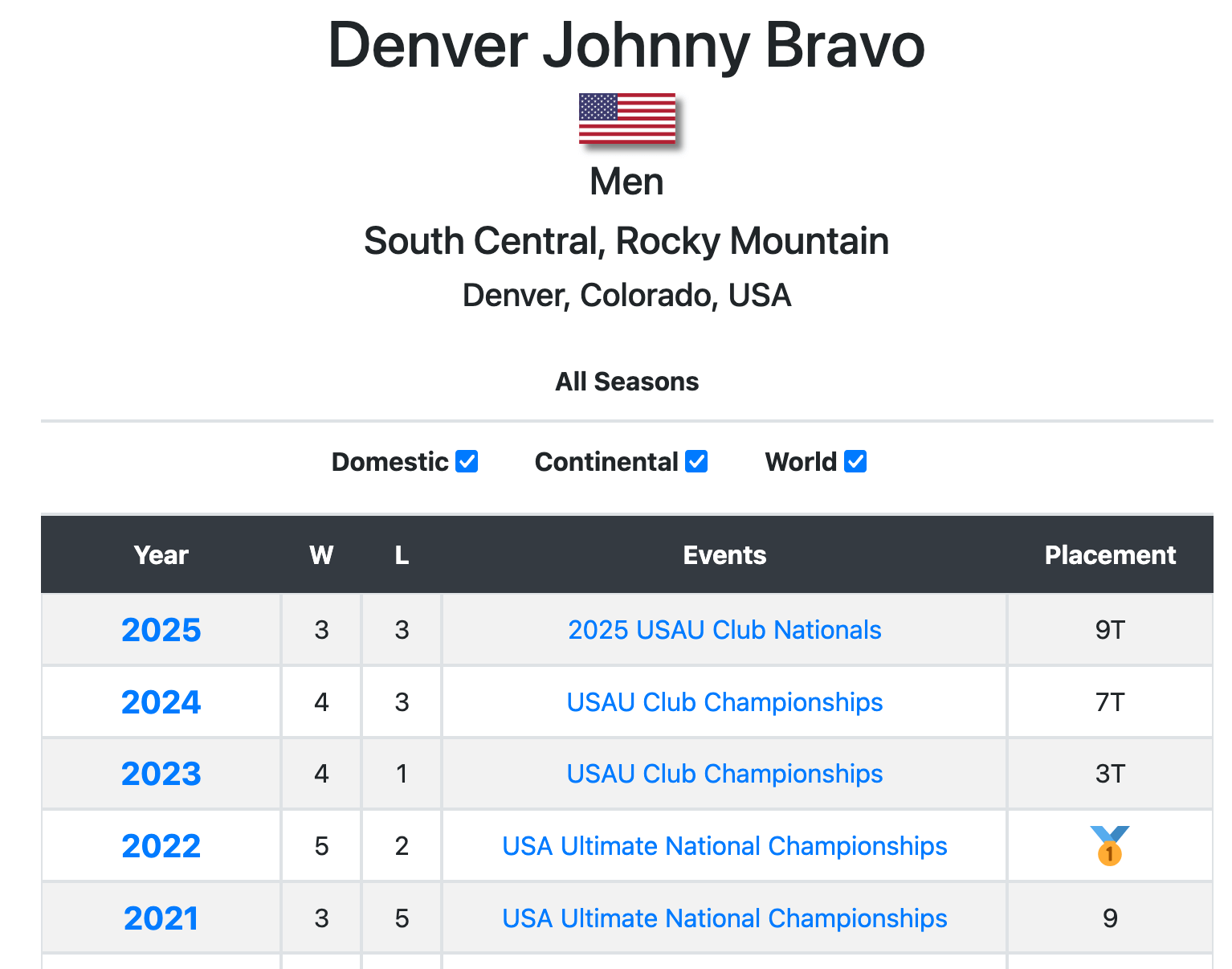
In the five post-COVID years that TK has been a coach on the Bravo roster, Bravo has:
won US Nationals once
lost in semis once
and lost in quarters/prequarters three times. (Never didn’t make the bracket)
These results are certainly better than a lot of successful teams (compares favorably to DiG or Revolver, for example) but arguably a bit worse than a few others (Rhino Slam, PoNY, Machine).
It’s basically impossible to say what this means about AP’s effectiveness, given that:
a) it’s hard to evaluate talent compared to a sport like basketball, so we can’t really say if Bravo overperforms their talent level due to an innovative scheme
b) Unlike in basketball, every single point must end with one team scoring, so we can’t reliably use scoring stats to determine the quality of a defense. For example, perhaps AP defense helps Bravo generate blocks more than their opposition, but their weak (in this hypothetical) offense means that they’re unable to score themselves, leading to them eventually getting scored on.
There is per-point turnover data available through the USAU Stats app that could theoretically help us answer point (b), but so far my attempts to contact USAU to ask for access to it have gone un-replied-to.
My personal take: there are a few areas where All Person defense aligns well with the universal defense principles I’ve written about, so I absolutely think it’s an improvement on the straight, tight person defense that many teams are still doing at the low-to-mid levels. But I don’t see it as the be-all-end-all of frisbee defenses, given a few drawbacks:
I can’t help but think continually forcing teams to the side of the field where they have more space is suboptimal, and teams will only get better at knowing how to take advantage of this.
The relative lack of downfield switching likewise doesn’t feel like the future
Giving up relatively more deep shots means that the turnovers you earn are less valuable (b/c your team is less likely to score starting farther from the goal)
(Also separate from the question of AP/not-AP, I believe good defense comes from building smart players to put on that defense. I’d rather play any structure with smarter players than a marginally “better” structure but played by players with less frisbee IQ.)
To be honest, the defense that’s closest to what I believe is optimal strategy is what San Francisco Revolver was doing in 2025 (see: Notes: Revolver vs. Machine). They had a somewhat similar poachy approach in the handler space, while downfield they combined hard, switchy defense on the unders with over the top help. Maybe they’re just lacking a catchy name for their scheme to get more people talking about it. (Next post: The Some Flow Guide to Whatever Revolver’s Doing on Defense14).
In other words, I can’t help thinking to myself what if the downfield defenders played All Person defense, too? AP does a lot of interesting things with marking and with handler defense, but then gives up (mostly) on the idea of switching when it comes to the downfield defense.
It’s interesting to hear in TK’s interview that he talks about how AP came from a desire to hang with the best of the best even when the team couldn’t quite keep up athletically. But later on, when talking about games where Bravo got beat deep a lot, he suggests he’d rather let Zeke [Thoreson] “use his amazing physical tools” than using the “band-aid” of helping in the deep space. But in my opinion, you’re always going to end up playing against offenses that are just as athletic as you, and you’re always going to be at a disadvantage b/c the offense gets to move first. So I can’t help but think that even the most athletic defenders need to be able to play the smartest team defense to be truly elite.
This play stood out to me watching the tape as a strong example of the suboptimal downfield defense. After Joe White catches the pass, there’s two defenders on the top sideline. It seems like a perfect opportunity for some bracketing, but both are playing on the under side. And then…one of them gets beat under anyway, while the other simultaneously gets beat deep:
I can’t help but think it’s possible to do more in the downfield space.
Sources:
Reddit threads
AP Defense (2026 April)
I want to learn AP defense (2026 March)
FM vs Directional Force (April 2025)
Colorado’s AP by TK with Cody Spicer (Video Episode) | Ep 84 (2025 April)
Is Force Middle over used now? (2024 April)
All Person (AP) Defense (2024 March)
Force Middle (December 2022)
Sources to learn force middle (August 2022)
Podcasts
Games
2026 Pro Elite Challenge vs. Rhino (just uploaded! But it feels like they’re not playing AP in this game, at least for the most part)
2022 US Open Semifinal vs DiG (Vimeo)
There are many more Bravo games on the YT channel of Richard Yuan but all the search results I saw are filmed from field height
Also many more games in Ultiworld’s (paywalled) library of course
Full list via Ultiverse
Other
How Bravo Slammed the Brakes on Truck (Ultiworld, paywalled)
Tim Kefalas’s blog (not actually that useful. He mentions on Pod Practice podcast that he deleted some old blog posts, trade secrets I suppose) (Here is his Ultimate-Reference page)
Bravo’s results at recent Nationals (via ultimate-reference):
Introduction at the end so the article doesn’t start with me talking about myself
I wanted to write up a breakdown of All Person defense for a few reasons. First, there had been a few previous Reddit threads (see Sources, above) asking how it works. Second, a Reddit user put together this post, using a combination of podcast transcripts, their own film study, and AI help. One of the replies called it an “extremely good post”, but, to be honest, I wasn’t that impressed by it (which is not to say it wasn’t better than a lot of what was out there before)15.
Third, Tim Kefalas mentions in his appearance on Pod Practice that he’s deleted old blog post(s?) to keep other teams from learning his trade secrets. And the only Ultiworld article analyzing Johnny Bravo’s AP defense is paywalled (again, see Sources above). But I take a different approach to life, and I like to see information be free. Trade secrets help one team, but open information pushes our entire culture forward (see Finite and Infinite Games).
So all that made me want to do a good writeup.
Now for the usual caveats:
I’m not a Johnny Bravo insider, so I may have gotten some of this wrong. But I’ve done my best to share what I see on the film from my own perspective, and what I hear the insiders talking when they’ve discussed AP on podcasts.
Bravo won’t play AP on every single point. Some of the points in the 2023 Machine game feature some under←→deep downfield bracketing, the 2024 game against Revolver has them playing something that looks like a matchup zone for significant periods, etc. Perhaps some of these tweaks are the next evolution of AP—resolving some of my complaints above about the lack of downfield teamwork—and it just hasn’t fully shown up on the tape yet.
As always, suggestions and corrections are very welcome!
(This is a joke, because that’s what the goal of every defense should be)
and poaching handler defenders
Using data from US Nationals
i.e. these are goals, they’re not “how it works”
(that I don’t think was explained well in other posts like this one on Reddit)
though arguably a two-yard gain is better than a 10-yard gain that could’ve happened otherwise
one of these switches is in the clip above
For example, I’ve previously mentioned this take in this article, search for “force middle” to see the relevant part
Though not always. I didn’t take careful enough notes to have a timestamp but I definitely remember Mikey Lun mentioning during a podcast episode that they played poacher near-sideline defense in their 2022 national final win against Truck Stop
As have a few other comments in other threads
Anecdote is not data, so I’m not saying “this is proof you need to worry about this issue”, I’m just saying “here’s an example of the potential issue I described in the text above”
Hear Ian Toner saying: “Look at this pace!”
not really. But maybe?
For example:
I think my explanation of the marking “progression” is much clearer
My explanation of the sideline trap strategy is completely missing from that post
Some of the language has the AI problem of not really making sense in reality. (Hucks that “Bypass transit time”? The marking scheme creates “angular pressure”?)
And of course, it doesn’t have any clips/images.
Great write up as always. We implemented this at the college level and its remarkable how many teams can't counter it when the cutter to handler layer connection is severed. The sideline switch is a big part of the defense and we would often rally off 3-4 consecutive switches, forcing the offense to lose yards down the sideline. I totally agree that it allowed me to play my less athletic players moreso than traditional man would have. We were able to run deeper D lines.
That being said, I am also with you that good teams figure it out and implementing switches downfield is the way to go. Usually though, this was good for us to slow down teams that were rolling offensively and extend the amount of time their O line was on the field while our O line could rest.
Couple thoughts:
1) I don't remember the exact context but I think one of the Pod Practice guys mentioned that one downside to AP is that if you want to play it well, you have to commit to playing it as your primary defensive look (in their experience/opinion).
2) IMO AP and downfield switching are totally independent. Bravo may choose not to switch or help as much downfield but no reason you can't combine FM or "flip force" marking schemes with more switching downfield. In fact I think it's even easier, since the most threatening space on the field is smaller than in a single direction force
3) To expand on that thought - I think there are a couple key advantages of FM:
(a) The purpose of the offense is to score, which means advancing the disc toward the endzone. There is a lot of value in having a mark that is making it more difficult for the offense to throw the disc in that direction. Brute Squad also ran a flat/straight up force for many years to great effect. Their coach Ari Jackson recently mentioned that people called it FM but it was just straight up (which in my opinion is a version of FM)
b) As you mentioned, orbiting can be easier in FM. This feeds into my thought that it can also make it easier to switch downfield. Thinking about it another way, in a single direction force, with the disc on the flat side, the strong space is in the middle of the field, but extends to the far sideline when its on the trap side. In an FM, the strong space is always in the middle of the field, so the field has "shrunk" in terms of downfield defense, making helping and switching easier.
4) You glossed over orbiting a bit but I think what Bravo does really well is orbit to force throws to go across the field. In your example you can see the front of the stack orbiting to take away continuations to the strong side/fill cuts to the middle.