A coach I’m friends with sent me a video they made their team with a few examples of “good marking”, especially showing where players succeed at shutting down both the inside break and around break lanes at the appropriate moments. One of the examples in that video was this clip, from the finals of the 2025 World Games:
[From about 1:02:50 here]
Claire Chastain of Team USA invests effort1 to shut down a potential around break throw from Lauren Kimura to Malik Auger-Semmar, then, as that threat clears out, Chastain settles back into a position of shutting down the inside break throw.
(Now that I see this play again in context, I think there’s a good chance what’s actually happening is Canada is running a pull play and Auger-Semmar is just going through the motions of “running the play” instead of actually reading and reacting to the defense. But look at what the play gets them! Nothing! Reason #5,439 why pull plays without enough flexibility are bad offense.)
I certainly don’t think this is bad marking, but I’m not sure I would call it great marking, either.
To me, though, this clip highlights a different microskill—or, at least, the lack thereof. I can’t remember having seen this talked about before, but I believe great cutters are able to read and react to what the mark is doing.
As I’ve said before: don’t not get thrown to. That applies to Auger-Semmar here—what went wrong that he ended up not getting the disc, even though he had two steps of separation?
If you’re trying to get the disc, and the mark reads the play well and makes it hard for the thrower to get the disc to you, you shouldn’t necessarily just give up and clear out2.
Instead, often there’s an opportunity to re-adjust your cut to attack a space that the marker isn’t taking away. The mark adjusts, and you adjust to them. And because the offense has the advantage of moving first, and defense is reactive, this can usually happen quick enough that the defense can’t continue shutting everything down. Not to mention that the mark often has their back to you, so they can’t react quickly when you start doing something new.
Take a look at the screenshot below of the moment when Auger-Semmar comes on to the screen. Are you really going to tell me it’s great offense that Canada was forced to throw a late-stall dump for their next throw? This was a missed opportunity for them, and not solely because of the USA’s defense.
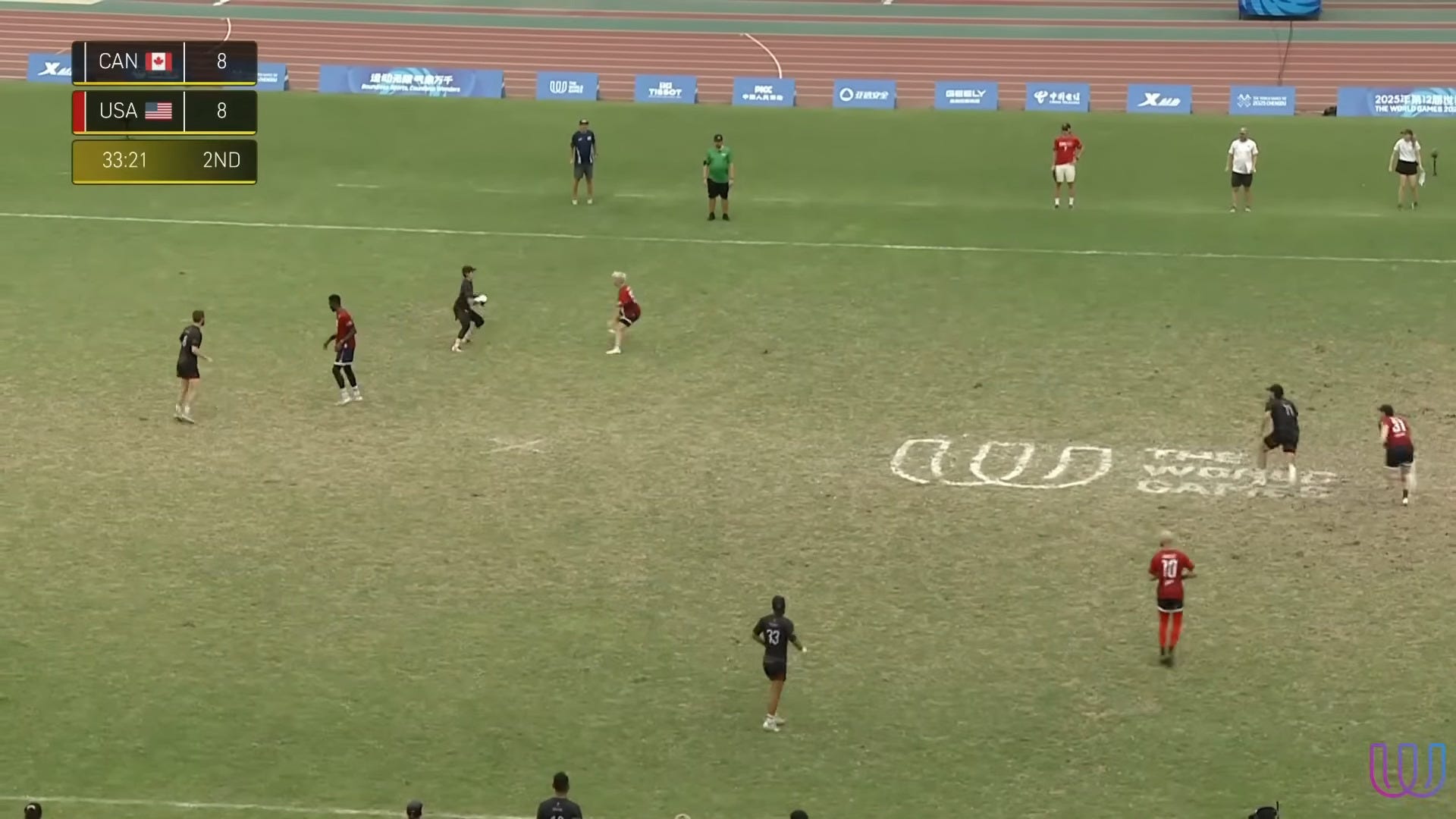
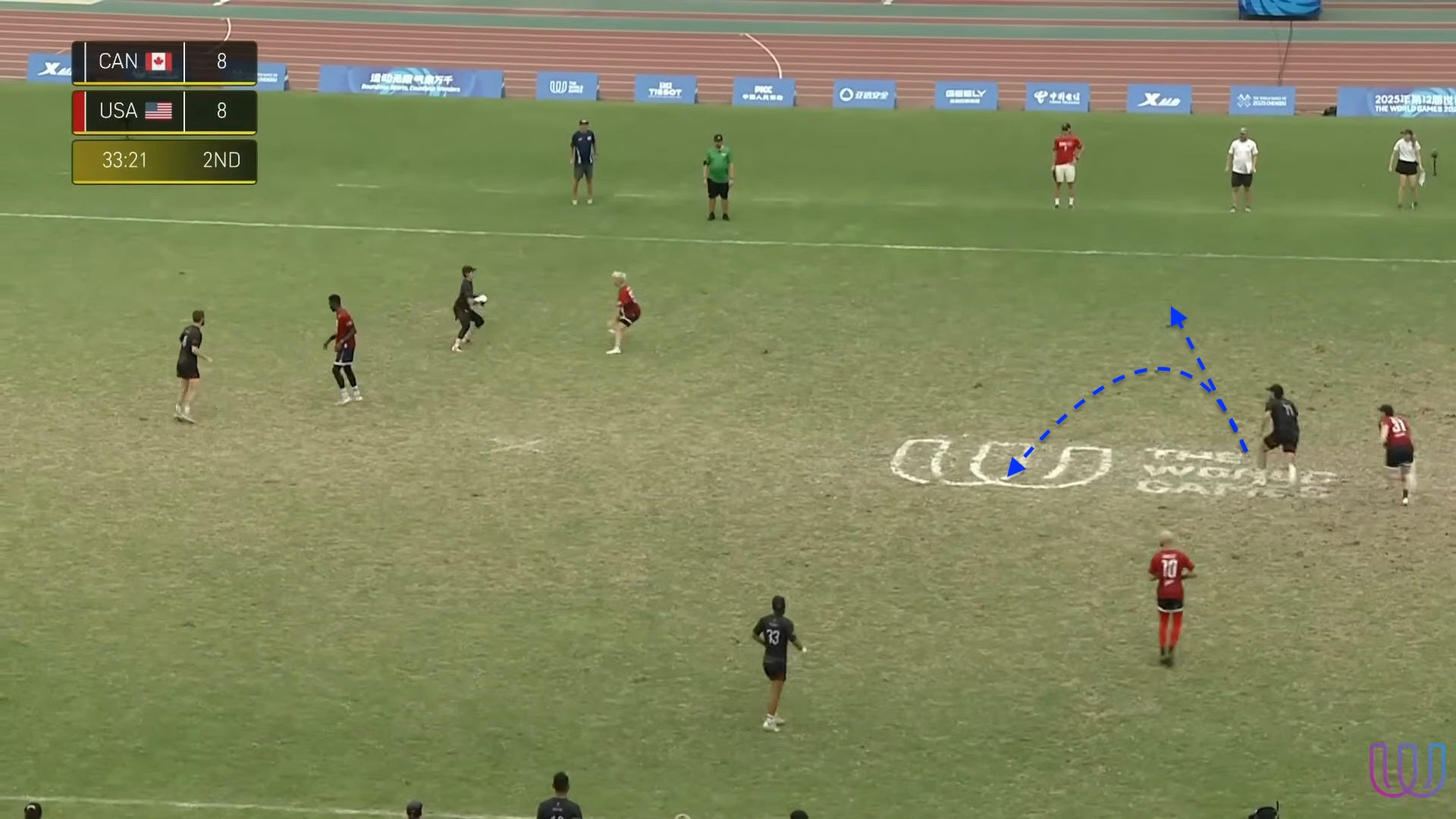
Look at all that open space! And Auger-Semmar has his man beat by a step and a half! And all he could think to do was to cut into the exact space where it was as hard as possible to throw to him!?
What I’d have liked to see him do here is what Jack Williams calls a “hook cut” (here, around 3:10)—slash across to the break side, but if the timing doesn’t work to get off the break throw, cut across the face of the disc back towards the open side:
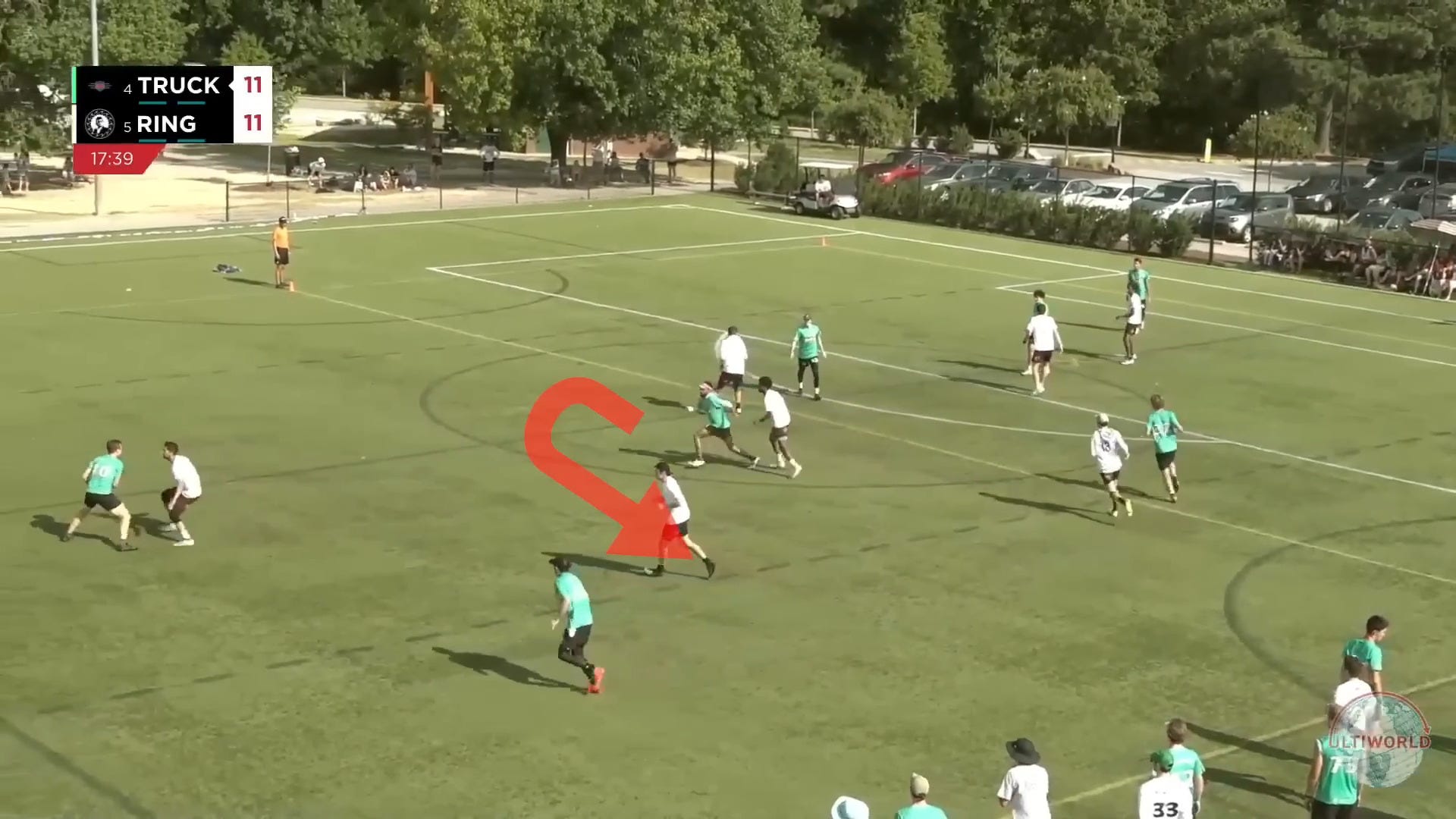
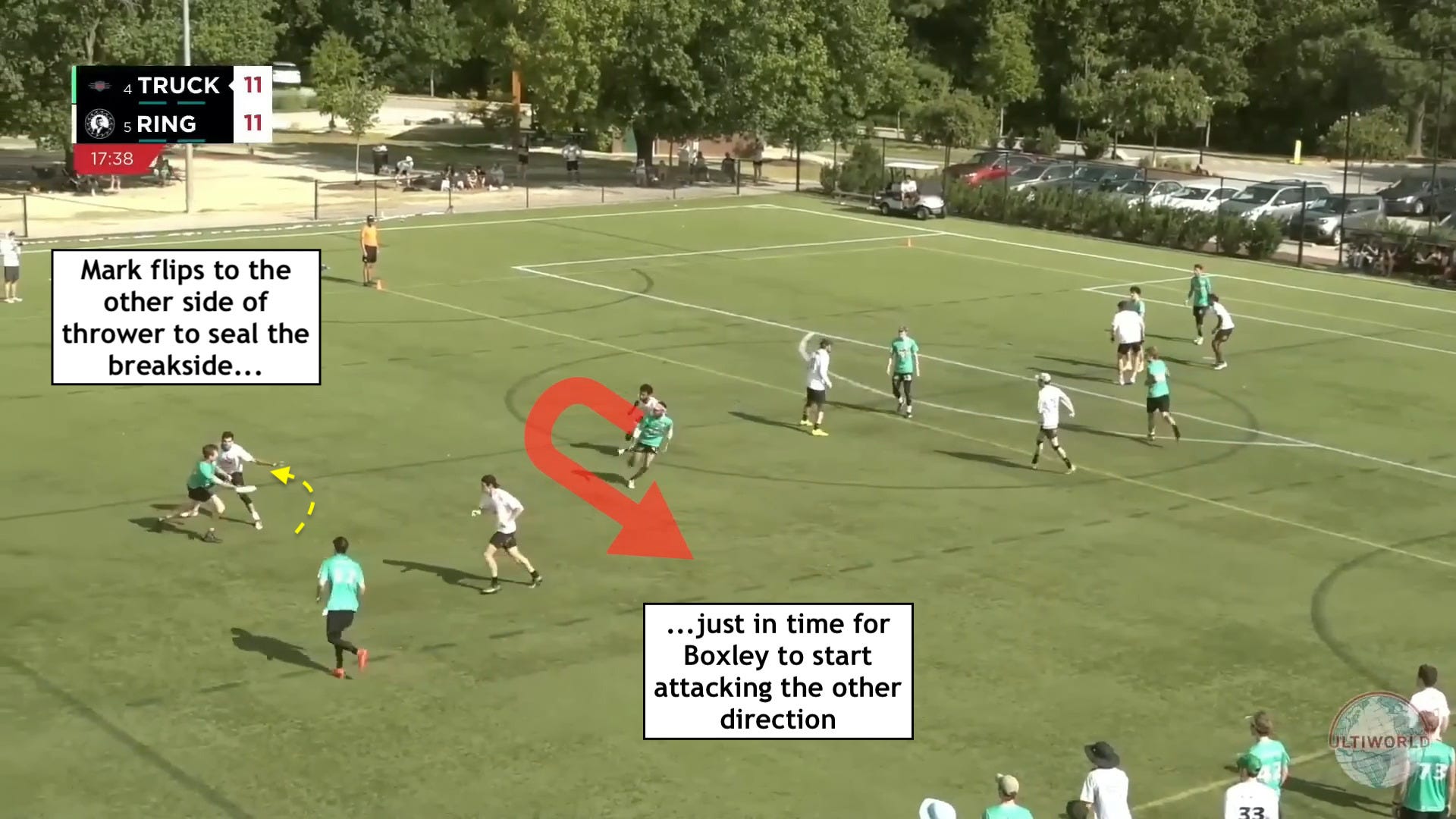
In the above screenshot from Jack’s video, Christian Boxley is attacking the break side (top of the image) to try to get a continuation pass there. The thrower has only caught the disc a moment ago, and the mark is still getting in position. But as the mark settles in to block the break side, Boxley adjusts his cut and hooks back to the open side, for a short gain that’s completely unchallenged by the mark:
‘Predicting’ as much as ‘reading’
Really it’s often predicting the mark—knowing the patterns that are likely to occur as the mark adjusts—as much as it is reading the mark in real time. A mark that wants to stop a continuation throw after a swing will commit to that side, leaving the inside open. If the mark sees an upline handler cut to the breakside coming3 they’ll try to shut down the inside first, then the around.
When I’m setting up the continuation swing cut, as in the Christian Boxley example above, I’m trying to predict the development of the play as it’s happening—as the disc is in the air to the center handler, I’m thinking, is their defender trailing far enough behind that they’ll have time to throw the continuation? Or will the mark get there soon enough to shut it down? If I think the mark will be shutting it down, my continuation cut to the break side is often just a setup, forcing my defender to commit their momentum so I can hook back in front of the disc. But if the mark’s not going to be getting there in time, I’ll time my cut to be open for the first look, to the breakside, before the mark has arrived.
These patterns are generally pretty predictable. And if you know how to do them when you’re marking, you already know how to counter them as a cutter.
Generalizing
While I think this front of stack “hook cut” is very effective and very underrated, reading the mark as a cutter is the more generalized concept at play here. It’s hard to find good video examples of a subtle skill like this, but here’s a few more situations where I think it comes in to play:
As a basic proof-of concept: perhaps the simplest showcase of this skill is something you’ll see happen in games with inexperienced players: the defense decides to force backhand after mostly forcing forehand all game, and the offense’s cutters start cutting to the forehand side anyway.
The upline cut seems like a good example of a more-or-less mirrored version of what’s happening on the hook cut. Say you burst into an upline cut, and the other team’s sideline starts yelling “no strike!” (or whatever they yell where you live).
If the mark shifts over enough to actually stop the throw upline, they’re leaving themselves vulnerable to a yardage-gaining break throw back to the middle of the field. If the mark shifts enough that you can tell the upline throw isn’t going off, that could be a signal to adjust your cut back to the new location toward the middle that the mark is now leaving open. The “no strike!” call is meant for the defender, sure, but there’s no rule saying you can’t also use it, as a player on offense, to be prepared for certain reads that might be appearing soon.
Like I said about the Team Canada example above: I don’t think the cutter should just give up and clear out because a marker did a good job of taking away an immediate threat. A better way to play offense is to immediately react to what the defense is doing by presenting a new threat somewhere else. A good offense can beat a good defense in this game of Whac-a-Mole.To theorycraft a little here: I’ve never been a big fan of force middle defenses—strategically it seems silly to always be giving offenses the wide side of the field. But they have undoubtedly had success! I imagine one reason for that is that offenses are just not used to a defense that changes the “meta” the way force middle does. Offenses are so focused on “continuation”, but force middle does a good job of shutting that down, requiring the offense to bounce the disc back towards the middle instead. A constantly changing mark means the offense needs to be constantly reading the mark, which they’re not always used to doing. (more on this later)
There are many more little moments where everyone is probably doing this subconsciously. Setting up a more horizontal dump throw against a flatter mark, but then diverting further into the backfield when the mark shifts to take away the swing pass. Or angling an in-cut a bit further towards the sideline against a flatter mark.
In general, I think this is a useful skill in a fast-paced, small-ball style offense: as a player catches the disc in motion, there’s often first a moment they’re unmarked, then a moment where the marker overruns the thrower slightly in the process of slowing down, then the marker looks to hustle back into the “correct” position. If you’re ready for this to happen, you can time your cut to attack different locations depending on what phase of this process you’re in.
It seems like it could potentially be asking a lot of the offense that they need to get open in direction A, and then if the mark shuts that down, to turn around and get open in direction B, too—even though your defender (assuming they’re trailing) is on that side of you.
It’s usually not as hard as it sounds, though. First of all, there’s situations like the Team Canada example above—Malik Auger-Semmar has a step under on his defender, so if he continues cutting breakside he’ll still be open, but if he slashes across back to the open side he’ll still be there early enough to cut in front of the defense, blocking them off from the throwing lane.
But even in situations where that’s not the case, it’s still usually possible to get open back in “direction B”, since the defense is chasing hard after you, and when you change directions it’ll take them time to slow down, too—see the Christian Boxley cut from Jack Williams’s video.
Final thoughts
While we’ve mostly talked about what the defense is doing on the mark, this is also a game of knowing your teammates and what throws they’re comfortable throwing. “Where can my thrower get me the disc?” is a question that asks both what the mark is doing and what the thrower can throw.
I’ve written a few times about 2024 Brown University’s small-ball style, and I imagine they were masters at mark-reading—both cutter and thrower reading two defenders at the same time, and both knowing exactly where the thrower was capable of getting the disc at all times.
Unsurprisingly, Brown did a good job of taking advantage of Colorado’s force middle in their 2024 national semifinal matchup. Whenever Colorado’s markers were (arguably) out of position, Brown made them pay—for example, watch this play and listen to Robyn Fennig’s commentary after the score:
I’ve been developing this idea lately that a lot of “midwit” frisbee offenses treat cutters like they have no brains—the system tells them where and when to cut, and then the throwers can use pump fakes to tell them to get out. There’s not really any room in that for cutters to use their brains. Brown’s cutters here aren’t going where “the system” tells them to, they’re reading what the mark is doing in real time and cutting to open spaces as they come open.
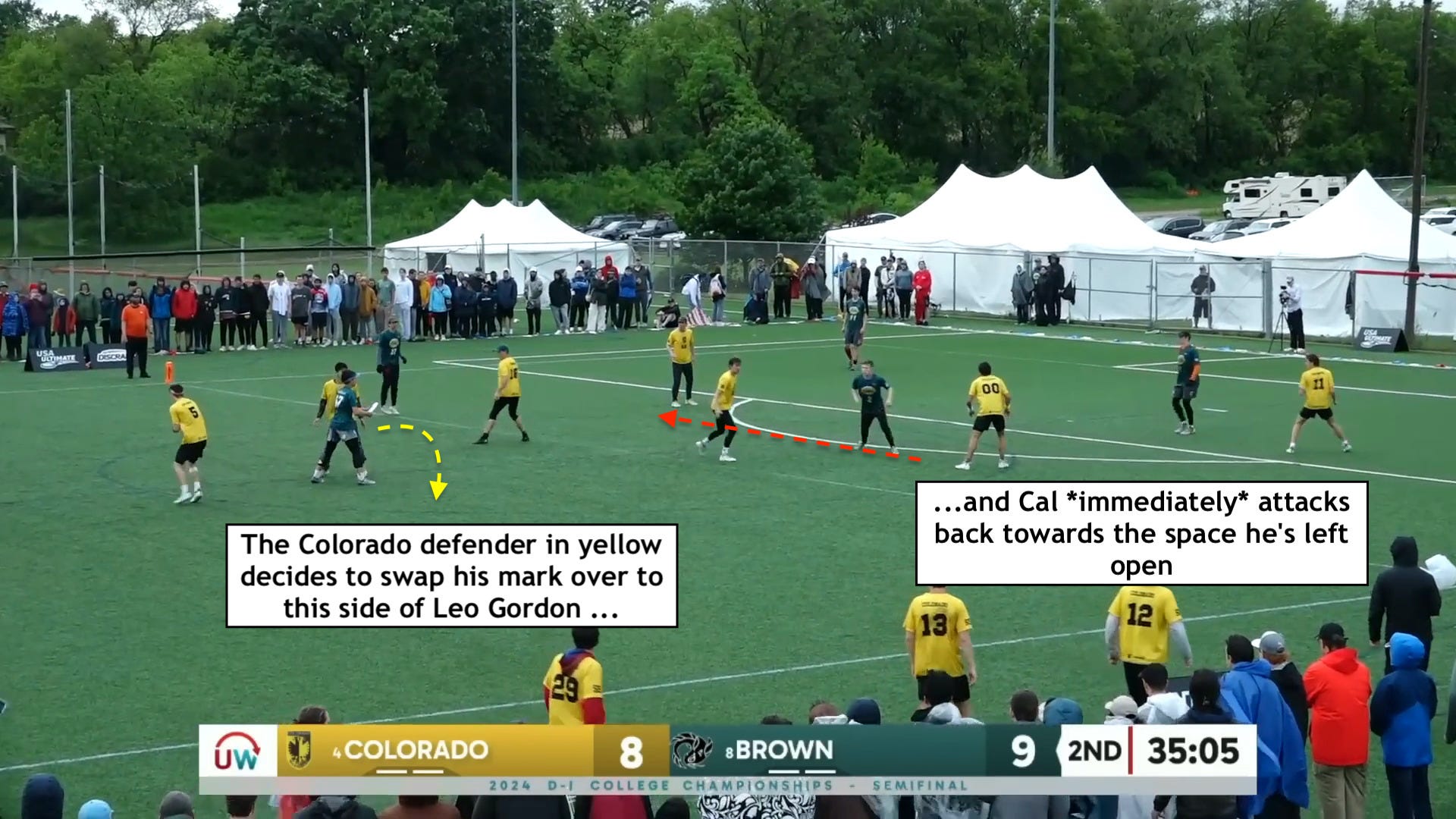
As always, this is the kind of skill that should happen subconsciously. I’m not out there thinking “oh, I have to read what the mark defender’s doing now”. Instead I just...go to places where I feel like the thrower will be able to get me the disc. But hopefully writing this all down (i.e., making the intuitive explicit) will help some people realize an opportunity to develop a new skill.
I didn’t want to say “sells out” b/c Chastain stays somewhat in control…
Friendly reminder that Jake Smart hates the phrase ‘clear out’
The cut/marking at 37:10 of the same world games final was another example in my friend’s video