Against starting your offense with something hard
Let your small dominoes knock down big dominoes
Anecdotally, it surprises me how many first-throw turnovers I see. The start of possessions is a critical moment for the offense. It’s hard to get open against a defense that’s had time to set up1, so offenses have to work harder to complete a first pass than they have to work when the disc is already in flow.
I think “traditional” frisbee offenses often make this challenging moment even harder than it needs to be by initiating the offense with high-degree-of-difficulty (higher than necessary, at least) passes.
For example, Brown University’s 2022 college championship game loss to UNC started with two consecutive turnovers on unnecessarily difficult throws (clip below). They lost that game, but came back two years later to win with a retooled offense that made things look easy.
I’d rather see offenses start with something easy as possible against a set defense. That could be “dominator”-style handler movement to get the disc to players in motion who can more easily attack the breakside with throws. It could be starting with short downfield cuts from the front of the stack instead of long downfield cuts from the back of the stack. It also means being happy to punish handler poaches with short gains on swings instead of wasting time staring downfield trying to throw past the poach.
We need to recognize (as some teams already do) that offense against a set D is hard, and that the path to efficiency is doing easy things when the D has the advantage. Let’s look at some examples, and some further thoughts about the mindsets at play here.
Dominoes
Basketball coaches (as I’ve mentioned before) use the concept of dominoes:...once you’ve got a small advantage—once you’ve knocked over the first domino—can you keep the dominoes falling until you reach the end of the chain, i.e. a high quality shot?
But there’s one thing I think could be improved about that metaphor. To me, the default mental image for a “row of dominoes” is something like this:

But what we really should be thinking about is a domino chain that looks like this:

The real power of a domino chain is not that one domino can knock over the next one, but that a small domino with momentum can knock over progressively bigger dominoes.
Our goal shouldn’t be to initiate the possession by gaining an immediate big advantage and then maintaining that advantage at a constant size. Possessions in basketball don’t (usually) start by throwing some crazy no-look pass through four defenders. They start with, say, a jab step that gets a defender to move 4 inches backwards.
When the defense is set, that’s when it’s hardest to play offense. So really what we should be doing is gaining a tiny advantage against a well-prepared defense, then a slightly bigger advantage against a slightly out of position defense, and so on until we reach the “full-sized” dominoes at the end—an easy goal.
(I do think dominoes are still a useful metaphor even if all the dominoes are the same size—you still want to play quickly to keep advantages rolling instead of letting your momentum stop—but the real power of the domino chain comes in starting with a tiny push that eventually ends with toppling a huge obstacle.)
Some examples
Let’s look at a few examples of first throw turnovers and/or first throw stagnation, plus a couple times where teams did things I like more.
Here’s a sequence I noted from a recent 2026 College Nationals game. The UNC handler picks up the disc and stares right into a poach defender for a solid 4 seconds before turning and shoveling a pass to the other handler. Even though the poaching defender was probably ~15 yards away from the reset handler, UNC doesn’t really manage to generate any advantage out of it (they don’t gain yards and they don’t really gain free access to the break side).
Later in the game, the UNC center handler throws a first throw turn (for not the first time, eg see here or here) and one of the announcers comments on it: “It’s just another first throw turn...I think they’re asking her to do a lot, and maybe too much, because it’s just giving the disc back.”
The 2025 South Central Regional Final between Johnny Bravo and Doublewide that I was watching recently likewise had two first throw turns—one from each team—both on throws trying to reach the breakside.
The 2025 Toronto Rush started out a game against the Boston Glory with a first throw turnover. It doesn’t seem like the highest degree-of-difficulty throw, and you can see in the background trees that there’s some swirling wind, but they did look away from an open pass back to the handler on the open side in order to throw a pass to the break side.
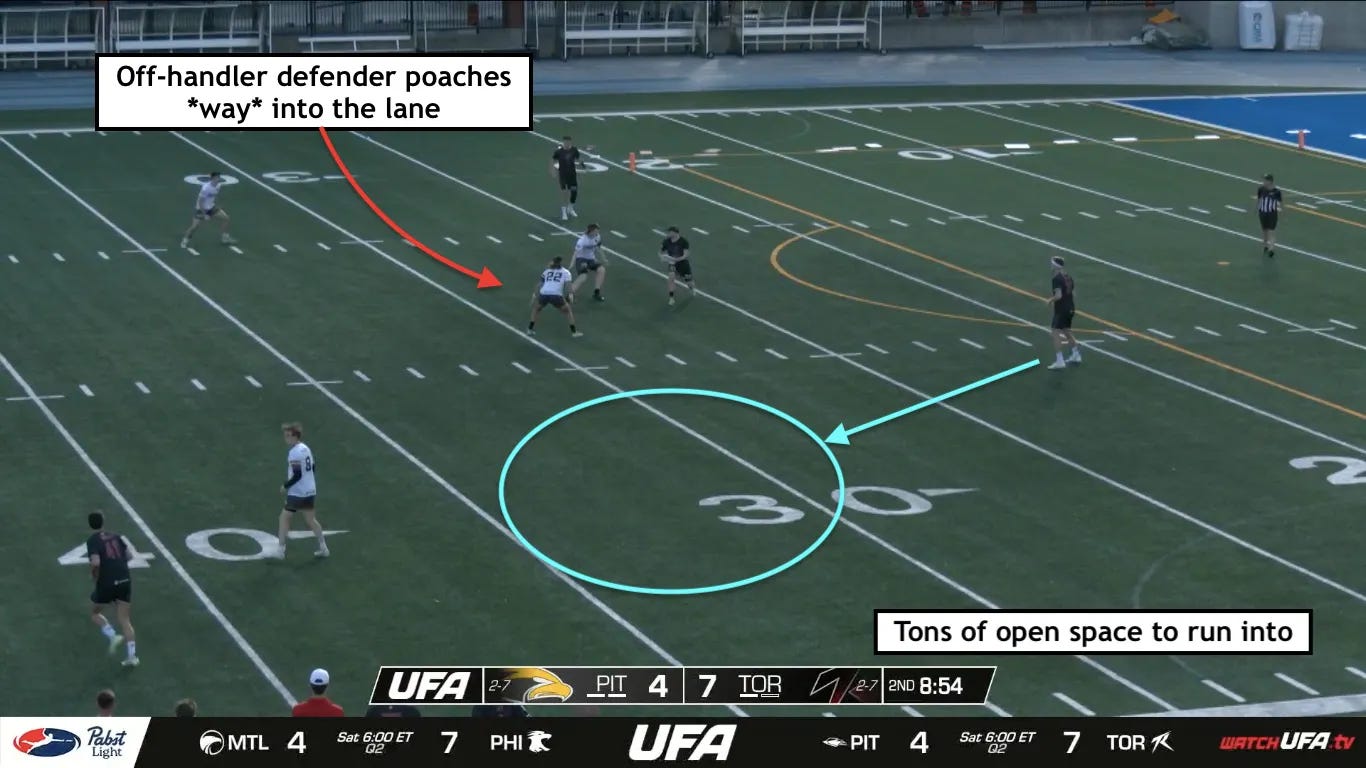
And here’s an example from the UFA that I used in a previous article. Much like the first clip above, the handler looks downfield a little too long, and doesn’t really generate any advantage out of some pretty extreme handler poaching:
This clip from the 2025 U-24 world championship match has the honor of involving 2 first throw turnovers (followed by a close call, that’s only saved from being a third consecutive first-throw turnover because it’s caught by an unintended receiver). The first throw, by Chloe Hakimi, isn’t a break throw like some of the examples we saw before, but it’s a bit aggressive to throw a first pass into basically a double team on a player who’s got barely a half-step of separation. (The announcer says: “quickly picked up...and thrown away. Somewhat surprising...” But I’d have to disagree...I think it’s actually less surprising than it should be.)
After the US turn, Canada hucks it deep on the first throw. Not the craziest decision as the cutter had some separation, but not a great throw. Then the US nearly turns the disc over on an overthrown 25-yard under caught by an unintended receiver downfield. But there was really no need to default to the big 25-yard throw when there was so much open space in front of the thrower.
Let’s take this clip from 2022 Medellin Revolution as an example of what I’d like to see more of. The disc is “centered” after a pull, but, instead of the handler turning around and looking downfield for the big gain, there’s two immediate swing passes and then another swing back to the middle before the disc makes its way to Levke Walczak cutting from downfield. The extra bit of side-to-side passing leaves Levke’s defender just a bit more unsure where the threatening spaces are, making Levke’s juke just a bit more effective:
The New York Empire have also been doing a good job of starting small, based on a quick skim through one of their recently streamed games, see here or here or here for example.
Here’s one final clip, this time from universe point at 2025 club nationals. I don’t think this is the most egregious example, it’s just a good defensive play as much as anything. But I don’t love running an offense where no player even gets within 10 yards of the thrower. With the disc stuck on the sideline no less, a known danger zone for offenses everywhere.
Why not just isolate Ella Juengst 5 yards in front of the disc, then focus on the bigger chunks once you get the disc off the sideline? Compare that to Revolver, who, when they get stuck on the sideline after a pull in their 2025 nationals run, immediately throw a short backwards pass on stall zero:
Hero-ism
Let’s change tack a bit and talk about the psychology of these kinds of decisions.
In her book Right Kind of Wrong (subtitle: The Science of Failing Well), author Amy Edmondson writes about the “hero feeling” that comes from individuals finding workarounds to the problems they face, and how those feelings of heroism cause people to be less interested in fixing the system that caused heroics to be required in the first place. It’s a longer quote but I think it really applies to situations we see on the frisbee field too:
Boston University professor Anita Tucker...observed that nurses confronted “process failures” surprisingly often—almost one an hour. A process failure was anything that disrupted a nurse’s ability to complete a task, such as an unexpected supply shortage in bed linens or medications. The nurses were acutely aware of these frustrating daily hurdles. Their jobs were hard enough!
...What we called “first-order problem-solving” was a work-around to complete the task without addressing causes of the problem. For example, a nurse working the night shift who ran out of clean linens to change her patients’ beds simply walked to another unit that had linens and took from their supply. Problem solved. The work-around required minimal time and effort. She’d taken the initiative and been resourceful in caring for her patients.
Never mind that the other unit was now in short supply...Like all quick fixes, the nurses’ work-arounds created an illusion of effectiveness. Confront a problem, implement a work-around, get on with your day. End of story. Except that it’s not. When we analyzed the hospital nursing care as a system, we realized that work-arounds, despite being effective in the short term, actually made the system worse over time...
...many of the nurses we spoke to described a “hero feeling” from using work-arounds that ensured that patients got the care they deserved. Whether walking down the hall to locate the extra linens or going to the pharmacy to obtain a missing drug, the nurses derived gratification from overcoming the many little hurdles their jobs threw in their path. But this hero feeling lessened their motivation to engage in second-order problem-solving [that is, improving the larger system so the workarounds aren’t necessary in the first place]...
Much like getting linens from another department is *a* solution for nurses whose own supply closet is empty, attempting a hard pass to the breakside is certainly *a* way to manufacture an advantage for your offense. But I question whether it’s the most effective way. Could a systemic change more consistently manufacture those easy advantages?
I expect that “hero feeling” exists on the frisbee field, too. Players who take pride in being able to break the mark (a first-order solution to the problem of beating the defense) are less interested in switching to an offensive system that doesn’t require them to complete such high degree-of-difficulty throws (which would be a second-order solution to the problem of good defense).
But, as other sports have shown us, offenses are more robust and more effective when they’re built on strong systemic principles instead of on individual brilliance. (Which is not to say individual brilliance is bad! Just that it shouldn’t be your main offensive system). These supremely talented players would look even better in dominoes-based, start-easy systems that manufacture easy opportunities for them instead of big-chunk-only systems that result in occasional early turnovers. (See: Mac Hecht being ready and willing to throw a backwards pass to get off the sideline on stall zero.)
Abusing poaches is your offense
To me, one of the lessons here is that offenses need to learn to be happy to make the defense pay, immediately, for poaching. Especially the kinds of obvious handler poaching we saw in a couple of these clips.
Too many handlers still seem to think their job is to throw the disc downfield, and they try a little too hard not to change that job description, even when the defense puts an extra player in the way.
But really the handler’s job is to make the defense pay, in whatever way the defense lets them. It’s only by showing the defense that you know how to punish their poaching that you’ll earn the right to throw the disc downfield. If the defense shuts down plan A (as any smart defense would do), you’ll maximize your chances to use plan A by immediately showing the defense you’re perfectly happy to go with plan B, too.
Caveats
The plural of anecdote is not data, as they say, so the fact I can find ~6 examples of first throw turnovers admittedly isn’t proof of anything. I’m sure there are tons more examples of turnovers that happened trying to start too big, but also there are many examples of turnovers that happened when doing “easy” stuff, too.
So I’m not offended if a few examples aren’t enough to fully convince you. But I do think there’s a real tendency here. Whether it’s a tendency to always look downfield first, or a tendency to personally enjoy successfully doing hard things like breaking the mark, or just the systemic style of playing “big chunk” offense looking for 25-yard gains and breakmark throws that solve problems with one pass instead of a system that builds up advantages to make gaining yards easy.
And I’m not saying never, ever make a hard throw. I just suspect the hard/easy ratio is off. The threat of a big throw opens up the small stuff, and the threat of small stuff opens up the big stuff, too. I’m just saying it seems like not enough teams do a good job threatening (and carrying out the threat of) the small stuff.
Final thoughts
I’d like to see the frisbee community establish more cultural memes around the idea of starting with something easy instead of something hard.
Partly that means more willingness to abuse poaches immediately instead of looking downfield past them.
Partly that could mean embracing a more “dominator” style at the start of points, to get the defense reacting to a few easy short passes before attacking downfield.
Or it could mean adapting Brown’s 2024 style with short, “front of stack”-esque isolation play, even if only when initiating the offense.
And partly it means embracing the “dominoes” concept as a mental model of building up your offensive attack. (dominator for dominoes?)
What do y’all think, do offenses actually turn it over on the first pass more than they should, or does it happen at the appropriate rate and I just cherry-picked the few examples I found over the course of a couple years of frisbee watching? (I don’t feel like I had to work that hard to find these examples...)
Of course, if you can just start before the defense is set, I always recommend it. But that won’t always be an option.
First throw turnovers are statistically most likely because first throws are the most common throws. Much in the same way car accidents are much more likely to take place nearby your place of residence.
I can't estimate the distribution but it wouldn't be surprising if it were logarithmic in shape.
Does feel like there's a bit of survivorship bias at play here. But I do agree with the overall premise of rejecting the work around or hero feeling and embracing the simple stuff.
Agree with basically all of the article! Just one question: is this not considered an easy throw in your mind? https://www.youtube.com/live/VECI6-nS96Y?t=1851&utm_source=substack&utm_medium=email Maybe I'm not aware of the wind conditions, but an unguarded throw to the force side(?, the mark seems flat at best) seems like low hanging fruit (compared to the doublewide bravo examples that were somewhat defended). Maybe the cutter should have come a little shallower to give an easier option if it was very windy