Thinking carefully about defensive overplays
When avoiding a bad play is more valuable than making a good play
It’s a relatively well-known trope in the NFL that the best cornerbacks (read: cutter defenders) aren’t necessarily the ones that get the most interceptions (read: D’s). The best cornerbacks don’t get the chance to get lots of interceptions, because they never let the person they’re guarding get open in the first place.
Here’s a 2014 article from FiveThirtyEight:
Take the great Deion Sanders. According to Pro-Football-Reference’s Approximate Value (a measure of an NFL player’s overall value to his team), Sanders peaked during the 1996 season, when he was named first-team All-Pro while playing every game for the Dallas Cowboys. Yet that same season, he tied his career-low for interceptions in a season (two) — even a broken-down, 37-year-old Sanders had more picks with the Baltimore Ravens in 2004...The same was true for [Darrelle] Revis last season.
Someone could (and maybe should) make the exact same point about defense in frisbee. But I’m taking things in a slightly different, but related, direction today. A more general idea we could draw from this example is “defense isn’t just about the plays that you make”. There’s lots to good defense that doesn’t show up in the stat sheet.
The theme today is that good defense is often about the mistakes that you don’t make.
In my opinion, frisbee culture too often makes the mistake of encouraging “hard” defense, whether or not it’s successful.
(For example, kinda: a day after I started writing this, I saw this post from Garrett Bush on Instagram, captioned “Imagine if he got this🤯”. Well, sure, but as the old saying goes, if my grandmother had wheels, she would have been a bike. I don’t deny it’s a very impressive leap and very cool video, but that doesn’t necessarily make it good defense.)
Did you go for that layout D? That was good defensive effort, even though it didn’t work (some people might say). Were you active on the mark? That’s good D, even if they still completed the throw. It matters less (I’ve heard people suggest) whether you actually make the play, as long as you set the tone.
This is not the smartest way to play defense. The best defenders are the best and knowing what plays they can make—and making them. But they’re also the best at correctly determining which plays they can’t make, and not attempting them.
To be fair, I’m not saying you should get 100% of the D’s you attempt to get. Obviously there’s some line, somewhere below 100%, above which it’s rational to attempt a block even if you end up failing. I’m just saying that I think this line is often too low, and we too often praise people for simply trying to make a play on defense even if they fail and end up out of position.
Let’s start with some marking examples. First, a clip from Dena Elimelech’s appearance on the Pod Practice podcast:
Dena watches herself lay out when the thrower pump fakes a throw to the breakside. She says “ooh, that’s embarrassing!”, but then Alex Atkins replies “selling out on the mark, that’s awesome!”.
I don’t want to read too much into what he means by that remark—there’s a good chance he’s just in “having fun chatting with a friend mode” and not “carefully sharing his frisbee takes” mode—but whether he 100% means it or not, I think it exemplifies the mindset I mentioned above of players, coaches, and commentators praising effort, even if that effort ended up being misplaced or ineffective.
The thrower eventually throws a flick back to the middle of the field, not really gaining yards, and then jogs off downfield away from the disc. In other words, nothing bad really happens for the Fury defense here. But that won’t be the case in our other examples.
For a subtler marking mistake that does get punished by the offense, let’s head to the 2025 World Games semifinal, Canada vs. Germany. Check out the video below, paying attention especially to the last pass before the assist. A great replay is included at the end of this clip, too:
A screenshot is worth 1000 words, as they say:
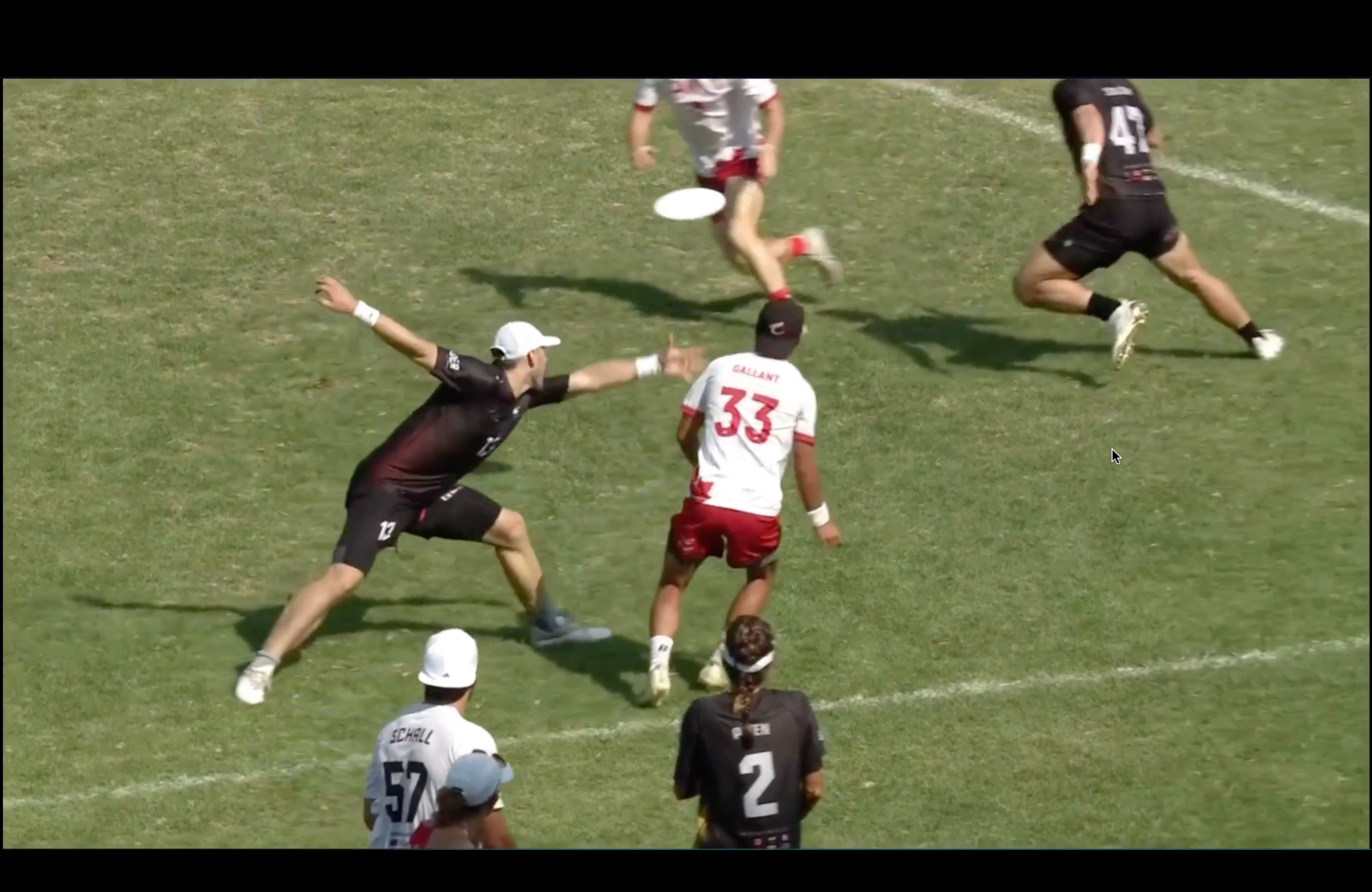
The German defender can’t stop themselves from lunging at a handblock attempt, even though they were nowhere near getting it. That (not to mention how they make matters worse by ballwatching just a moment too long) leaves the defender off-balance enough that Marty Gallant simply accelerates forwards into the endzone for a totally unguarded score.
The Toronto Rush gave up a very similar goal in an early 2025 game against the Philadelphia Phoenix. This time, it’s a backhand inside break back to the middle of the field, and it happens from further out, but otherwise it’s a mirror image of the last example: the marker reaches out to attempt a handblock on a disc they were never all that close to (and ballwatches for just a moment), gets off balance, and the thrower immediately takes off downfield for a wide open goal. The reach happens 7 seconds in:
The scorer was 20+ yards out when they threw the disc and took off—I think it’s important to understand how that one little reach that got the marker off balance was actually a 20-yard mistake.
I think these two plays were clearly more “instinct” than they were a conscious decision to attempt to get a D. I’ve probably said this before, but I think great defense is about learning to control your desire to just react to everything the offense does.
(Also, hear how the announcer says “Toronto [is] playing really great D...” at the exact moment this mistake is being made. I don’t think they were actually talking about the mark being active, but nonetheless it’s a little ironic.)
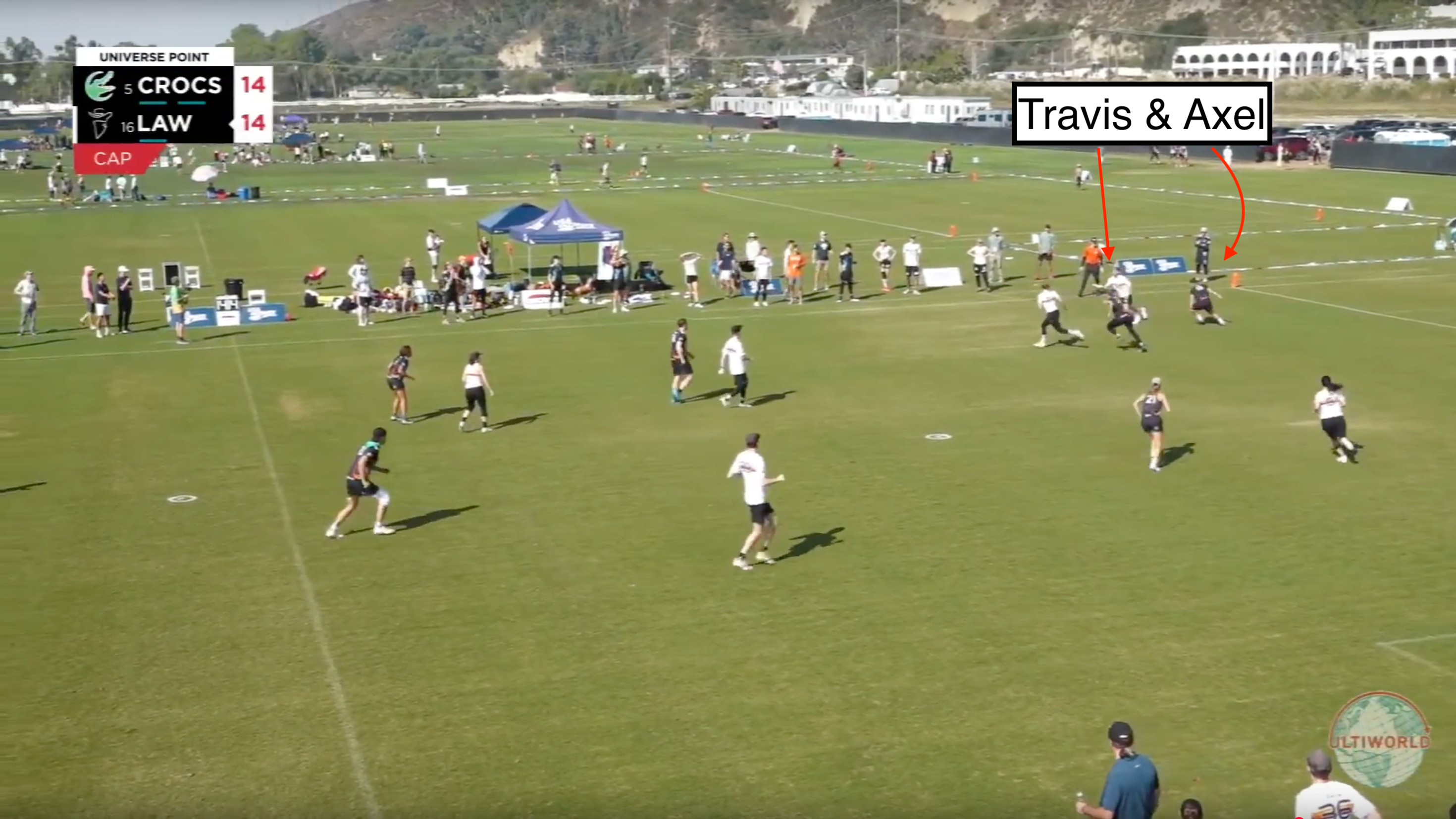
Let’s look at a couple cutter defenders now. On universe point in pool play at 2023 US Nationals, Axel Agami Contreras goes for the run through block on a swing pass to Travis Dunn. He *just* misses and ends up maybe two yards behind Travis. But Dunn reacts quickly, getting rid of the disc and cutting upline before Agami Contreras can get back in position.
Look at where Dunn is when he catches the disc after Agami Contreras’s run through attempt:
and where he eventually sets his pivot foot after catching the upline return pass:
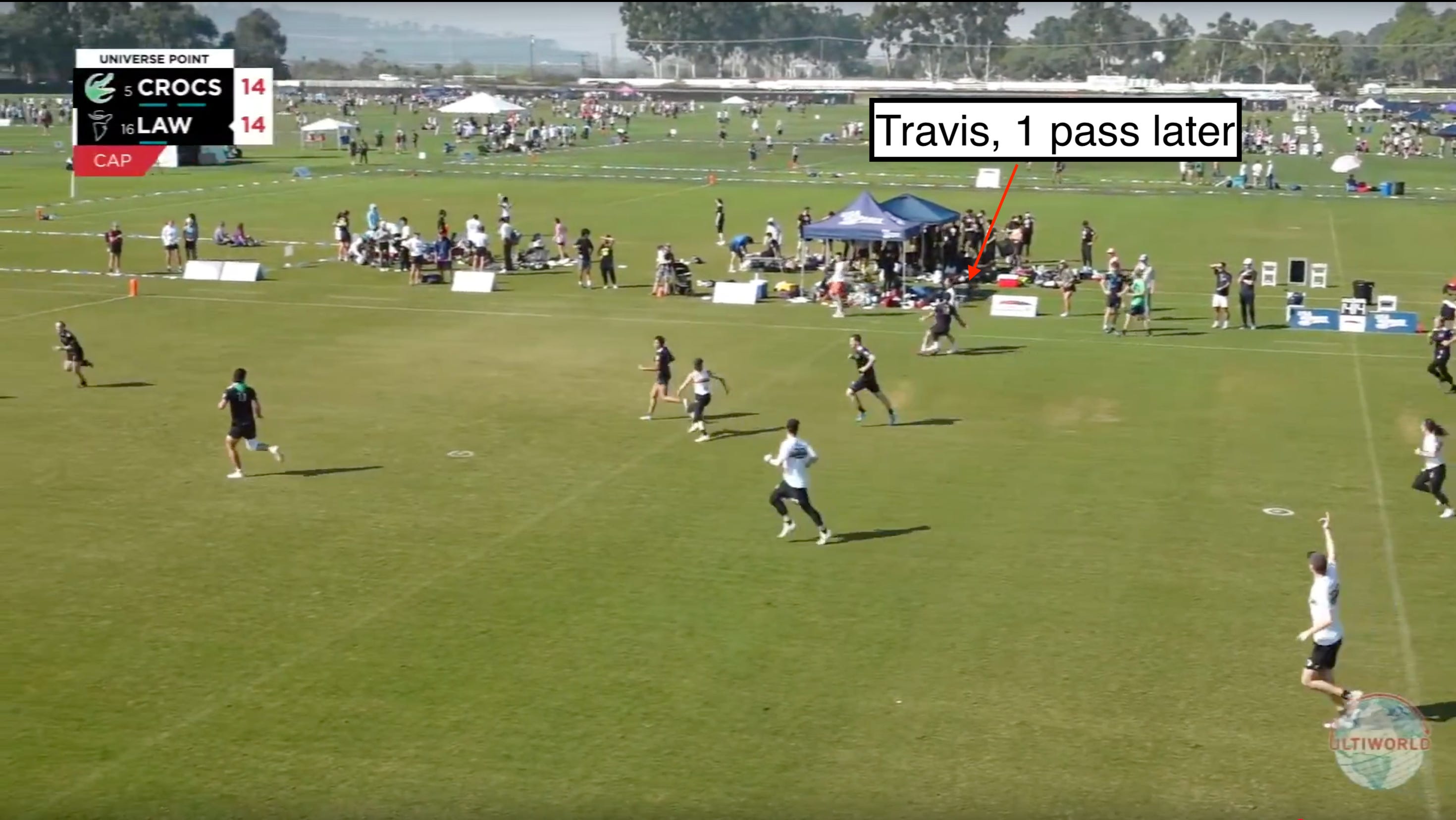
This is basically a 40-yard mistake by the defense! If he was in position to mark, he would’ve even had a good chance to stop Dunn from throwing the upline pass he throws in the first place.
You hear the announcer saying “Agami Contreras was almost on it”. Not exactly praising him, but it feels close to those same cultural norms of “hey, you tried to do something cool, that’s pretty impressive”—there isn’t really any hint of “hey, you just got out of position and it cost your team 40 yards on the game-deciding point”.
A very similar play to this happened more recently, on universe point of the gold medal game of the 2025 World Games. Felix captured it nicely in his finals recap video for Hive Ultimate:
I don’t have much to add here that I didn’t say about the Lawless game above. If you look at the situation before and after, this single mistake cost the defense 30+ yards and led directly to the game-winning goal.
Of course, I’m not saying these mistakes are the only reason the defense gave up the score in each clip. Marty Gallant was less than 10 yards from the endzone when he caught his defender reaching—Team Canada probably had a 90% chance of scoring anyway, so this error was worth 0.1 points, at most. Lawless was ~65 yards from the endzone when Agami Contreras overran the swing pass, and Lawless still hadn’t scored when he caught back up, so it may have been a 0.25-0.35 point error (assuming a baseline hold percentage of about 60% and a 85-95% chance to score from Lawless’s position after the mistake).
But these mistakes add up over the course of a game & tournament. Great defense is adding up those 0.1-point advantages, over and over again at every opportunity.
And of course, overplaying won’t always be punished. Dena Elimelech’s overplay wasn’t punished at all. Sometimes you’ll be playing against attackers who aren’t aware enough and/or locked-in enough to punish you for small mistakes. Other times, there’s just no one open and even a smart offensive player will have nothing they can do with the disc to punish your overplay in time.
So: sometimes defense is more about not making mistakes—and living to fight another day—than it is about making the big play. Sometimes the best thing to do is to do nothing, and wait a little longer for the right moment to strike:
(Yes, I’ve used this clip before)
It’s cool to make the big play, but great defenders are also obsessed with always being in the right place. This is yet another example of Be good at frisbee, not just frisbee-like things—people focus on the flashy, easy-to-train skill. There’s no column in the stat sheet for “successful layout percentage” (though, there could be TBH). But I’d wager that being great at deciding when to layout (and when not to) is a much more important skill than being great at laying out.
[Update (2025-12-30)]:
My post on Revolver vs. Machine pointed out a few overplays from that game, namely:
Unsuccessful runthrough near the sideline at 18:43 (offense didn’t really have any way to punish)
Two consecutive unsuccessful layouts by Revolver starting at 1:20:32 (only semi-exploited by the offense, Revolver was working hard to recover)
An unsuccessful point block attempt (at 1:22:45) directly before Mac Hecht gets the disc for the game-winning assist. Hecht smartly runs away from the defender on the ground, forcing them to scramble and leading to defensive confusion on the switches.
Dexter Clyburn jumping to D a hammer where he wasn’t even close to at 1:13:45 (pretty clearly exploited by the offense for the score):
Here’s what I wrote about this example in the post: “he could’ve
(a) realized early that he wasn’t gonna get there, and started backing off to guard the next pass, preventing the score, or
(b) realized late that he wasn’t gonna get there and stopped early to at least put a smothering mark on,
but instead he (c) jumps at a disc he’s multiple feet away from D’ing and isn’t back to good marking position in time to stop the scoring throw from going off.
https://www.instagram.com/reel/DSXPdEOiq8-/?igsh=MWRvanZmZHEwd2Yycw==
This clip from the SEA games supports your case
Primum non nocere !