Caring about getting downfield of the disc
Winning frisbee's "mini-transitions"
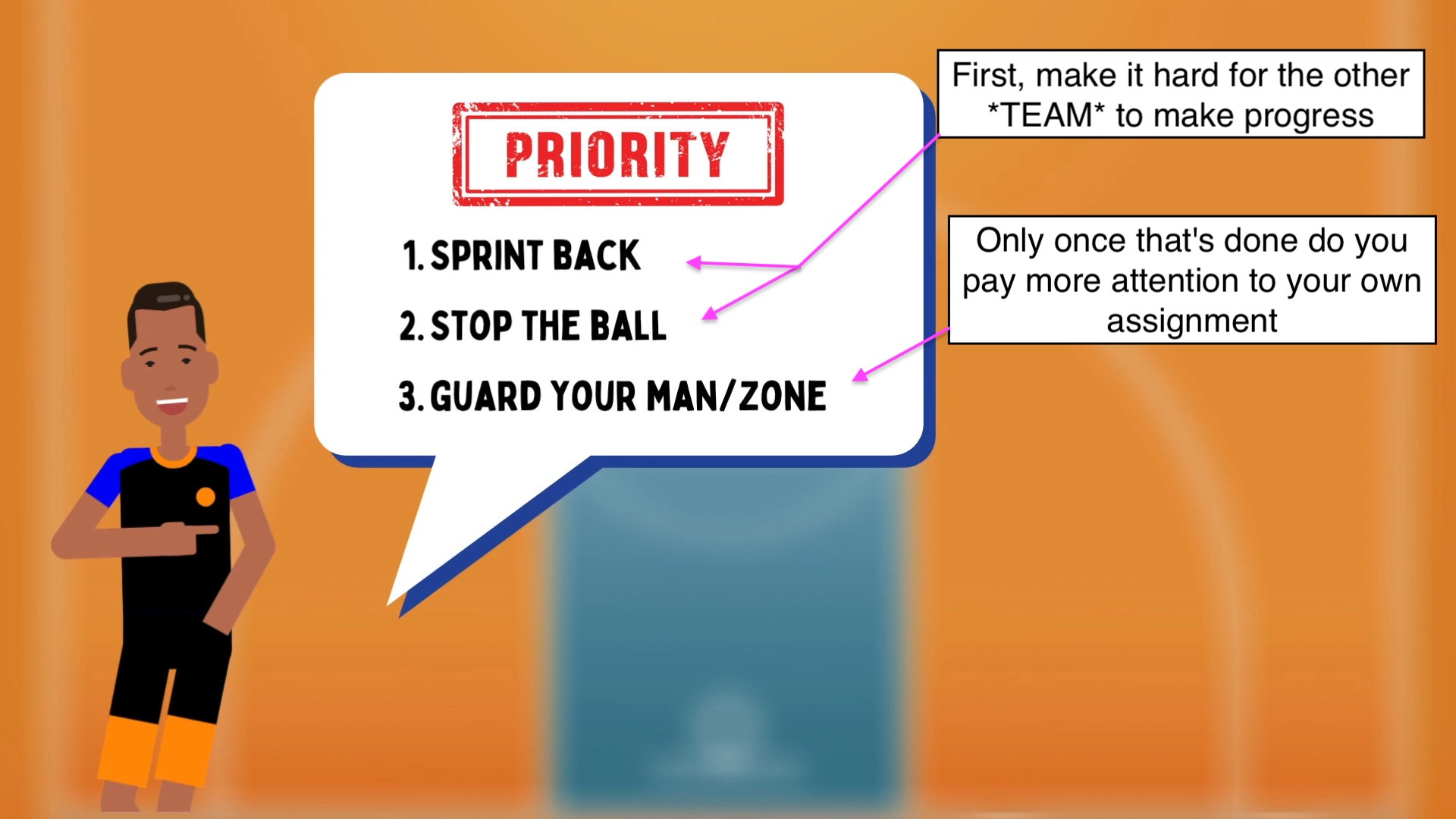
Everyone who plays basketball learns basically the same approach to playing fast break defense. The first step is to simply get back on defense and slow the progress of the ball so the offense can’t score easy points. We do that regardless of who is guarding who—whatever matchup you get stuck with is better than giving up an easy score. IF AND ONLY IF your team succeeds at that first task, then you can start worrying about “matching up with your man”.
For example, here’s a video of Hall of Fame coach John Calipari teaching a defensive transition drill. Note how he points out that “you’re guarding whoever you’re guarding” on defense. The drill is designed, in fact, to make it impossible for the defense to know in advance where it’ll have to concentrate its efforts1. Here’s another video with a screenshot that matches how I learned to play transition defense:
Frisbee is full of mini-transitions
But I think there’s an important difference between ultimate and basketball that actually makes this even more important in ultimate. Because a basketball court is so small, the ball will basically never be 10 yards or more downfield (downcourt) of you, except during a fast break.
In frisbee on the other hand, the offense will often complete passes (deep in cuts, short hucks, basically any sequence of 2-3 passes in a row that gain yards) that leave defenders 10 or more yards behind the play.
The typical ultimate player’s response here is to jog downfield at whatever speed the offensive player they’re guarding is jogging downfield. This is poor defense. You should be trying to accelerate away from the player you’re guarding, in order to get downfield and clog up passing lanes while your assignment is still in a position where the thrower wouldn’t want to throw to them.
It’s good offense for the offensive players to jog downfield. The offense is happy for the 2-4 players still involved in the play to have all that space to work with. But on the defensive side, you should be denying them those same advantages.
There’s a more general point here, too. I think frisbee defenses still generally underrate the yardage game.
As I said in my defensive philosophies post:
...even in high-level frisbee, the simplest example of what you should and shouldn’t give up is still one of the best strategies: make it hard for the offense to get close to the end zone. Even if that means you make it easier for the offense to go backwards.
There’s quite literally no point in stopping the offense from going backwards if you can’t stop them from going forwards at a high enough rate. An offense can literally never score on you by throwing backwards. (With the possible exception of, like, this throw.)2
This is one thing that zone defenses in frisbee get right—when you say “we’re playing zone”, suddenly many frisbee players manage to understand that being 10+ yards in the backfield is a bad thing that you should hustle to fix. But as Thinking Basketball and Shane Battier have pointed out, good man defense includes zone defense principles, and vice versa. Getting downfield of the disc is a ‘zone principle’ that most frisbee man defenses still haven’t fully incorporated.
So let’s look at a few examples where players do or don’t work hard to get downfield of the disc.
Finney
Here’s Carolyn Finney from the 2024 US Women’s US National final:
Finney is marking the thrower, but when the throw goes up she immediately accelerates away from her assignment and rushes to get downfield of the disc:
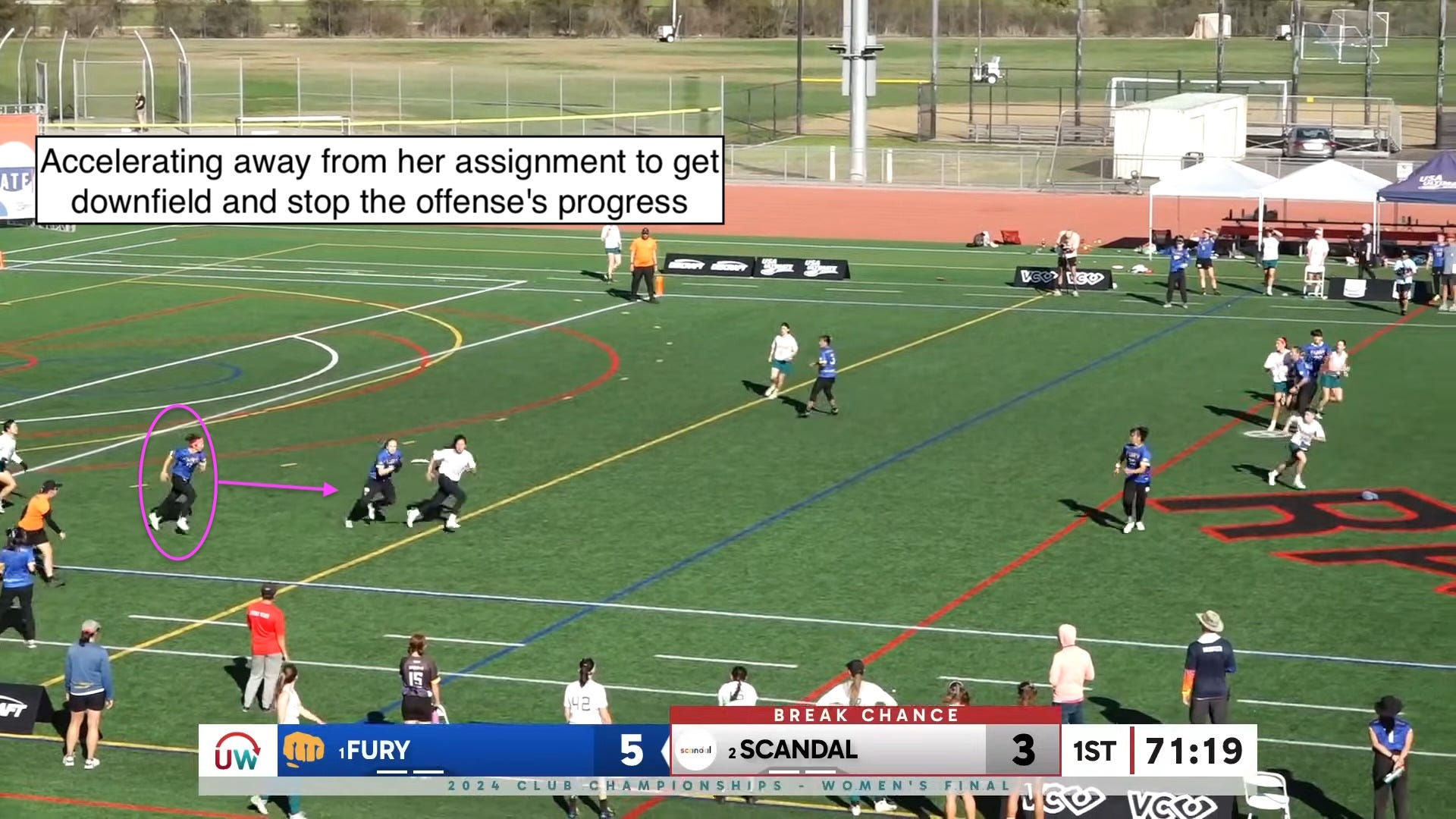
The turnover that results is seemingly due to an illegal double team by Finney that the next thrower didn’t see before releasing the disc. I support playing by the rules, so I’m not saying you should do everything exactly like Finney did here, but I think the effort to get downfield far before her assignment did is exemplary.
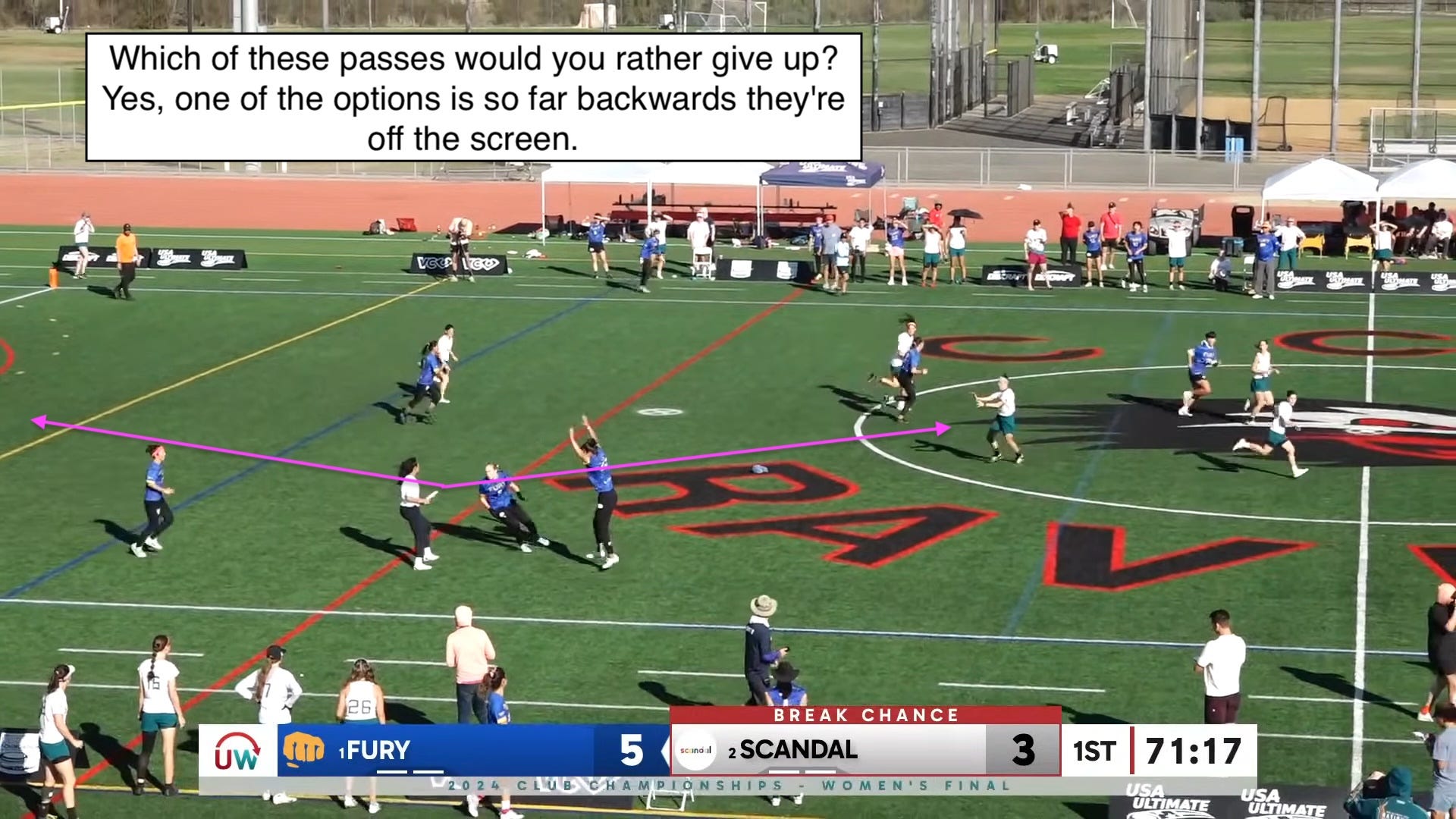
To put it another way, which of these wide open options would Fury, as a team, rather give up? I think the answer should be pretty obvious:
A post-turnover transition
Now here’s an example of what not to do, from Fury’s previous game in the 2024 semifinals.
On the last point of the game, a Molly Brown drop on a swing pass means that Molly is on defense with multiple players far behind the disc. This is a pure transition situation, just like the basketball videos we saw at the beginning of the article.
I’m not very impressed by any of the deepest Molly Brown defenders on this play, who all could’ve hustled harder to get back on defense. But I especially want to draw your attention to one player who watched the turnover happen:
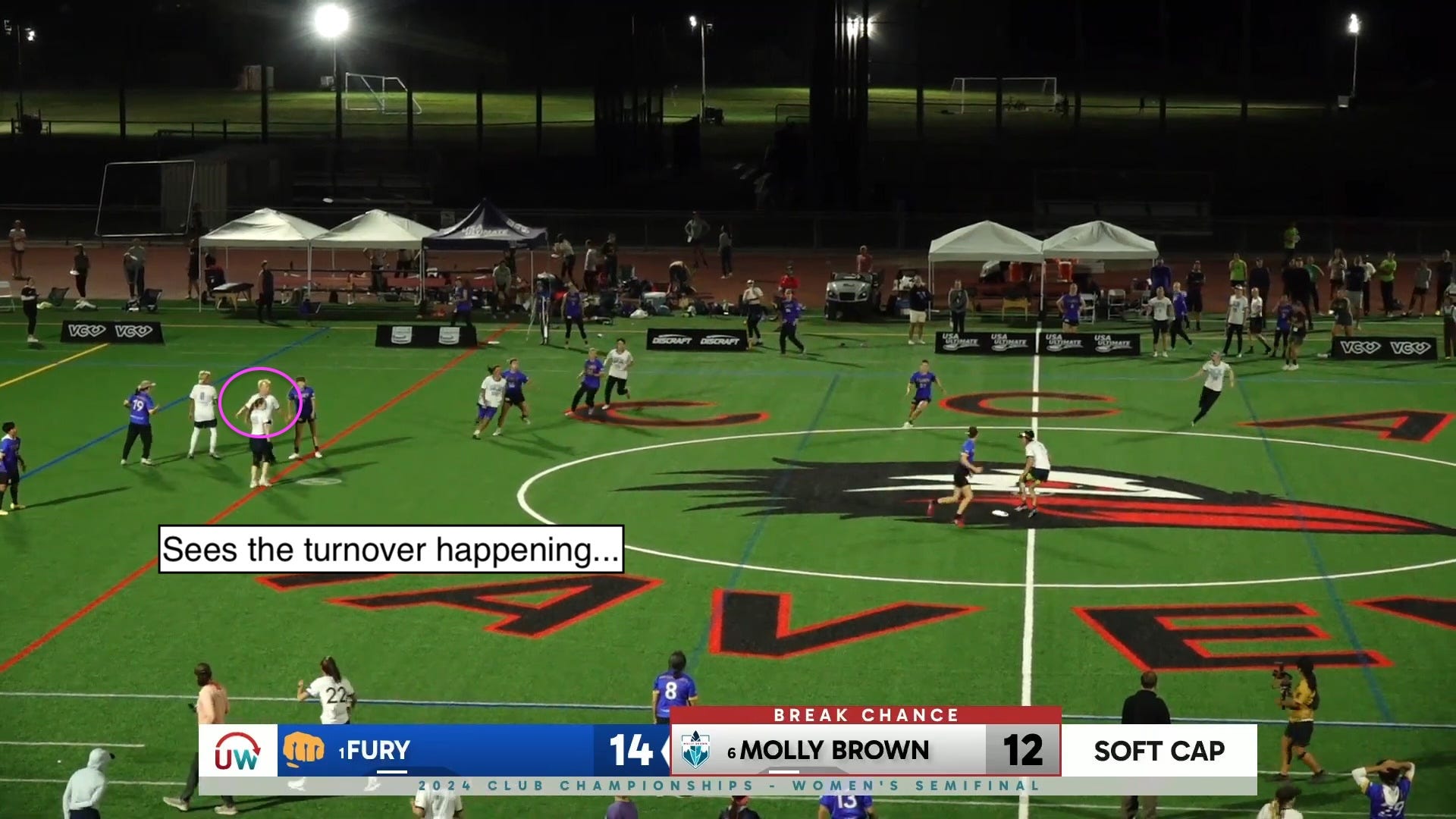
and then, while about 20 yards behind the disc, turned their back to the disc to focus on “their assignment”:
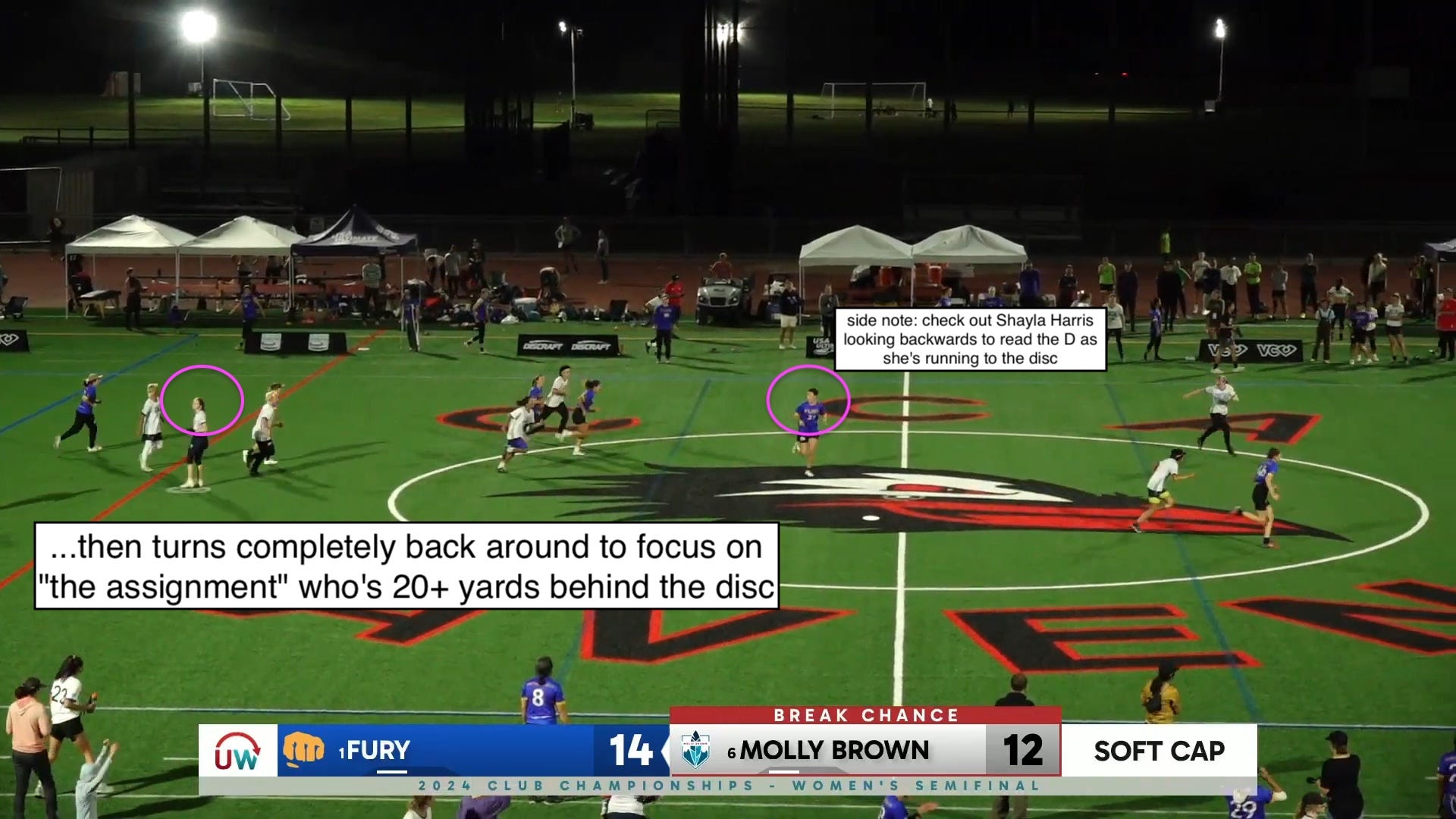
Look, could they have actually made an impact on this play? Maybe not. I might even say probably not. But it’s the last point of your season—it’s the last pass of your season. You need to be selling out to stop the offense from making progress. Whatever last ditch effort you can give to try to make an impact on the play is worth it to make your season last a couple passes longer. Sure, your person didn’t catch the next pass...but now your season is over, is that really what you wanted?
GONA
There’s been some discussion in the English-speaking ultimate world lately about Japanese team GONA, after Hive Ultimate made some content about them. For example, see this recent Reddit thread. They run an “attack from the back” offense where multiple players often start behind the disc:
I like what GONA is doing, but I also think poor defense is making it look better than it should.
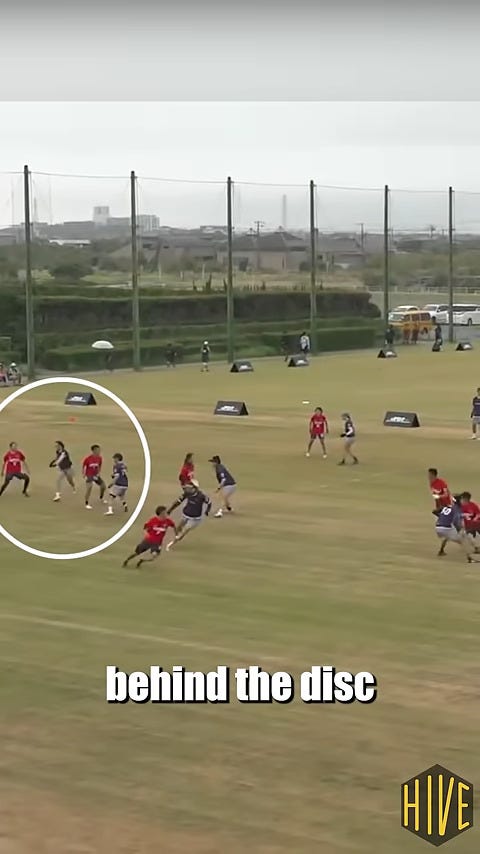

The anonymous YouTube commenter gets it right on this one: if they want to be behind the disc...let them! It shouldn’t matter if you’ve never seen this exact offense—”I’m going to sag off them unless they’re actually making themselves a threat to help the offense make progress” should be a core defensive principle you apply no matter the offense’s formation.
A superdump
This play happened in Toronto Rush’s first game of the 2025 season. DC is stuck on the sideline late in the game, and instead of staying tight to the far side handler, Rush’s Luc Comire (#15, near the middle of the screen 6-12 seconds into the video) sags downfield and back towards the middle of the field:
DC completes the “superdump”, losing 20-25 yards while swinging the disc across the field. But I wanted to include this clip because it’s a memorable pass and because this, in my opinion, is a win for the defense. Not every instance of you getting downfield of the disc is going to end with a poach block. When you can force the offense to go backwards where they otherwise would’ve gone forwards, you’ve made defensive success slightly more likely.
Japan 2016
A recent Hive Ultimate video featured another Finney-like example of a player actually hustling to get downfield of the disc:
I love this one for the same reasons I love the Carolyn Finney example above. Check out the visible effort he’s putting into not just staying with his assignment, but accelerating away from him. He makes a quick peek back at the player he’s guarding, but his main focus is rightly on the bigger threats—the yardage gaining threats.
As in the Finney example, we can ask ourselves the question of which of these passes would we rather give up:
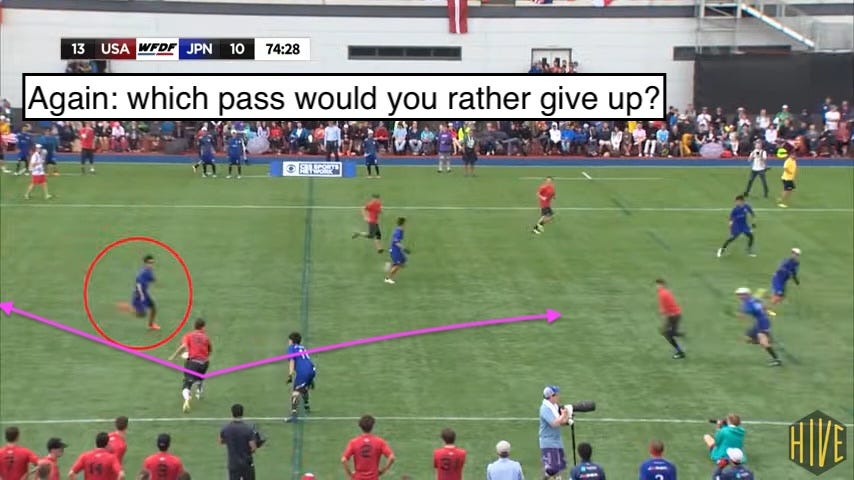
The answer to that question is clear to me. Do you play frisbee like it’s clear to you?
A couple ‘mini-transitions’
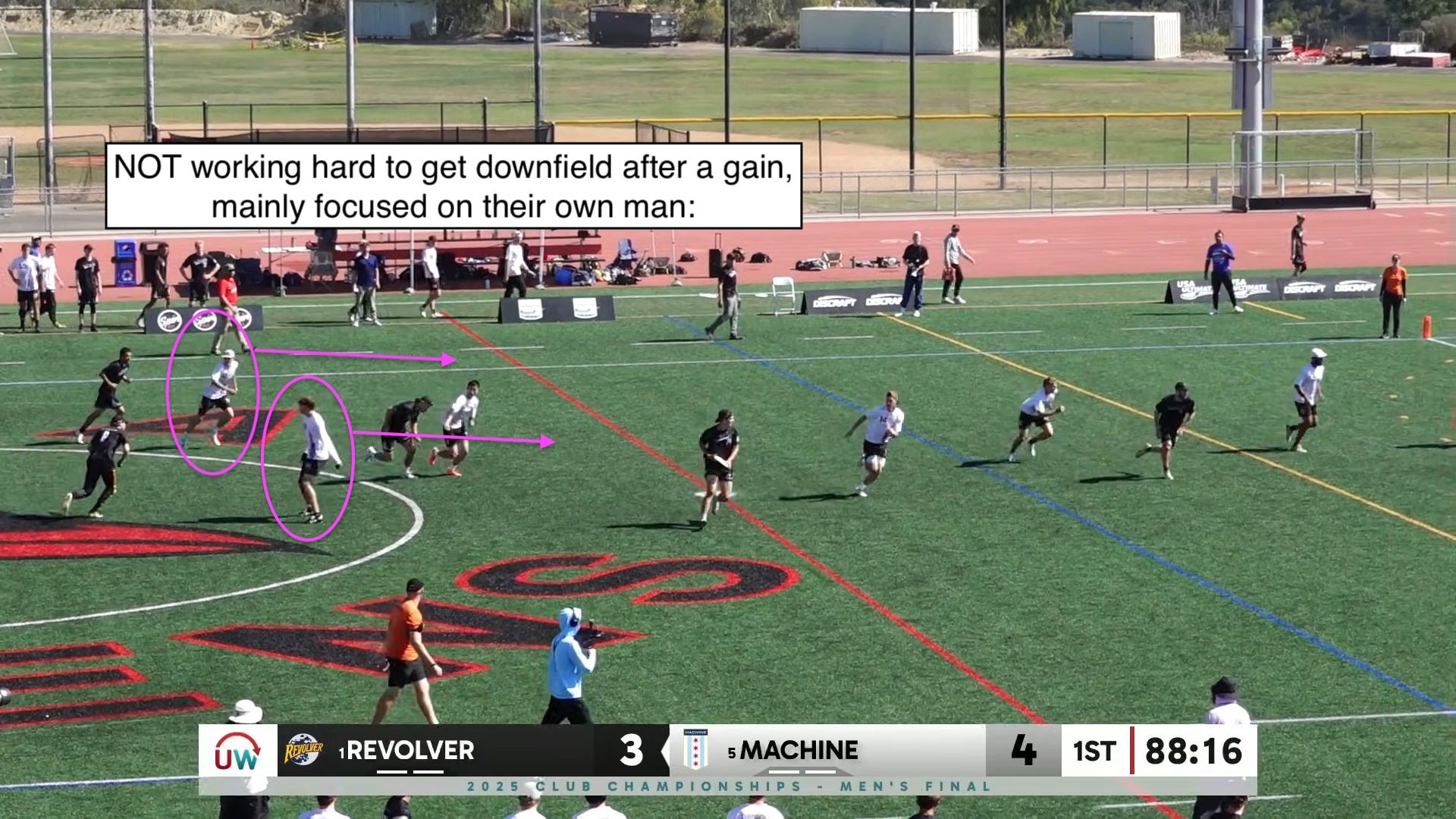
In my experience, it’s basically trivial to find examples of players not working hard to get downfield of the disc after medium-sized gains. Here’s one I called out in Revolver vs. Machine, although I don’t think it’s the most compelling example:
After the pass is completed to Mac Hecht (i.e. the pass before the score), watch how the Machine defenders who are deepest behind the disc are not really trying to separate from their man, and are instead happy to jog alongside them maintaining a constant buffer3.
Would it have affected the play in this case? Maybe not...again I could even say probably not. Hecht throws the scoring pass pretty quickly. But look at how open the downfield throwing lanes are because there are 3 Machine defenders in the backfield. But I might at least say the defender who gets scored on might not have gotten beaten to the open side so easily if he could trust there would be help sagging into the break side.
Shout out to a commenter, Sam, who pointed out on one of my older posts that Ultiworld has highlighted Revolver having players intentionally lag behind the disc as early as 2013:
Once again, the rest of the cutters stay out of the way and allow that clearing cutter to set himself up. Most of Revolver’s cutters have found themselves behind the disc, and they are in no rush to change that. Revolver currently have a 2v2 matchup downfield, and bringing three more cutters into the mix would only clog up space.
And that as early as 2018, PoNY knew the way to counter it (paywalled):
An under-appreciated key to Revolver’s successful isolation schemes over the years has been their ability to pull defenders out of the active space by having their cleared cutters and handlers lag behind the play. Teams having been playing into their hands for years by continuing to guard these players tightly....
PoNY simply refused to cooperate...every time a Revolver player...tried to lag even with or behind the disc, the New York defenders punished it by recognizing the ploy and then moving downfield to shrink the isolation space.
So, there’s nothing really new in my article today—these tactics are known and used. They just haven’t fully penetrated frisbee culture, even at the highest levels, as we’ve seen in some of these examples. I’m not claiming to be inventing a tactic no one has seen before, I’m simply raising awareness.
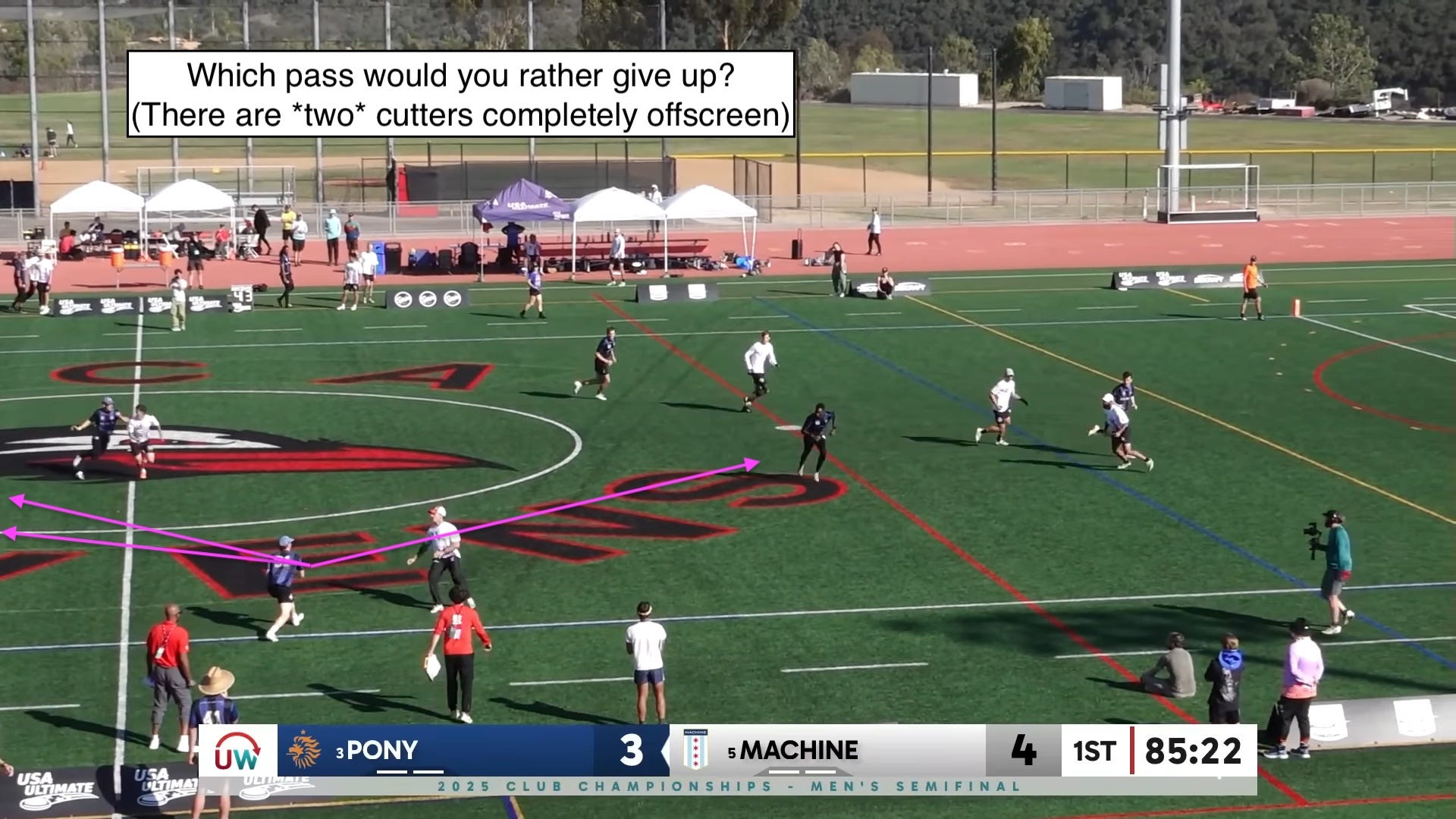
Here’s another mini-transition example I spotted skimming through PoNY vs. Machine in the 2025 semifinals:
Again we see what we saw in the previous example: as the disc moves downfield, the defenders behind the play stay with their assignments, instead of attempting to accelerate away from them. We don’t see them show up onscreen again until their assignments are also back in the play.
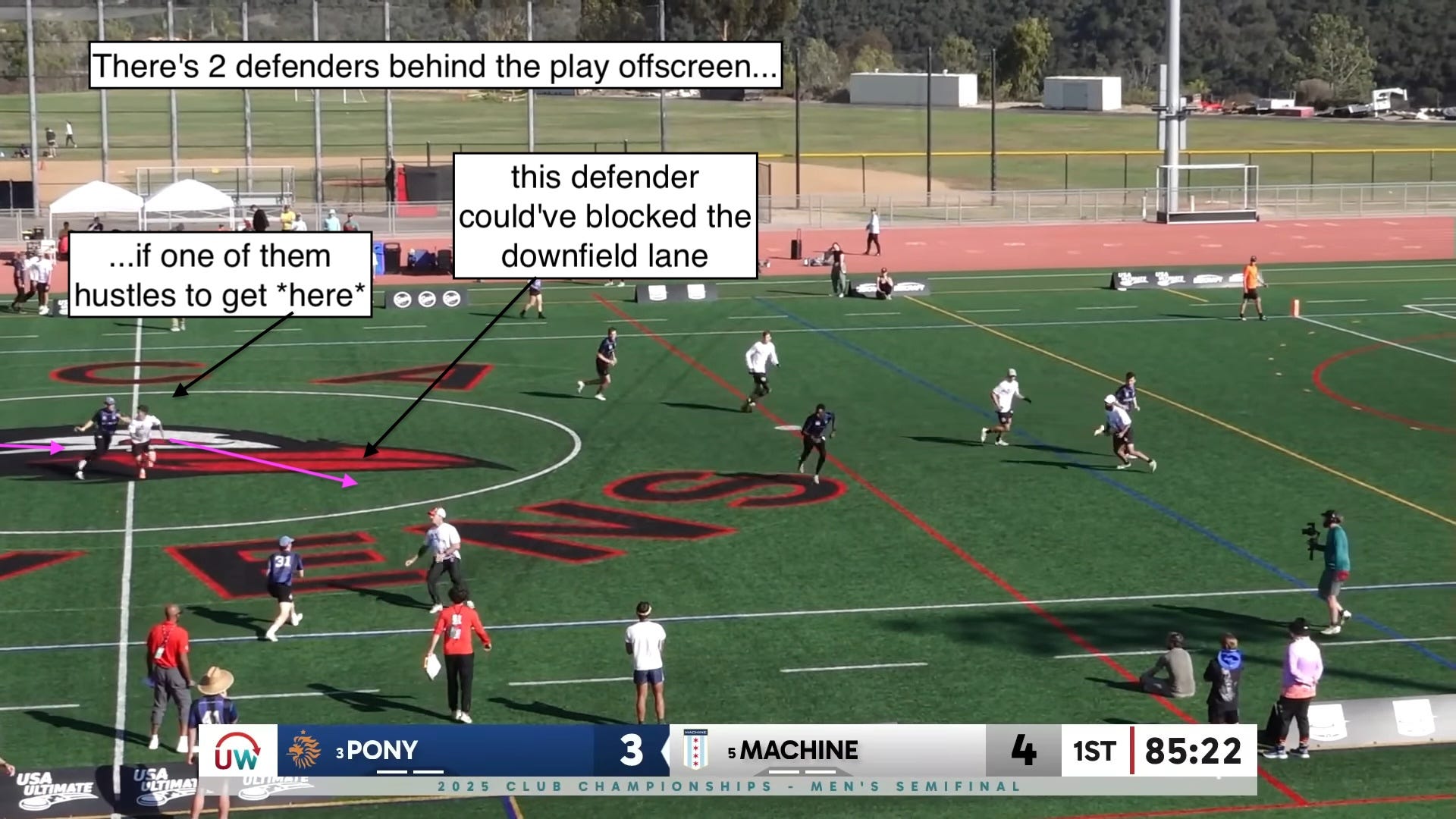
Where Team Japan or Carolyn Finney were getting in the way of the downfield passing lanes, here the passing lane is wide open for the continuation to Marques Brownlee:
Final thoughts
Care about getting downfield of the disc. It’s kind of that simple.
I’ve mixed together a couple related topics here, mainly:
The general principle of caring about getting downfield of the disc (whether in a stopped disc like the GONA clip, right after a turnover like the Molly Brown clip, a sideline trap like the Rush clip, or in mini-transitions like the other clips)
The specific situation of trying to win the “mini-transition” opportunities that come every time the offense gets a 10+ yard gain (like the Finney/Team Japan/Machine examples)
While I think the general principle is important, I actually started writing this article because of the “mini-transitions”. I’d love to see more players and teams consistently hustle downfield when the disc moves downfield. The goal is not to stay even with your assignment, the goal is to beat your assignment downfield so you can clog up the passing lanes, even if just for a second or two. Smart players and teams have been doing this for years, but it’s still nowhere near fully absorbed into our culture. It’s not sexy like a layout block, but it’s a hidden key to great team defense.
I’ve used this video in a post before. I’ll mention this post again later...
We’re all smart people here so I’ll put the hopefully-obvious caveats in a footnote instead of in the article itself: I’m not saying backwards passes are completely worthless. Offenses can use them effectively to attack new parts of the field, keep the defense a step (mentally) behind the disc, etc. But most frisbee players, most of the time, are looking to attack downfield, and I’d much rather make the offense work for a score than let them complete forward pass after forward pass.
Another caveat: given what the stats say about how hard it is to play offense trapped on the sideline, I might also prefer a 5, 10, or maybe even 15 yard gain that keeps the disc right on the sideline to a 5 yard loss that puts the disc back in the middle of the field.
or even somewhat getting beat downfield
Another great article.
I think it's worth pointing out this is important for transitions and mini-transitions, but ignoring a lagging handler is ineffective in normal flow.
At a league game this fall, I (an old slow guy with great throws) was being guarded by a player with recent national championships under his belt. Instead of shutting me down, he went downfield to poach. He didn't get any D's but I did throw a few scores and a few more hockey assists.
When you don't guard a dump the other team never has to take a risky throw. Defensive pressure becomes non-existent. Even if the handler is 10 yards back initially they can reposition to catch the disc for a minimal loss and in a power position.