95% of misreads are to the high side
Sometimes reading discs better means fighting your instincts
In my experience, as both a frisbee player and frisbee watcher, something like 95% of the misreads on long, curving, floating passes are misreads to the "high" side.
A note on the terminology: I'm thinking of the "low side" as the direction the disc is falling towards, and so the "high side" is the direction the disc is falling from. Usually these situations are happening on windy days, so the high side is almost always the upwind side, and the low side is the downwind side. (You can also think of the high side as the side of the field the disc is on when it reaches its high point, and the low side is the side of the field where the disc reaches its lowest point, i.e., where it hits the ground).
In other words, if a player misreads a disc, it's almost always because it blades over their head, and not because it lands "in front" of them. But this is a systematic error—if all your misses are to one side, you should adjust your strategy until that’s not the case.
Below is an example I noticed watching the windy 2025 Pro Champs tournament a few weeks ago. (From here, paywalled, at 1:38:20 or so)
I don't have any other examples readily available (yet), but I can tell you I eye-witnessed a player for a Regionals-bound men's team do pretty much exactly the same thing you see in this video at Sectionals a few weekends ago. I think this is pretty obviously a common mistake, but if you disagree please leave a comment!
The DC Scandal cutter (#24, white hoodie under their jersey) makes a well-timed deep cut down the center of the field. The huck is thrown, but gets slowed by the wind and starts tailing to the 'left', in other words, towards the sideline at the bottom of our screen. The receiver adjusts—but it's too little and too late. The disc slashes down over their head, heading further to the low side than they expected.
Here's my attempt at diagramming the path they took:
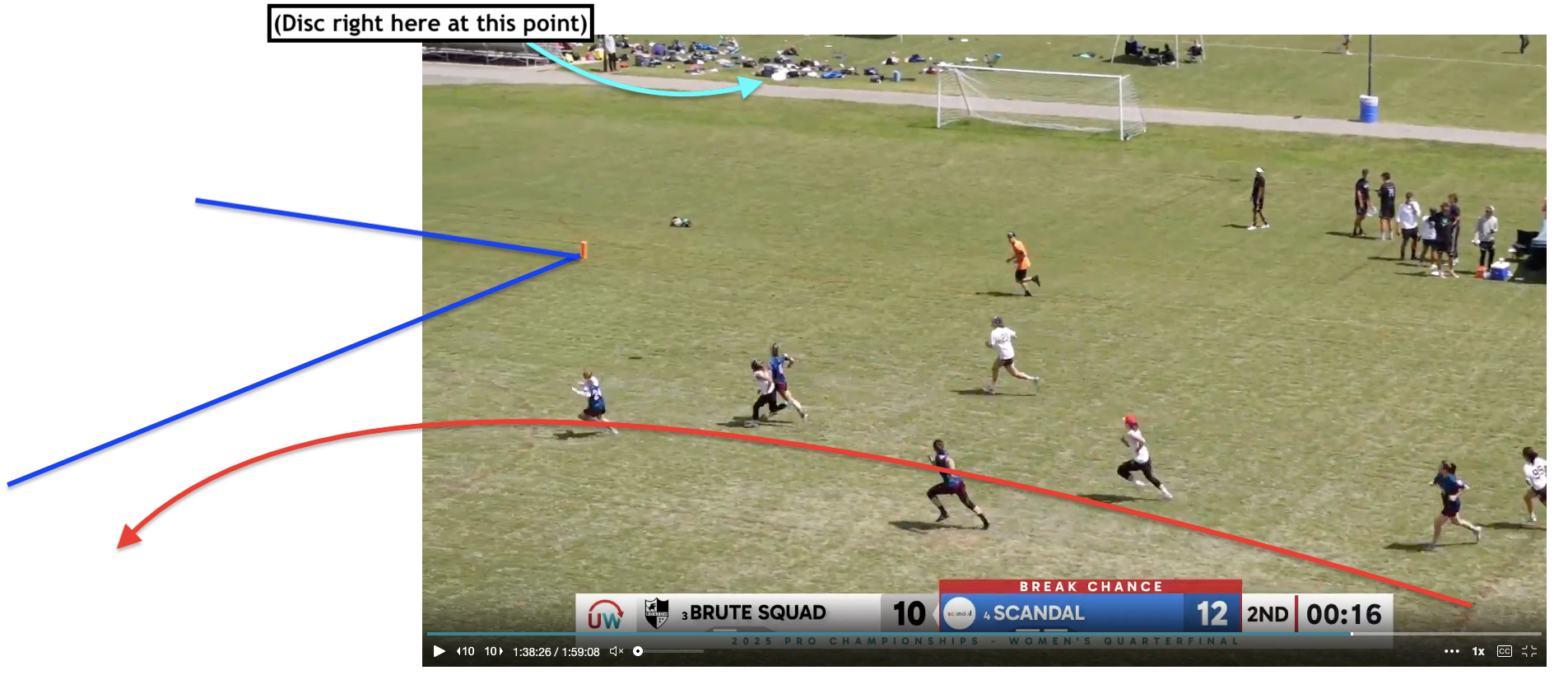
For a large part of my frisbee career, this would happen to me too. Not to mention all the times I'd be standing on the sideline, see a huck being affected by the wind, and think to myself, no way they're catching that—it's blading over their heads for sure. No one ever, in my experience, gets too far on the low side. If they misread it, it's because it's going over their head, not because it's landing in front of them.
I'm not sure why exactly this happens. Maybe people don't get enough practice reading discs in crosswinds, so they tend to go where the disc would go if there was no wind? Maybe it's just instinct to go where the disc *is* instead of going where it's *going*? (I'd guess it's mostly this one)
But once you realize this is happening all the time, you can learn to fight those instincts. After this had happened to me enough times, I eventually noticed the pattern. And with enough practice, I was able to start to fight my instincts—I'd start chasing down a huck in the wind, notice my instinct was to go [here], and then force myself to instead go much further to the low side.
I'm a big believer in "trusting your body" and not over-thinking things on the field, but I believe this is a situation where our bodies (brains) trick us into playing badly. I had to run so far to the low side that I felt like a dummy—I mean, my instinct was telling me to go somewhere else, so of course it felt silly. But then I'd go to the "silly" spot and the disc would end up hitting me right in the chest.
On a huck like our example, I'd try to take a path like this:
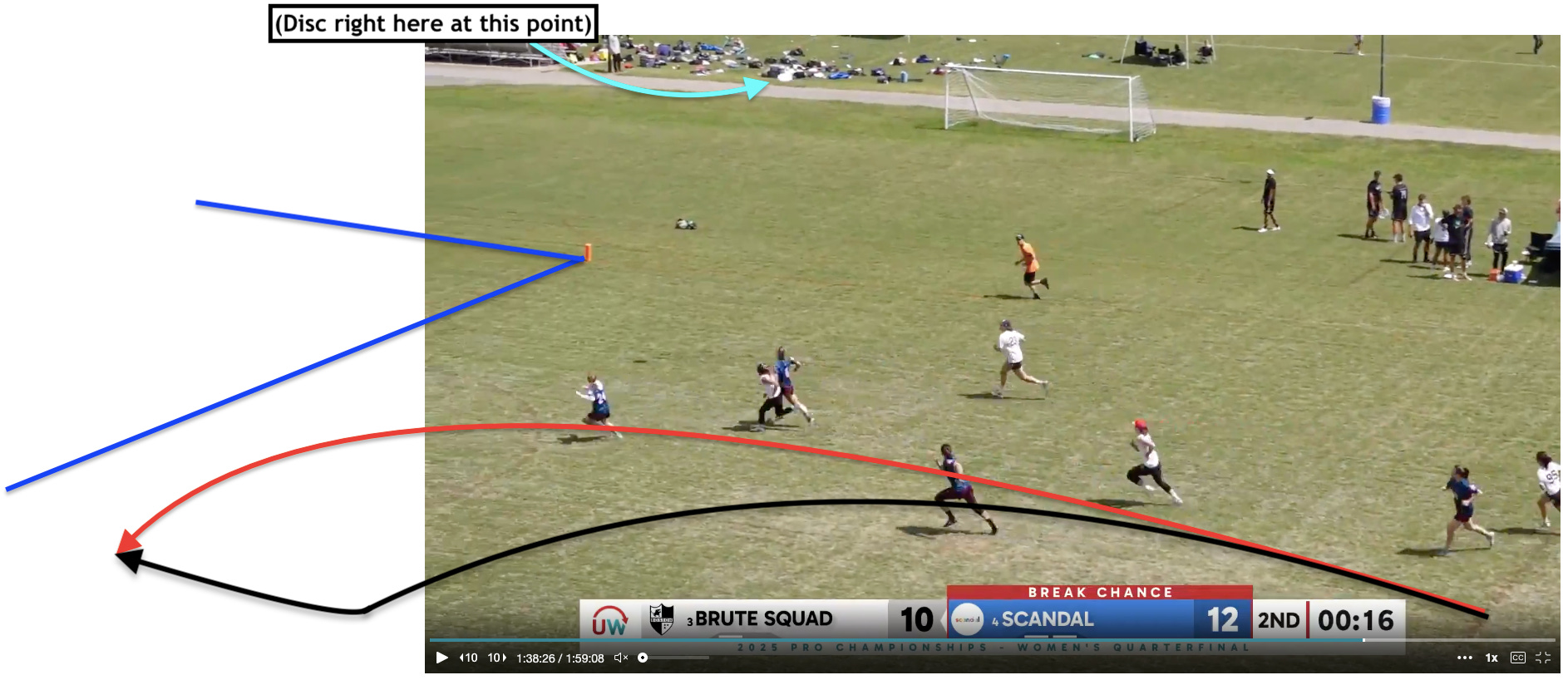
There are a couple potential benefits to doing this.
In the best case scenario, you end up making a straight line to the catch point, which saves you time because, of course,1 the shortest distance between two points is a straight line.
But even if you don't take a perfectly straight line to the disc, I find this path still works much better because you're both running forward and looking forwards. Much more comfortable—and thus much easier to accelerate hard—than running to a point over your left shoulder while looking in the opposite direction over your right shoulder.
There's also an element of simply benefiting from being proactive. I think it's pretty clear in the video that the DC cutter wasn't running at a full sprint. They had time to get to the right spot, they just didn't realize until too late that they aren’t heading towards the right spot.
So, maybe, it's as much about making that realization a second or two sooner than it is about the path you choose to take. And I do think it's possible to make that realization a beat sooner.2
I sometimes even turn away from the disc early in its flight, in order to fully commit my body to getting way to the low side as soon as possible. What I lose by not keeping a good visual on the disc early in the flight is made up for by being in better position to "attack" it when it comes down.
And maybe that’s part of the story here, too. Too many people never take their eyes off the disc when tracking down a huck. But, sometimes, looking away is the only way to chase down a huck, as having awareness of the spaces around you allows you to hit maximum acceleration towards the catch point.
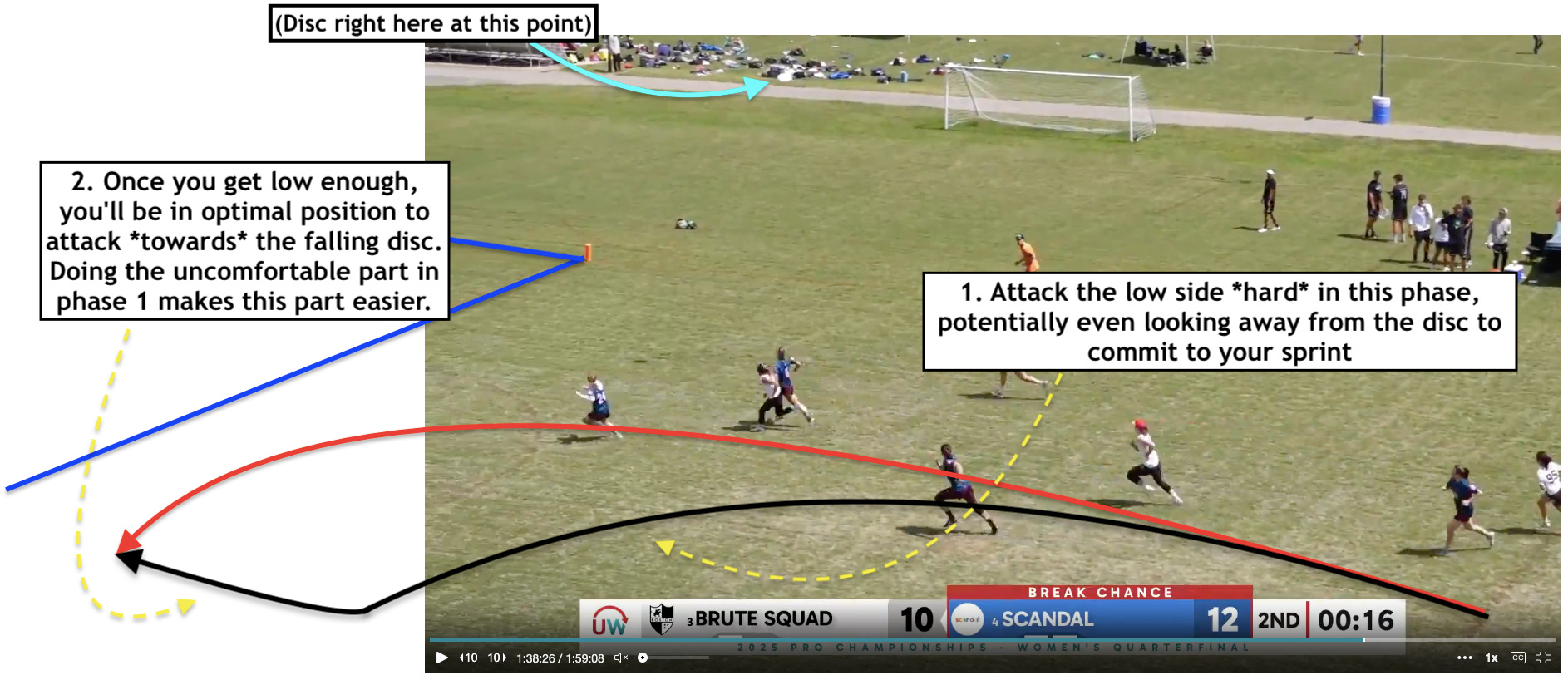
To be clear, I'm not saying this turnover was the cutter's "fault". A concept I learned from the book Extreme Ownership is to look for things that you could've done better, even in situations where you don't feel like the team's failure was your fault. The thrower could've thrown a better pass. No doubt. But that doesn't stop us from also thinking about what the cutter could've done differently.
And in fact, making these reads correctly feels like the kind of skill that no one will ever praise you for. If you do it right, it just looks like you're running to the spot where the disc is going and then catching it. What's impressive about that? And if you don't do it right, well, it's not your fault—the thrower's huck got caught by the wind.
But, yeah, overall I think this is a place where a lot of frisbee players, including those playing at higher levels, could do better. Recognize this pattern (assuming you agree with me that it is a pattern), and fight your instincts to build new, better instincts. Strive to improve your proactivity/reactivity ratio in reading wind-affected discs.
Update (2025-09-22):
Here’s another example from the same tournament, submitted by a reader. I think the receiver maybe had a little less time to react compared to the clip above, but still exhibits the same pattern of ‘the path they run follows the path of the disc’, when they had a chance to instead commit to getting to the low side earlier:
And if there's one ‘math X frisbee crossover’ comment you've heard before, it's probably this one
There's also a chance that the wind changed while the disc was in the air and the cutter was reading the disc correctly at every moment in this clip. But based on my experience I'd say that's not the most likely explanation.
That's definitely the case. I believe it's due to the way our brain processes this type of situation. Rather than solving a complicated differential equation, we just go for a simply heuristic : is the distance between myself and the object I follow is reduced by the step I took. This works great with ball (as long as the spin rate isn't crazy). With a disc the curve tends to be much more than anticipated hence the misses on the high side as our approach ultimately leads to our downfall.
This skill should be taught super early !! I also think that smaller players are less subject to it because any high disc means a lost duel. We tend to be forced to approach it more towards the low side to have a chance at it anyways.
This is definitely a thing. I've always put this down to everyone learning to read the flight of a ball in early development - the same reasoning for why new players think that to throw far you should throw at an upwards angle.
I spend a lot of my time coaching newbies using the phrase 'Remember it's not a ball' to try and trigger this thinking.
I remember in my early days laying out to grab a disc that arched like on the video example, expecting praise and instead being asked why I didn't just run to where the disc was going. While blunt this was probably the best feedback I've ever received.