The MVP Machine: How Baseball's New Nonconformists are Using Data to Build Better Players, by Ben Lindbergh & Travis Sawchik. Published in 2019.
First, there was Moneyball. But once every team know that it's good when he gets on base, players that get on base become a lot more expensive. So what comes next? What comes next is figuring out how to build players who "get on base" (or do any of a variety of other things that lead to winning):
“I don’t think people realize that if you’re a Moneyball team right now, you’re getting your ass handed to you,” says one quant for an MLB club. “When you hear the smart teams saying they use analytics now, they’re not saying they’re doing Moneyball. They’re saying they’re doing the thing that comes after.” This new phase is dedicated to making players better. It’s Betterball. And it’s taking over.
Perhaps it's not a coincidence that the Moneyball clip I linked above ends with this exchange:
> Billy, man, I think there's one thing you're forgetting here. None of those three guys knows how to play first base.
> Well, you're gonna have to teach one of them.
>... Teach?
This exchange matches well with the stories told in The MVP Machine of teams who, for the longest time, did the bare minimum to develop players. But in the past 20 years or so, that's finally starting to change, as exemplified by this story of Gerrit Cole who had his "mind blown" by simply...actually getting feedback:
When he reported to spring training, the Astros pulled him into a conference room for an hourlong, personalized pitching pitch. Seated at the head of the table, Cole listened as the brain trust told him they’d been watching and trying to trade for him for almost two years. They laid out what they liked and what they thought could be better. “You don’t scare the player by telling them there’s this massive overhaul,” Hinch says. “Certainly not Gerrit Cole.” Every recommendation was backed up by video, heat maps, and clear explanations. Houston’s presentation had the intended effect: Cole describes his reaction as “mind blown” and says, “I’d never experienced any meeting like that, at all.”
Or take this discussion of how minor league players are (were) treated:
As long as they make at least $1,160 a month, minor leaguers aren’t entitled to overtime and don’t get paid during spring training or the off-season. Consequently, many minor leaguers have to scrimp and save during the season and work second jobs over the winter, when they could be devoting their time to getting better at baseball...
In the past, one of the most obvious manifestations of minor leaguers’ lousy pay was an ascetic diet composed of items from the peak of the food pyramid. “The most difficult thing for me was making $250 every two weeks while living in one of the most expensive cities in the world,” says Brian Bannister, who started his pro career pitching for the Low-A Brooklyn Cyclones. “When my parents came to town, they took all of the guys on the team to Costco, and I bought a mountain of Gatorade, Top Ramen, and macaroni and cheese. I literally survived off of those three food groups for months.”1
If you want your minor league players to develop into major leaguers, wouldn't you...want to help them do that? At least teams have finally started to figure it out:
Belatedly, teams are filling up players with premium unleaded. With the Red Sox, Bush says, “Guys get the food they need all the way down the levels.” That’s increasingly the case across the sport.
So, how are teams and individual players winning at "betterball"? At risk of forgetting something semi-important, the main types of development discussed in The MVP Machine are:
Learning to pitch harder
Learning to pitch with more spin2
Learning new pitches
Switching to a more effective mix of pitches (e.g. throwing 40% fastballs / 40% sliders/ 20% changeups instead of 70% fastballs / 20% sliders / 10% changeups)
Building a more effective swing (which—to oversimplify—generally means swinging "up" slightly more, as balls hit in the air have a better chance of getting you on base than grounders)
Catchers learning to better "frame pitches" is mentioned a few times (e.g., "Atlanta Braves catcher Tyler Flowers studied data to make himself baseball’s best pitch-framer, capable of stealing extra strikes by receiving borderline pitches smoothly. "). However, they never go into enough detail for me to have learned how they're actually doing it.
I think it's fair to say The MVP Machine was my kind of book. Earlier this year I wrote a post summarizing my philosophy around playing offense, in which I wrote as my very first bullet point:
Good offense comes from good frisbee players. The perfect horizontal stack cutting pattern won't make up for a team's lack of individual skills. Having skilled players with the variety of throws, the release speed, the catching ability, the cutting know-how to notice and attack open spaces, etc etc is more important than the offense's shape.
In some ways, this bullet point is as important as all the others combined....
So it's probably unsurprising that I enjoyed learning how MLB teams and players are thinking about player development. And as someone who's tried to debunk the insane concepts in frisbee culture, the following quote struck a chord with me, too:
Unlike Trevor Bauer and Kyle Boddy, Bannister isn’t brash; he doesn’t take Twitter potshots or call out coaches who don’t see things the same way. “My goal was always to be the most coachable guy on the team,” he says. Yet his studies drew him to the same conclusion: baseball was beset by beliefs that didn’t stand up to scrutiny in the more illuminating light of the post-PITCHf/x era. Right-handers have to throw from the third-base side of the rubber to maximize deception; pitchers should come to a balance point during their deliveries; changeups must be at least 10 mph slower than fastballs; pitchers need to pitch on downhill planes. “I’ve pretty much debunked all of those pitching concepts that are just rehashed over and over again to every pitching prospect that comes along,” Bannister says. “And I disagree with almost all of them completely.… I think those things, as innocent as they seem, have destroyed more pitchers’ careers over the years than anything else.”
We could likewise do so much better at developing frisbee players3.
Weighted balls
If there's one thing I'm definitely not going to forget from The MVP Machine, it's that pitchers have learned that training with weighted balls is one best ways to throw harder:
They [Trevor Bauer and his dad] went to the local batting cages and found a pitching instructor named Silvio, who was from the Dominican Republic. He taught a practice that incorporated the first unconventional training implement adopted by the Bauers: throwing weighted balls. In the Dominican Republic, Silvio explained, pitchers threw weighted balls, or almost any heavy object they could turn into a projectile, to build strength. When they went home, Warren and Trevor filled a Tupperware container with water and soaked several baseballs. At eight years old, Bauer had his first experience with a tool that later became a well-known part of his training regimen.
“After three days the water would be all full of algae and moss and whatever. They’d smell terrible,” Bauer says. “We’d be throwing soaked balls, gripping wet balls, gloves would get wet, splatter us in the face.… Throwing weighted balls then wasn’t popularized. You couldn’t go online and buy them.”
While there are a lot of anecdotes in the book about players who gained velocity via weighted ball training4, the peer reviewed science discussed in the book was slightly less convincing:
The athletes Boddy was training gained velocity. In 2016 and 2017, college pitchers who completed weighted-ball programs at Driveline increased velocity by 2.7 mph and 3.3 mph, respectively, when comparing their first bullpens to their last. (Although Driveline’s first peer-reviewed velocity study of weighted-ball effects in 2018 yielded range-of-motion gains in a six-week program, it did not produce overall velocity increases. The group that did gain velocity suffered no injuries.)
However, a quick search on Google Scholar found a 2021 meta-review that says:
Caldwell et al. determined that 7 out of the 10 studies in their systematic review reported significant increases in throwing velocity following completion of weighted ball programs. The velocity increases ranged from 2 to 11 mph.
So it seems likely that the data matches up with the anecdotes—weighted ball training works.
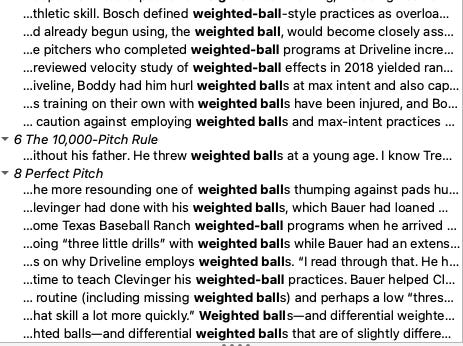
It feels so obvious in retrospect. But somehow no frisbee player has ever suggested I should try throwing weighted discs. I did throw a heavier-than-normal disc once. But the friend who brought it to play with had more of a "this could be an interesting way to switch things up" mindset than a "this is a GREAT way to build longer throws" mindset. Are disc golfers practicing with weighted discs?
There was one part of weighted ball training that surprised me, though. It turns out it's not just about throwing heavier-than-normal balls. Lighter balls have their place, too:
Throwing a heavier ball—say, seven ounces—increases total force. When the pitching arm is cocked back to begin the throwing motion, in maximum external rotation or lay back, the ball feels heavier. The body adapts to manage the greater total force. But overload training could also be paired with underload training in a complementary, two-pronged approach that could improve total force and peak force. The underload ball enables the arm to move much faster, creating a higher peak force that ultimately determines throwing velocity. Strengthening the body with heavier balls and greater total forces allows it to take on greater peak forces.
To give a bit of credit to frisbee players, another "unusual" training method the book suggests for pitchers is long toss—i.e. just throwing as far as you can (to quote: "Throwing baseballs hundreds of feet forces a pitcher to exert maximum effort, expanding his body’s capabilities"). And most frisbee players play their fair share of long toss.
Aside from weighted balls and long toss, one of the main characters profiled in The MVP Machine says it's important to learn intent—i.e. people don't spend enough time simply learning to throw hard. I couldn't help but include this quote in the review:
Boddy has a radical suggestion for how we should teach children intent. “Don’t ever play catch with a six-year-old,” he says. “I’d put my kid by a fence, and I’d throw the shit out of the ball into the fence, like as hard as possible.” That way, Boddy says, the child will learn and mimic an adult’s max-intent mechanics. Kids copy the adults they’re around, Boddy notes. Boddy’s theory on why the children of major leaguers succeed at such a high rate is not so much genetics—which doesn’t hurt—but because they’ve emulated more effective throwing and movement patterns. If you play catch, lightly, at low intent, kids learn the wrong motion, he says. “[Then] you yell at them at age twelve when they’re not athletic,” Boddy says. “But you just spent six years teaching them how to throw like an idiot, so what do you expect?”
And yes, I obviously went and bought myself some weighted frisbees. I'll let you know in a year or two how much they've helped.
10,000 hours vs one small tweak
The MVP Machine is, at times, an ode to growth mindset:
These new peaks in performance aren’t just the product of better technology. They’re a manifestation of a new philosophy of human potential. Increasingly, teams and players are adopting a growth mindset that rejects long-held beliefs about innate physical talent. One of the only innate qualities may be how hard players are willing to work. Scouts have historically graded players based on five physical tools, but in an era of optimization, a player’s approach to practice is a once-unsung sixth tool that affects the other five.
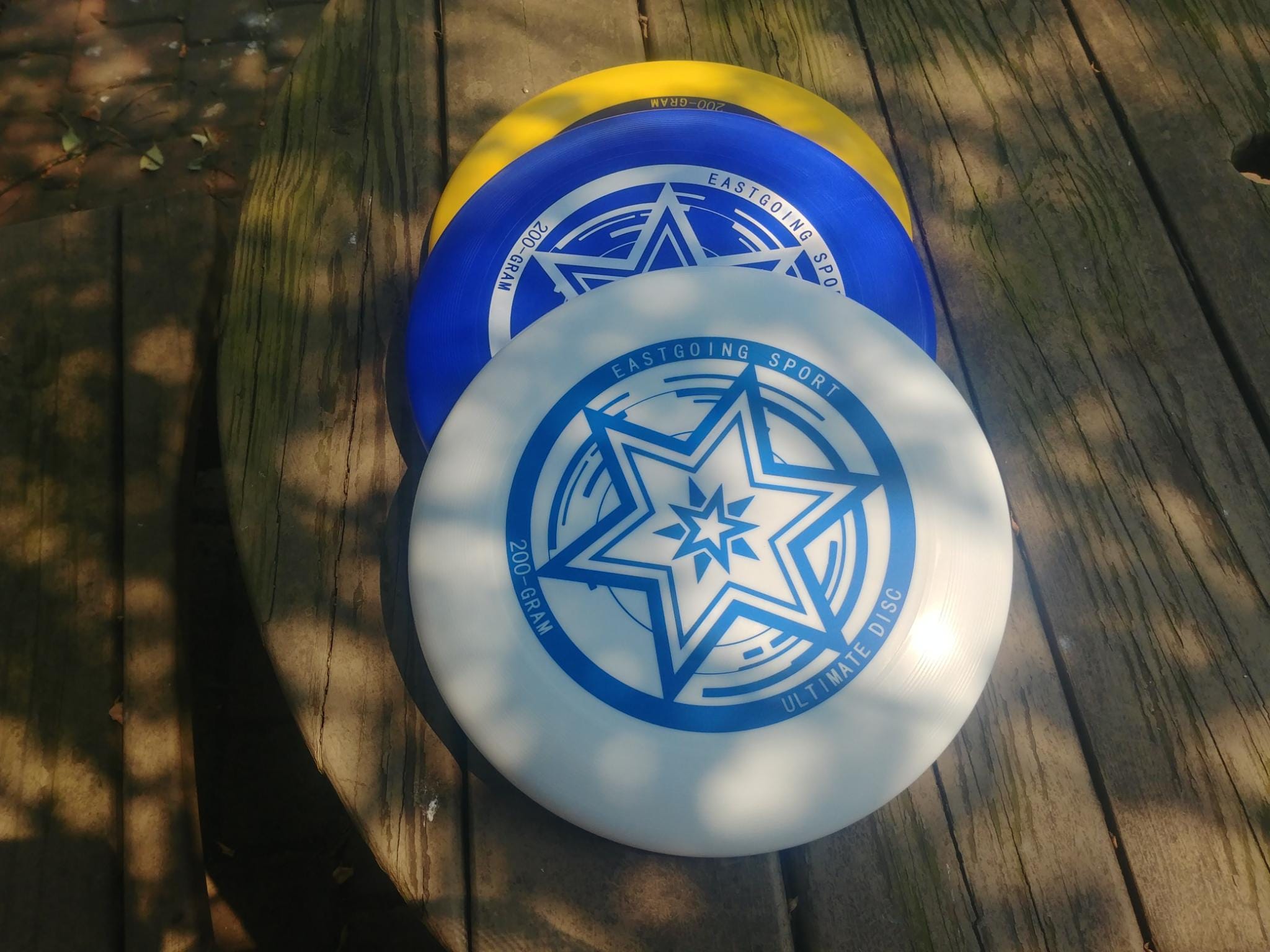
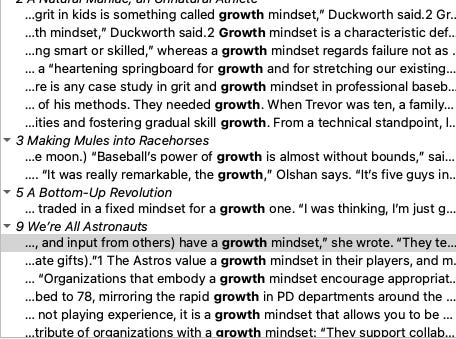
And it's not subtle, either. All the famous thinkers in the world of growth mindset/development research are mentioned by name: Anders Ericsson, Malcolm Gladwell's 10,000 hours, Angela Lee Duckworth, Carol Dweck. The words "growth" or "growth mindset" show up tens of times across multiple chapters:
It feels like there's an interesting tension here, in a way. Players work endlessly for 10+ years to get good enough to be a mediocre professional baseball player. But then one small tweak to their pitching or swinging form developed over the course of one winter can lift them from years of mediocrity to become an All-Star. It doesn't seem like you can succeed without that first step (10+ years of hard work), but, after putting in that work, sometimes "one small tweak" is all you need to make things click.
I guess it confuses me a little bit—how come these players don't need 10+ years of practice with their new form to succeed after making tweaks? On the one hand, I get it—once you've spent years learning to use your body in a certain way, incorporating slight changes is not that hard. But on the other hand, it feels weird that players could be practicing the "wrong way" for years and years, but the skill they developed still translates well enough that they can switch to doing things the right way within a couple months. If practicing the "right way" is so important, how come it isn't harder to fix your swing after years of practicing "wrong"?
The authors notice this tension too, in their own way, dedicating a chapter (titled "Just Be Better") to players who tried and failed to play "betterball" and fix their flaws. The authors don't really have any great answers to the question (and neither do I). One player didn't fix their pitching flaws but got a job in a front office after learning so much about pitching mechanics in their attempt to become better. Some players are possibly coming up against the innate limits of their skill, which could happen when you're going up against the best players in the world. Maybe it's partly survivorship bias—we remember the players who succeeded in getting better and forget the ones who failed.
Ultimate frisbee is very obviously different in that hardly anyone is working hard enough to actually maximize their skills. Pretty much anyone who wants to become a better thrower could do so, simply by putting in the hours in an intelligent way. There are still so many players, even top players, who aren't throwing hammers or even don't throw with a loose elbow. I think players who are working hard should be encouraged too—sometimes all it takes is that one last tweak for everything to come together. You have to be willing to continue experimenting to find that tweak, but it's out there (probably).
Though, perhaps hard work pays off even in the more cutthroat environment of Major League Baseball—it still comes down to deliberate practice and growth mindset:
[Bauer worried that other players would adopt his training regimen & innovations, leaving him scrambling because his innate athleticism isn't that impressive—] Other pitchers’ ceilings will be higher than Bauer’s.
“His fears are not stupid,” Boddy says. But Boddy comforts him with this: few, if any, pitchers are willing to work as hard, to put in the necessary deliberate practice. “I was like, ‘Can you name a single major or minor leaguer that works as many hours as you in the off-season?’” Boddy says.
Bauer couldn’t.
“Well, it doesn’t matter then, does it?” Boddy told him. “You haven’t fixed the problem that us humans have, which is that we don’t like to work very hard. If you fix that problem, you’re in line to make billions of dollars doing something else.”
Final thoughts
The MVP Machine was a good book for me because it discussed a number of subjects I'm already interested in—growth mindset, player development in sports, throwing science. To be honest, the book was longer than it needed to be; I thought a couple of the later chapters could've been cut out or cut down significantly. But anyone who's interested in learning to throw frisbees better should be trying to learn how baseball players become better throwers—those guys are obsessed with understanding throwing.
numbers might be out of date, The MVP Machine is six years old at this point and I remember seeing some news about a narrowly avoided minor league strike a few years back.
More spin makes the ball ‘break’ more, which is good for confusing hitters
An idea that's also discussed on a recent Pod Practice episode, sorry for not having an exact timestamp. I certainly don’t claim to be the only one who thinks this.
"Left-handed pitcher Brandon Mann made his MLB debut for the Rangers in July 2018, a few days before his thirty-fourth birthday, making him the oldest American-born player to break into the bigs since 2002. Texas had signed him in January after watching him throw at Driveline, whose weighted-ball program he credits for propelling his fastball from the mid-to-high 80s to the low-to-mid 90s."
or
"Ramírez was perhaps more open-minded compared to other pitchers, as he was desperate to remain in the majors and had added 2 mph to his fastball (93.1 mph in 2017 to 95.3 mph in 2018) the previous winter through a weighted-ball program"
I found this interesting reddit discussion about whether throwing heavier discs will help you with disc golf distance: https://www.reddit.com/r/discgolf/comments/lilv3e/could_throwing_a_weighted_disc_develop_distance/