[I know most readers won’t care about this; if that’s you, feel free to skip it! (OTOH it’s super short). But multiple real-life friends asked when the summer league predictions are coming out, so I decided to post them again. More of my usual stuff coming out later this week!]
Last year my predictions were barely better than chance, and lost (as they had previously) to Oliver’s data-driven method. I said last year (2025) that I was less confident in my predictions than in 2024. This year my meta-prediction is that I feel more confident than I did in 2025.
A couple new things to note this year:
I recruited Sammy and Sam to also provide predictions. (If you want me to post your predictions next year too, get in touch)
Oliver had two AIs (Claude and Gemini) also generate predictions. They both roughly do what he was already doing with his own spreadsheet-based methods, so I don’t think it’s surprising that those three methods came up with generally similar ideas.
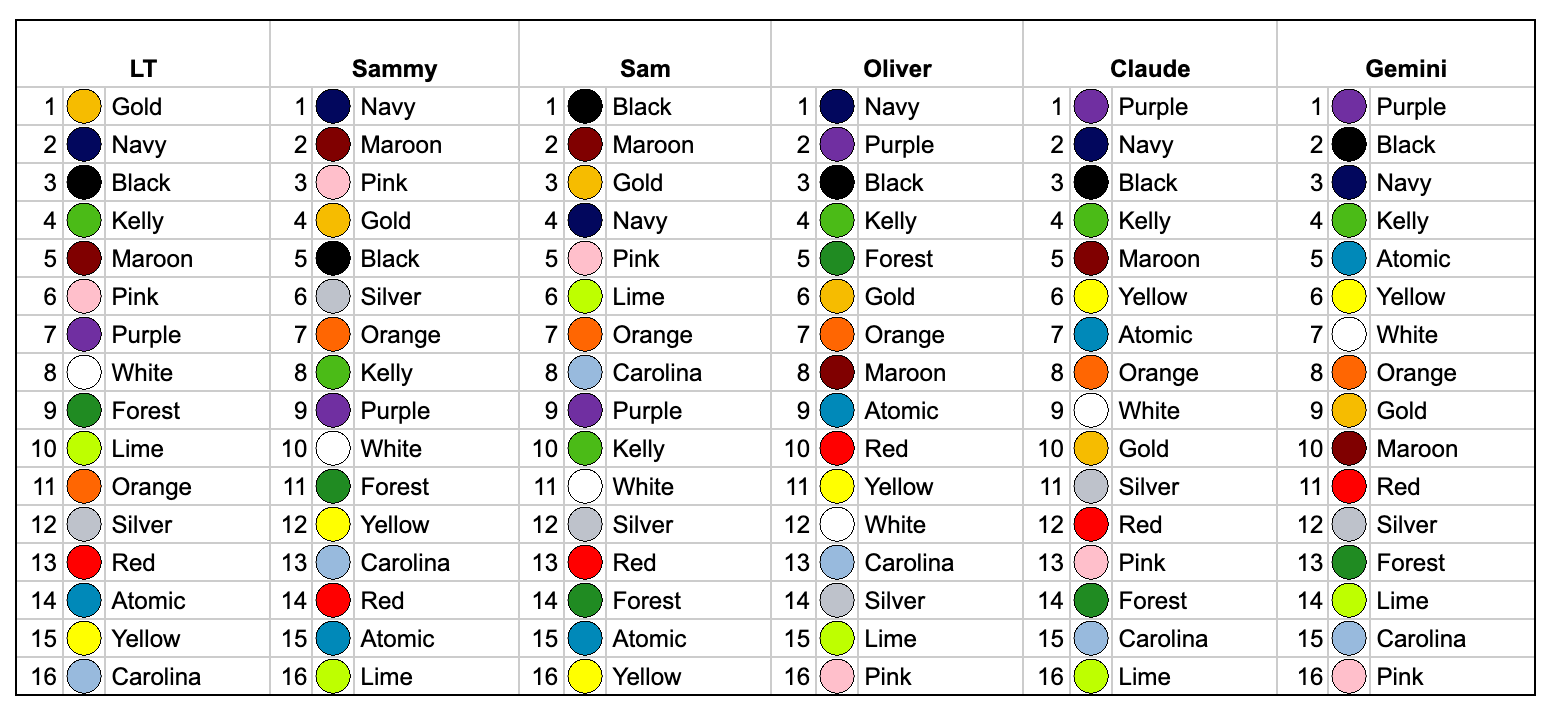
Here are the predictions:
Here’s the average of all six rankings:
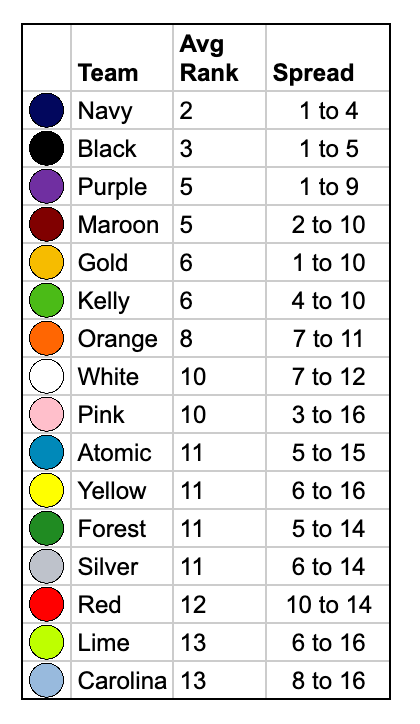
Lime and especially Pink win the award for being ranked all over the place. Navy has the steadiest ranking, with none of the six predictions putting them below 4th.
The other obvious point of comparison is to look at the average for the three humans compared to the average for the three numbers-only methods (Counting Oliver as “the numbers” since his ranking is purely numbers driven). Those rankings are below:
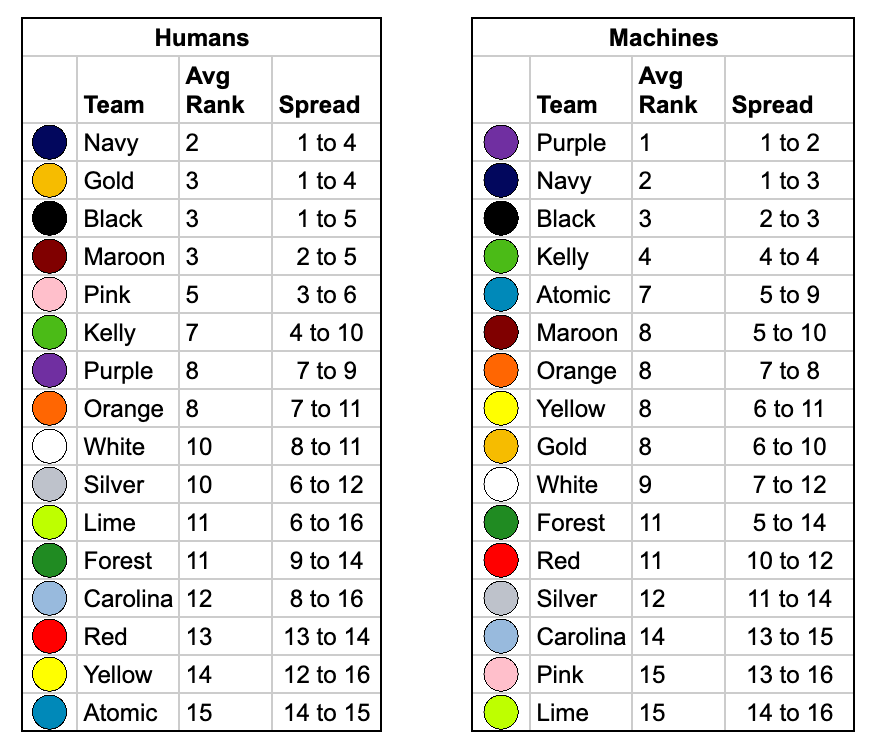
The humans like Gold and Pink more than the machines do. The machines rank Atomic and Purple higher than the humans do.
For the most part, the machines have very similar predictions to each other—very small spreads. Eight teams have a difference of 0,1, or 2 between their best and worst machine rating. Forest wins the “The Machines Can’t Decide What To Think of You” award, with a 9-spot spread between their worst and best ratings, while no other team has a machine spread of more than 5.
There’s a good chance the full average outperforms any of us. The humans and machines each have legitimate, independent insights1 and averaging them together probably helps combine that knowledge while canceling out each party’s biases.
Most importantly, all teams are predicted to have lots of fun!
Machines have more complete knowledge of which players have been successful in the past. Humans have better knowledge about new-to-the-league players and about how skilled/healthy/available players are currently.